Special hoses in technology and science
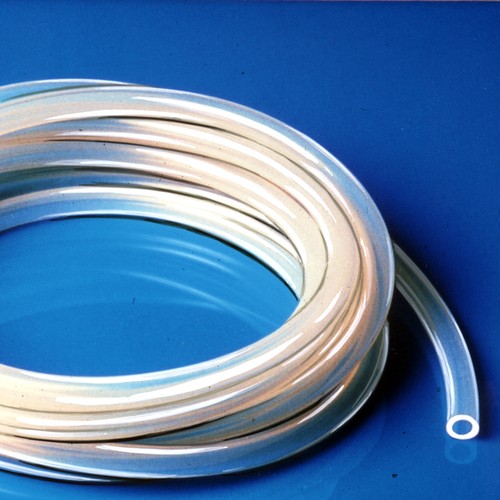
Whether in science or technology – whenever liquids or gases need to be transported from point A to point B, hoses of all kinds are used. When operating temperature, pressure, or mechanical stress deviate from standard conditions, special hoses are required. Often, liquids or gases must be conveyed at elevated temperatures, for example because further processing is not possible at room temperature or because heat itself is needed and the transported medium merely serves as a carrier, as in heat exchanger applications.
Tightness, inertness, and durability are key characteristics required of steam, water, and chemical hoses. Since all solid materials tend to soften and lose their shape as temperature increases, dimensional stability is an important criterion for high-temperature products. To meet these requirements, modern high-temperature variants – as well as the corresponding connectors, cocks, and valves – are manufactured from a wide variety of materials.
Applications for high-temperature hoses
Typical applications for these flexible components include:
- Transport of fuel and liquefied gases
- Exhaust gas removal
- Conveying of liquid foods
- Provision of process steam and process heat
- Mobilisation of organic solvents and fuels
- Use in medical and sterile environments
Materials for hose products
High-temperature variants are produced from a wide range of materials, depending on the specific application. Common technical materials include:
- Silicone (silicone rubber)
- FPM/FKM (Viton®, fluoro rubber)
- IIR (isobutyl rubber)
- EPDM (ethylene-propylene-diene rubber)
- EPDM/PP (ethylene-propylene-diene/polypropylene)
- ETFE (ethylene tetrafluoroethylene)
- MFA (modified fluorinated alkoxy)
- FEP (fluorinated ethylene propylene)
- PEEK (polyether ether ketone)
- PFA (perfluoroalkoxy)
- PI (polyimide)
- PTFE (polytetrafluoroethylene)
- Stainless steel
High-temperature hoses made of silicone: the flexible all-rounder
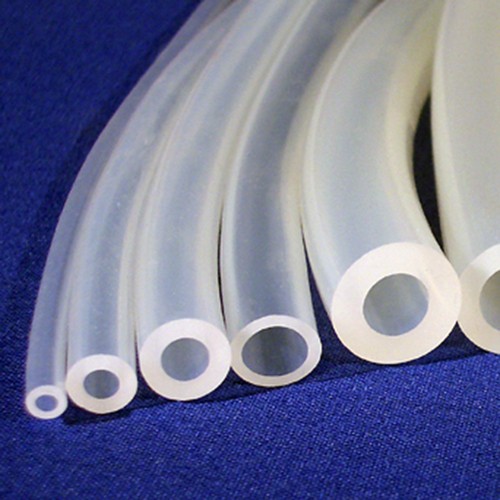
Silicone is a siloxane-based, transparent, and flexible polymer of synthetic origin. Through modifications in the manufacturing process, silicones can be produced with a wide range of properties, including coloured and high-temperature-resistant variants. Thermal resistance is achieved in individual models across a broad temperature range from -60 °C to +300 °C. Many THOMASIL silicone tubing can be used continuously at up to +250 °C and even briefly up to +350 °C. This makes silicone an excellent material for high-temperature applications.
THOMASIL silicone tubing complies with FDA and BfR regulations and is therefore suitable for use in medical applications. Reuse in this field requires sterilisation, for example by hot air or steam sterilisation. Typical temperatures are around +180 °C for hot air and +130 °C for steam sterilisation.
Another key aspect in medical technology is biocompatibility. Silicone materials meet the requirements for low cytotoxicity, pyrogen-free properties, and implantation compatibility. The high-performance types from Reichelt Chemietechnik meet the specifications of USP Class VI according to the United States Pharmacopeia. Transparency – and thus the ability to observe transported fluids – is another advantage of silicone as a material.
For applications involving both elevated temperatures and high pressures, silicone tubing also offers an excellent solution. Depending on the specific dimension, it can withstand operating pressures of 12 to 14 bar.
Silicone rubbers are generally soft and flexible but can be produced in a wide range of Shore hardness levels. Common hardness grades are between A 50° and A 70° according to DIN 53505. Due to their high elasticity and tear resistance, these products are particularly durable and can also be used as pump tubing for peristaltic pumps and pinch valves.
Their relatively low price makes silicone one of the most widely used materials for special tubing. However, due to their high gas permeability, silicone variants are less suitable for gas transport – unless gas permeation is desired, such as in aeration applications.
Viton hoses: heat resistant and chemically stable
The fluoroelastomer FPM (also known as FKM or Viton®) is a widely used technical material. Thanks to its chemical and thermal stability, it is ideal wherever contact with aggressive chemicals combined with mechanical and thermal stress excludes other materials.
Because of its abrasion resistance and elasticity, Viton tubing is particularly suitable as feed lines for peristaltic pumps. Temperatures from -20 °C to +200 °C are no problem, and they can tolerate short-term peaks up to +250 °C, qualifying them as high-temperature components.
For demanding conditions, fluoroelastomer variants with Shore hardness between A 55° and A 75° (DIN 53505) are available. Their mechanical strength and flexibility make them ideal for harsh environments, where Viton materials outperform silicone alternatives. Compared to other materials used in high-performance hose production, Viton® has a relatively high density, resulting in excellent gas tightness. Unlike silicone, Viton is well suited for low-loss gas transport.
For high-temperature applications, compliance with fire safety standards may be required. Viton products from Reichelt Chemietechnik are partially classified according to UL 94 V0 and are therefore particularly suitable for such applications.
Butyl rubber – not just for inner tubes
Although isobutylene-isoprene rubber (IIR, also known as butyl rubber) is best known from tire production, chewing gum, or laboratory gloves, it is also an excellent material for high-temperature tubing. The material withstands continuous exposure between -30 °C and +100 °C, and briefly up to +140 °C. Due to its high density and strong resistance to acids and alkalis, Butyl-IIR Tubing is well suited as hot water hoses and steam lines. However, they are not recommended for the transport of organic solvents, fuels, or mineral oils, as butyl rubber is not resistant to these substances. The major advantages of IIR are its elasticity and very low gas permeability.
EPDM hoses: full potential through combinations
Ethylene-propylene-diene rubber (EPDM) is a high-quality polymer known for its durability and UV stability. It is often used as weldable film in landscaping and flat-roof sealing. As flexible tubing, EPDM is frequently combined with other materials such as metal braids, glass fibre fabrics, or elastomers in double-jacket configurations. EPDM tubes can withstand continuous exposure from -35 °C to +120 °C, depending on the specific design.
A proven combination is the elastomer-thermoplastic blend of EPDM and polypropylene (PP). EPDM/PP tubes are used as pump tubing with a Shore hardness of approximately A 60°.
These materials exhibit good resistance to most organic and inorganic media. Their service life can exceed that of silicone tubing by up to 30 times. Special pharmaceutical versions are available for medical use; they are autoclavable and certified according to FDA 21 CFR §177.2600, USP Class VI, ISO 10993, and EU 2003/11/EC.
PTFE and ETFE hoses as high-temperature types
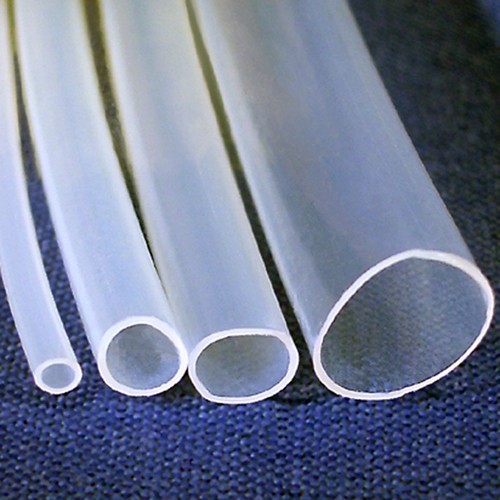
Polytetrafluoroethylene (PTFE) is known worldwide under its trade name and familiar as a non-stick coating for frying pans. Its positive properties – temperature resistance (-200 °C to +260 °C), almost universal chemical inertness, and hydrophobicity – make it an ideal material for high-temperature tubing.
PTFE tubes are resistant to nearly all inorganic and organic substances and are therefore suitable for conveying acids, alkalis, and solvents of almost any kind. They feature a very low coefficient of friction and ensure excellent gas tightness (low permeability). Typical applications include microelectronics, analytical technology, process engineering, biotechnology, and medical technology.
Ethylene tetrafluoroethylene (ETFE) was developed from PTFE. Like its well-known relative, ETFE is non-stick and chemically inert. It can be used continuously between -200 °C and +150 °C. ETFE tubing is often used in HPLC analysis, where its chemical inertness and high pressure resistance are decisive advantages.
PEEK hoses: the high-tech polymer
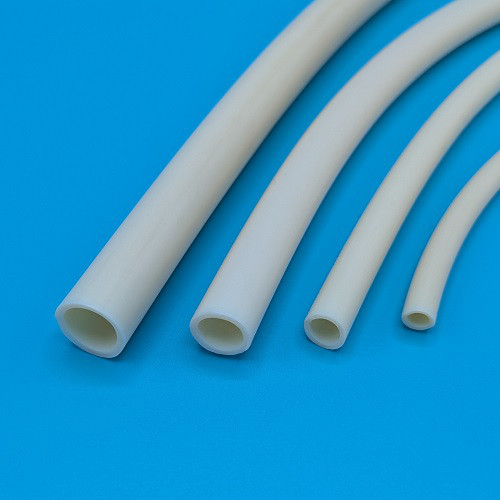
Polyether ether ketone (PEEK) is a biologically inert, odourless, and physiologically safe beige-brown polymer. It is characterised by excellent chemical stability as well as outstanding physical and mechanical properties, making it a nearly universal engineering material.
In many areas, PEEK can even replace ceramic and metallic materials, which is why it is regarded as a high-tech polymer. With a temperature range from -40 °C to +300 °C, it performs reliably even where other plastics fail. Components and flexible tubes made from PEEK are increasingly used in the food and pharmaceutical industries, particularly for high-temperature and high-pressure applications. Depending on geometry, operating pressures between 52 and 420 bar are achievable. The only drawback of this relatively new material is its comparatively high cost.
Metal hoses – when things get really hot
Alongside numerous plastics, metals also play an important role in high-temperature hose construction, with stainless steel leading the way. Unmatched in temperature stability, stainless steel products can be used from -10 °C to +550 °C. They also offer excellent pressure resistance. However, their use is limited by reduced flexibility. Stainless steel types are therefore mainly found in instrumental analysis (e.g. HPLC) or, in larger diameters, as corrugated lines in process and plant engineering.
High-temperature hoses for oil
For transporting hot oil, FPM/Viton hoses are particularly suitable due to their excellent chemical resistance and temperature stability from -20 °C to +200 °C (short-term up to +250 °C). In contrast, butyl rubber hoses (IIR) are not suitable for mineral oils or petroleum products. PTFE variants, with their universal chemical resistance and a temperature range from -200 °C to +260 °C, also represent an excellent option for oil applications.
High-temperature hoses for water
Several materials are suitable for hot water applications: butyl rubber (IIR) is particularly resistant to hot water and steam up to +140 °C. Silicone tubing, with its temperature resistance up to +300 °C and pressure resistance of 12–14 bar, is another excellent choice. EPDM hoses – especially those reinforced with metal braiding or in double-jacket design – also perform well in hot water service up to +120 °C.
Buy high-temperature hoses from rct-online
Reichelt Chemietechnik offers not only a comprehensive range of high-temperature hoses but also suitable accessories such as temperature-resistant valves, cocks, and hose connectors.
High-temperature products and other heat-resistant items can be ordered easily from our online shop – with no minimum order quantity. Benefit from high-quality, readily available products at fair prices. If you are unsure about your selection or have further questions, please feel free to contact us by phone or e-mail. Additional chemical and technical information about the materials offered can be found in our glossary. Using our resistance list, you can easily determine the ideal material for your specific application. We look forward to your order!
Close window
Special hoses in technology and science
Whether in science or technology – whenever liquids or gases need to be transported from point A to point B, hoses of all kinds are used. When operating temperature, pressure, or mechanical stress deviate from standard conditions, special hoses are required. Often, liquids or gases must be conveyed at elevated temperatures, for example because further processing is not possible at room temperature or because heat itself is needed and the transported medium merely serves as a carrier, as in heat exchanger applications.
Tightness, inertness, and durability are key characteristics required of steam, water, and chemical hoses. Since all solid materials tend to soften and lose their shape as temperature increases, dimensional stability is an important criterion for high-temperature products. To meet these requirements, modern high-temperature variants – as well as the corresponding connectors, cocks, and valves – are manufactured from a wide variety of materials.
Applications for high-temperature hoses
Typical applications for these flexible components include:
- Transport of fuel and liquefied gases
- Exhaust gas removal
- Conveying of liquid foods
- Provision of process steam and process heat
- Mobilisation of organic solvents and fuels
- Use in medical and sterile environments
Materials for hose products
High-temperature variants are produced from a wide range of materials, depending on the specific application. Common technical materials include:
- Silicone (silicone rubber)
- FPM/FKM (Viton®, fluoro rubber)
- IIR (isobutyl rubber)
- EPDM (ethylene-propylene-diene rubber)
- EPDM/PP (ethylene-propylene-diene/polypropylene)
- ETFE (ethylene tetrafluoroethylene)
- MFA (modified fluorinated alkoxy)
- FEP (fluorinated ethylene propylene)
- PEEK (polyether ether ketone)
- PFA (perfluoroalkoxy)
- PI (polyimide)
- PTFE (polytetrafluoroethylene)
- Stainless steel
High-temperature hoses made of silicone: the flexible all-rounder
Silicone is a siloxane-based, transparent, and flexible polymer of synthetic origin. Through modifications in the manufacturing process, silicones can be produced with a wide range of properties, including coloured and high-temperature-resistant variants. Thermal resistance is achieved in individual models across a broad temperature range from -60 °C to +300 °C. Many THOMASIL silicone tubing can be used continuously at up to +250 °C and even briefly up to +350 °C. This makes silicone an excellent material for high-temperature applications.
THOMASIL silicone tubing complies with FDA and BfR regulations and is therefore suitable for use in medical applications. Reuse in this field requires sterilisation, for example by hot air or steam sterilisation. Typical temperatures are around +180 °C for hot air and +130 °C for steam sterilisation.
Another key aspect in medical technology is biocompatibility. Silicone materials meet the requirements for low cytotoxicity, pyrogen-free properties, and implantation compatibility. The high-performance types from Reichelt Chemietechnik meet the specifications of USP Class VI according to the United States Pharmacopeia. Transparency – and thus the ability to observe transported fluids – is another advantage of silicone as a material.
For applications involving both elevated temperatures and high pressures, silicone tubing also offers an excellent solution. Depending on the specific dimension, it can withstand operating pressures of 12 to 14 bar.
Silicone rubbers are generally soft and flexible but can be produced in a wide range of Shore hardness levels. Common hardness grades are between A 50° and A 70° according to DIN 53505. Due to their high elasticity and tear resistance, these products are particularly durable and can also be used as pump tubing for peristaltic pumps and pinch valves.
Their relatively low price makes silicone one of the most widely used materials for special tubing. However, due to their high gas permeability, silicone variants are less suitable for gas transport – unless gas permeation is desired, such as in aeration applications.
Viton hoses: heat resistant and chemically stable
The fluoroelastomer FPM (also known as FKM or Viton®) is a widely used technical material. Thanks to its chemical and thermal stability, it is ideal wherever contact with aggressive chemicals combined with mechanical and thermal stress excludes other materials.
Because of its abrasion resistance and elasticity, Viton tubing is particularly suitable as feed lines for peristaltic pumps. Temperatures from -20 °C to +200 °C are no problem, and they can tolerate short-term peaks up to +250 °C, qualifying them as high-temperature components.
For demanding conditions, fluoroelastomer variants with Shore hardness between A 55° and A 75° (DIN 53505) are available. Their mechanical strength and flexibility make them ideal for harsh environments, where Viton materials outperform silicone alternatives. Compared to other materials used in high-performance hose production, Viton® has a relatively high density, resulting in excellent gas tightness. Unlike silicone, Viton is well suited for low-loss gas transport.
For high-temperature applications, compliance with fire safety standards may be required. Viton products from Reichelt Chemietechnik are partially classified according to UL 94 V0 and are therefore particularly suitable for such applications.
Butyl rubber – not just for inner tubes
Although isobutylene-isoprene rubber (IIR, also known as butyl rubber) is best known from tire production, chewing gum, or laboratory gloves, it is also an excellent material for high-temperature tubing. The material withstands continuous exposure between -30 °C and +100 °C, and briefly up to +140 °C. Due to its high density and strong resistance to acids and alkalis, Butyl-IIR Tubing is well suited as hot water hoses and steam lines. However, they are not recommended for the transport of organic solvents, fuels, or mineral oils, as butyl rubber is not resistant to these substances. The major advantages of IIR are its elasticity and very low gas permeability.
EPDM hoses: full potential through combinations
Ethylene-propylene-diene rubber (EPDM) is a high-quality polymer known for its durability and UV stability. It is often used as weldable film in landscaping and flat-roof sealing. As flexible tubing, EPDM is frequently combined with other materials such as metal braids, glass fibre fabrics, or elastomers in double-jacket configurations. EPDM tubes can withstand continuous exposure from -35 °C to +120 °C, depending on the specific design.
A proven combination is the elastomer-thermoplastic blend of EPDM and polypropylene (PP). EPDM/PP tubes are used as pump tubing with a Shore hardness of approximately A 60°.
These materials exhibit good resistance to most organic and inorganic media. Their service life can exceed that of silicone tubing by up to 30 times. Special pharmaceutical versions are available for medical use; they are autoclavable and certified according to FDA 21 CFR §177.2600, USP Class VI, ISO 10993, and EU 2003/11/EC.
PTFE and ETFE hoses as high-temperature types
Polytetrafluoroethylene (PTFE) is known worldwide under its trade name and familiar as a non-stick coating for frying pans. Its positive properties – temperature resistance (-200 °C to +260 °C), almost universal chemical inertness, and hydrophobicity – make it an ideal material for high-temperature tubing.
PTFE tubes are resistant to nearly all inorganic and organic substances and are therefore suitable for conveying acids, alkalis, and solvents of almost any kind. They feature a very low coefficient of friction and ensure excellent gas tightness (low permeability). Typical applications include microelectronics, analytical technology, process engineering, biotechnology, and medical technology.
Ethylene tetrafluoroethylene (ETFE) was developed from PTFE. Like its well-known relative, ETFE is non-stick and chemically inert. It can be used continuously between -200 °C and +150 °C. ETFE tubing is often used in HPLC analysis, where its chemical inertness and high pressure resistance are decisive advantages.
PEEK hoses: the high-tech polymer
Polyether ether ketone (PEEK) is a biologically inert, odourless, and physiologically safe beige-brown polymer. It is characterised by excellent chemical stability as well as outstanding physical and mechanical properties, making it a nearly universal engineering material.
In many areas, PEEK can even replace ceramic and metallic materials, which is why it is regarded as a high-tech polymer. With a temperature range from -40 °C to +300 °C, it performs reliably even where other plastics fail. Components and flexible tubes made from PEEK are increasingly used in the food and pharmaceutical industries, particularly for high-temperature and high-pressure applications. Depending on geometry, operating pressures between 52 and 420 bar are achievable. The only drawback of this relatively new material is its comparatively high cost.
Metal hoses – when things get really hot
Alongside numerous plastics, metals also play an important role in high-temperature hose construction, with stainless steel leading the way. Unmatched in temperature stability, stainless steel products can be used from -10 °C to +550 °C. They also offer excellent pressure resistance. However, their use is limited by reduced flexibility. Stainless steel types are therefore mainly found in instrumental analysis (e.g. HPLC) or, in larger diameters, as corrugated lines in process and plant engineering.
High-temperature hoses for oil
For transporting hot oil, FPM/Viton hoses are particularly suitable due to their excellent chemical resistance and temperature stability from -20 °C to +200 °C (short-term up to +250 °C). In contrast, butyl rubber hoses (IIR) are not suitable for mineral oils or petroleum products. PTFE variants, with their universal chemical resistance and a temperature range from -200 °C to +260 °C, also represent an excellent option for oil applications.
High-temperature hoses for water
Several materials are suitable for hot water applications: butyl rubber (IIR) is particularly resistant to hot water and steam up to +140 °C. Silicone tubing, with its temperature resistance up to +300 °C and pressure resistance of 12–14 bar, is another excellent choice. EPDM hoses – especially those reinforced with metal braiding or in double-jacket design – also perform well in hot water service up to +120 °C.
Buy high-temperature hoses from rct-online
Reichelt Chemietechnik offers not only a comprehensive range of high-temperature hoses but also suitable accessories such as temperature-resistant valves, cocks, and hose connectors.
High-temperature products and other heat-resistant items can be ordered easily from our online shop – with no minimum order quantity. Benefit from high-quality, readily available products at fair prices. If you are unsure about your selection or have further questions, please feel free to contact us by phone or e-mail. Additional chemical and technical information about the materials offered can be found in our glossary. Using our resistance list, you can easily determine the ideal material for your specific application. We look forward to your order!