 Reichelt Chemietechnik Magazine
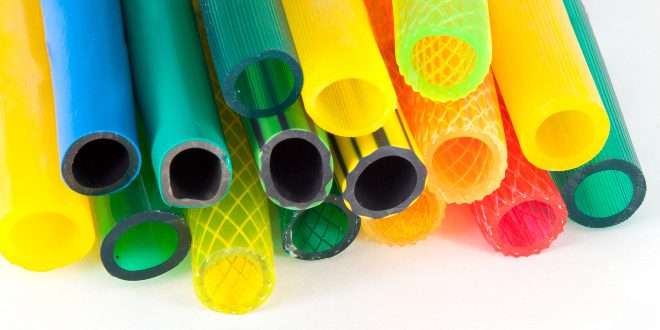
Hoses convey a wide range of media across many industries. Each application – whether fuel hoses, medical hoses, chemical hoses or simply garden hoses – has its own requirements and calls for different properties. Key parameters, from material composition and diameter to working and burst pressure, help you choose the right hose. Find out everything you need to know about the most important parameters and properties of hoses.
Which materials are used for hoses?
Polyamide (PA), polyethylene (PE), polytetrafluoroethylene (PTFE), polyurethane (PUR), polyvinyl chloride (PVC), thermoplastic elastomers (TPE) and other fluoropolymers are among the most common hose materials.
Plastic hoses are the first choice when properties such as low weight, chemical resistance or transparency are required. They are UV-resistant, withstand pressure and are suitable for a wide temperature range – but they are fairly rigid and not elastic.
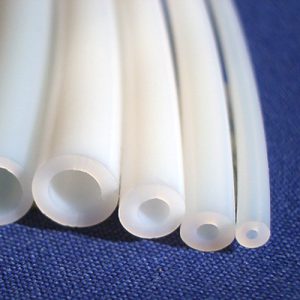
Rubber hoses made from elastomers such as natural or synthetic rubber are, as the name suggests, elastic and flexible. Without additional reinforcement from an outer cover, fabric or helix, however, they offer only limited pressure resistance. Their temperature and chemical resistance are also lower than that of rigid plastic hoses such as PTFE hoses. They are used for conveying water and abrasive or aggressive media, and as welding hoses.
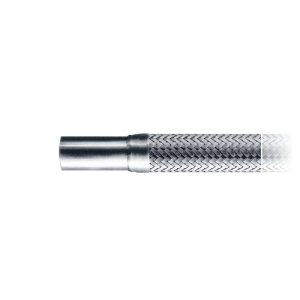
Stainless steel capillaries and corrugated hoses are a special case. Designed for both vacuum and high-pressure applications, they withstand even the harshest temperature conditions up to +550 °C.
Hose construction: reinforcement, covers & more
Alongside the material, the construction of a hose plays a key role in determining its properties.
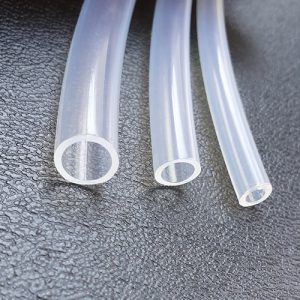
Simple plastic and elastomer hoses consist of a single layer. Typical examples include pump tubings, micro-bore hoses and capillaries. Their pressure resistance is limited to varying degrees, depending on the material and wall thickness.
Many hoses, however, consist of several layers: an inner tube (also known as the lining), a reinforcement layer and an outer cover. The inner tube material must be compatible with the medium being conveyed.
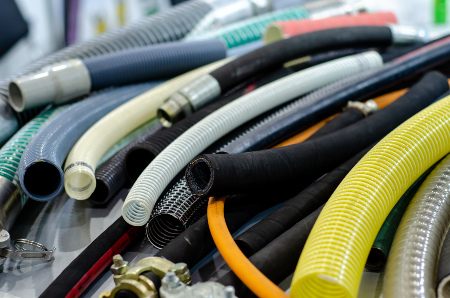
The reinforcement gives the hose dimensional stability and pressure resistance and may consist of several layers. Depending on the application, steel or plastic wires, or metal, textile or plastic braids serve as reinforcement. On multi-layer hoses such as double-jacket hoses, the outer cover protects against weathering and external stresses such as abrasion and chafing, and also provides insulation.
Key parameters: inside diameter, wall thickness and outside diameter
The inside diameter is also referred to as the nominal size, abbreviated to NW (from the German ‘Nennweite’) or DN (from the French ‘diamètre nominal’). For historical reasons, it is often stated in inches. The correct unit, however, is the millimetre, in accordance with DIN EN ISO 6708 ‘Pipework components – Definition and selection of DN (nominal size)’. The outside diameter equals the inside diameter plus twice the wall thickness.
For soft hoses pushed onto hose tails or hose spigots, the inside diameter is the key dimension. The outside diameter can also matter, however, if a hose clip is also used to secure the connection.
For rigid hoses and capillaries connected with cutting ring fittings or ferrules, the outside diameter is the decisive dimension. The cutting ring sits on the outside of the hose and is secured with a union nut.
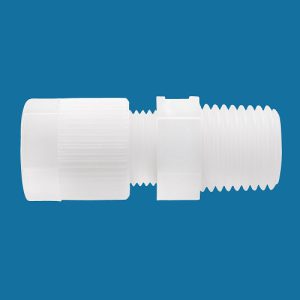
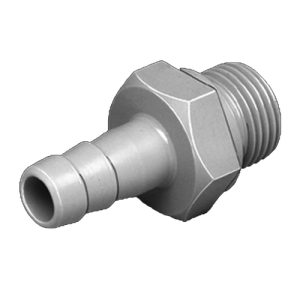
With compression fittings, which suit both rigid and soft hoses, the inside and outside diameters are equally important. The hose end slides onto a support insert and is then secured by an external clamping ring and a union nut.
Connectors made of plastic and metal are available in numerous designs and a wide range of materials.
What is the difference between working pressure and burst pressure?
Burst pressure is the pressure at which a hose ruptures. It is tested in accordance with DIN EN ISO 1402:2021-08 ‘Rubber and plastics hoses and hose assemblies – Hydrostatic testing’. The maximum working pressure is then derived from the burst pressure in accordance with DIN EN ISO 7751:2017-06 ‘Rubber and plastics hoses and hose assemblies – Ratios of proof and burst pressure to maximum working pressure’.
For a water hose or hot water hose with a working pressure of up to 10 bar, the ratio of working pressure to burst pressure is 1:3; for other liquids and compressed air, it is 1:4. For hose systems that convey liquids which vaporise when released into the atmosphere, the burst pressure must be five times the working pressure. Steam hoses must withstand as much as ten times the working pressure.
A proof pressure test confirms that a hose system is fit for service. The system is held at proof pressure – up to 50% above the working pressure – for a specified period and must show no leaks or permanent deformation.
Key parameter: bend radius
Every hose system has a specific minimum bend radius. It depends on the material, inside diameter, wall thickness and reinforcement, as well as on the temperature, the medium conveyed and its pressure. Reinforced hoses usually have a larger bend radius than simple rubber hoses.
At low temperatures, the hose wall often stiffens, which increases the minimum bend radius. A water-filled hose can be bent more tightly than an air-filled one because the water pressure stabilises the hose wall. Bending a hose more tightly than its minimum bend radius allows can cause leaks or even ruptures. Supporting and routing hose lines correctly helps to prevent such damage.
Key parameter: Shore hardness
Hardness indicates how a hose deforms and how much mechanical stress it can withstand. Harder materials are less flexible but more mechanically robust than softer ones.
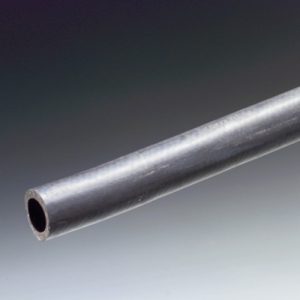
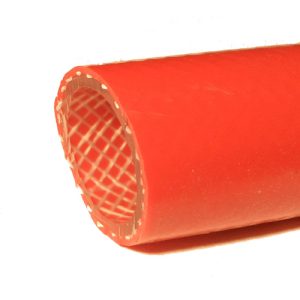
Hose hardness is determined by the Shore hardness test, using a hardness tester known as a durometer. The durometer presses a thin, cone-shaped pin made of hardened steel – the indenter – into the test material with a defined spring force for a defined time and measures how deep it penetrates. The result is expressed on a scale from 0 to 100 Shore: a penetration depth of 0 mm corresponds to 100 Shore, while a depth of 2.5 mm corresponds to 0 Shore.
Different indenters are used depending on the hardness of the material. Soft materials such as rubber mats and silicone tubings are tested with a flat-tipped indenter under a load of 1 kg. The result is given as Shore A hardness.
Harder materials such as polyethylene (PE) or polyamide (PA) are tested with a round-tipped indenter under a load of 5 kg. Their hardness is given as Shore D hardness. You can find detailed information on Shore hardness testing in our magazine article ‘Shore A and Shore D hardness’.
Key parameter: conductivity
Conveying liquids and solids such as powders or granules through hose systems creates friction. This friction can build up an electrostatic charge on the hose wall and lead to sparking. Conductive or dissipative hose systems, known as antistatic hoses, prevent this.
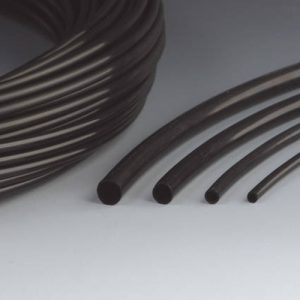
Under the German statutory accident insurance rules for safety and health at work (BGR), a material with a volume resistivity of 104 Ωm or less is classed as conductive. A material with a volume resistivity between 104 and 109 Ωm is classed as dissipative. Conductive additives such as graphite powder can increase the conductivity of the hose material. Alternatively, an integrated wire helix or metal braid can dissipate any static charge.
Sizing hose systems
Three parameters determine the size of a hose system: flow rate, inside diameter and flow velocity. A chart that combines all three, known as a nomogram, lets you read off the required inside diameter for a known flow rate. For the flow velocity, the 6-3-1 rule, derived from practical experience, provides the following guide values: 6 m/s in pressure lines, 3 m/s in return lines and 1 m/s in suction lines.
If the inside diameter is too small, the flow velocity rises and internal friction increases. This leads to pressure loss and heat build-up in the hose system. As a result, plasticisers can leach out of certain elastomer hoses, causing the hose lines to lose flexibility and harden prematurely.
To ensure the safe operation of chemical hoses, operators must inspect them at regular intervals. A visual inspection reveals cracks, deformation, abrasion and kinks. Pressure tests check the integrity of the inner tube and reinforcement. For conductive and dissipative hose systems, conductivity must also be tested. Documented test results and inspection tags provide operators with proof that they have met their duty of care.
Image credits:
Featured image | ©79mtk – stock.adobe.com
Hoses and corrugated tubes in various designs | © Олександр Луценко – stock.adobe.com