 Reichelt Chemietechnik Magazine
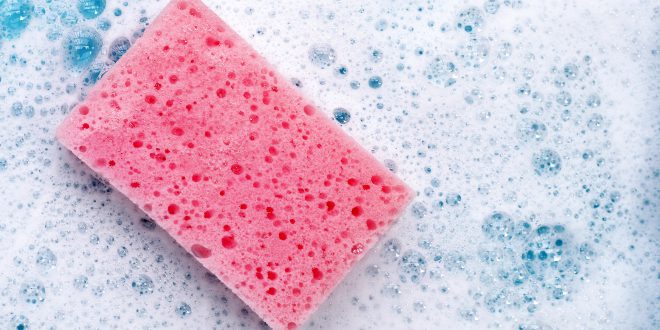
Foams are present in many areas of everyday life. Whether in a relaxing bath, as the head on a freshly tapped beer or as expanding foam on building sites – foam is everywhere and can serve various functions. Quite often, however, foam formation is entirely undesirable. So what lies behind this airy material? What is foam made of, and what are some examples of foams in chemistry and engineering? This article looks at their composition, properties and applications to answer some key questions about these versatile substances.
Foam in Chemistry – Definition
The bubbles usually contain air. Depending on the application, however, they can also hold gases such as nitrogen or carbon dioxide.
Looking at foams at the molecular level helps to explain the stability of foam walls. The key factor is the interface where the bubbles meet the solid or liquid foam walls. Due to the high surface tension, this interface is energetically very unfavourable. This is why pure liquids such as water essentially do not foam. Where stable foam walls are needed, adding surfactants or other surface-active substances stabilises the interface.
Foam Stabilisers
Surfactants are molecules with hydrophilic (water-loving) and hydrophobic (water-fearing) ends. They align at the interface so that the hydrophilic part dissolves in the liquid phase, while the hydrophobic part protrudes into the dispersed phase. This reduces the high surface tension and forms a stable foam wall.
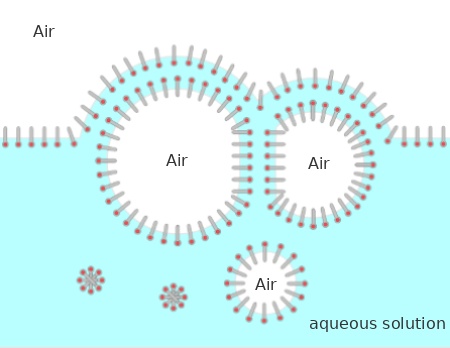
If the foam walls are not stabilised, phase separation occurs. This means that the gas bubbles escape upwards and the continuous phase collects at the bottom: the foam walls collapse. Solid foams can have a relatively long lifespan, whereas liquid foams such as soap bubbles break down relatively quickly.
Foam Structures
The structure of foams depends on the arrangement and size of the bubbles. There are two basic foam structures, which can gradually merge into one another within a single foam layer.
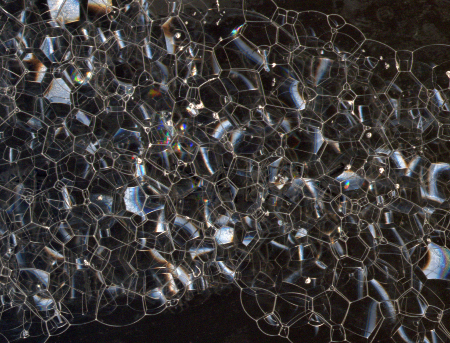
Spherical foam always occurs in foams with a high liquid content and has round bubbles. Polyhedral foam, by contrast, has a low liquid content, so the bubbles deform each other into polyhedra separated only by thin foam walls.
However, two-dimensional foam also exists, in which the bubbles sit exclusively side by side. This type of foam can be observed whenever polyhedral foam is compressed between two closely spaced plates.
Examples of Foam in Chemistry and Industry
Foams are used in numerous applications and industries. Sometimes they serve a purely visual purpose, but in most cases they perform key functions and contribute to product performance. In certain situations, however, foam formation can also be a drawback. Manufacturers must therefore adapt foam formation to each application by selecting suitable processes, surfactants or other additives.
Liquid Foams
In the food sector, milk froth and beer foam are probably the best-known examples of liquid foam. Ingredients such as proteins act as natural foam stabilisers. These examples also show the importance of the gas inside the foam walls.
Liquid foam plays an important role in fire protection in the form of firefighting foam, which many fire extinguishers contain. It helps to separate the fuel from its surroundings and thus smother the fire. In addition, the firefighting foam releases water as it breaks down, which also contributes to the extinguishing effect.
In cosmetics, liquid foams are sometimes already part of the product, but the foam often only forms during use. Examples include soaps, shampoos, shaving foams and facial cleansers. Besides the cleansing and conditioning effect of the ingredients, the foam provides a pleasant texture or easier application.
Solid Foams – Foam Materials
Alongside foams with liquid walls, solid foams are just as versatile and well established in numerous industries. Foam materials are so popular because they combine the classic properties of polymers with those of cellular systems such as natural sponges. They are therefore lightweight, highly deformable and provide very good thermal and acoustic insulation.
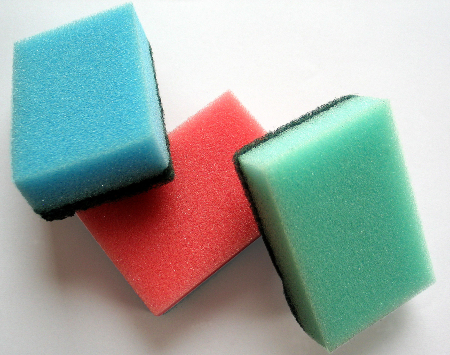
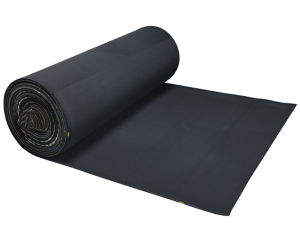
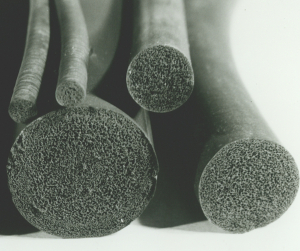
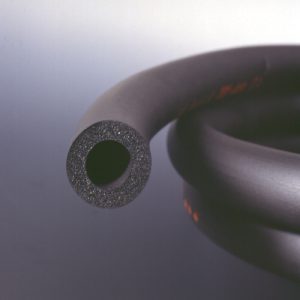
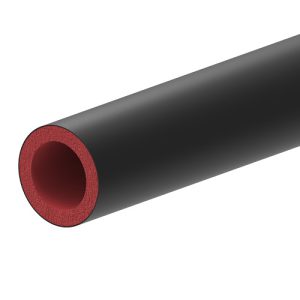
They are usually resistant to mechanical stress, and some can also retain liquids very well. Last but not least, foamed plastic saves material and energy. Typical products made from foamed plastics include insulating hoses, insulation mats, foam rubber sheets and seals.
Foamed Plastics
Polyurethane is one of the most important plastics in the field of foams. PU, also known as PUR, can be processed into both flexible and rigid foam. Foamed plastics are indispensable as engineering and auxiliary materials. They are available as sheets, profiles, round cords and adhesive and non-adhesive tapes. Their uses extend to custom-made moulded parts for vehicle manufacturing. The construction industry often uses PUR foam for insulation and sealing. It is also widespread in upholstered furniture, mattresses and packaging.
Foams made of polyvinyl chloride (PVC) are also of great importance. Rigid PVC foam plates are very popular in the advertising industry, for example as advertising boards and in displays. Thanks to its durable, easily printable surface, rigid PVC foam is also widely used in model making.
Porous plastics are related to foam materials, although manufacturers usually produce them by sintering plastic powders rather than by foaming. Today, they are essential in many modern filtration applications in laboratory and process engineering. Sintered sheets, sintered filters and sintered rods made of porous plastics are characterised by their low weight and good formability. The filter elements are also resistant to breakage and tearing, as well as to many chemicals.
Volcanic Rocks
Pumice is another material that counts as a solid foam due to its porous structure. This volcanic rock has various uses, including insulation, abrasives and personal care.
Aerogels and Metal Foams
Aerogels are another interesting class of solid foam materials. These highly porous solids consist almost entirely of air. They are mainly produced from silica gels. However, plastics and metal oxides can also serve as starting materials.
Thanks to their low density, aerogels are mainly used for thermal insulation. As one of the most effective insulating materials in the world, they also suit specialist applications such as spacesuits. However, producing aerogels is a complex process, which makes it relatively laborious and expensive.
Metal foams also offer tangible advantages. Aluminium foams in particular have led to high-quality applications. As crash components, they absorb impact energy particularly well. Aluminium foams are also ideally suited to mechanical engineering, where fast-moving assemblies must be lightweight and withstand dynamic loads.
Foams in Everyday Life
Foods such as bread, cheese or ice cream are not usually associated with the term foam. Because of their air-filled cells or bubbles, however, they are also solid foams, in this case edible ones.
Technical Parameters of Foam Materials
Besides the type of plastic used, compression hardness is a suitable way to describe a foam material. It defines how much the material deforms under load and thus indicates its firmness.
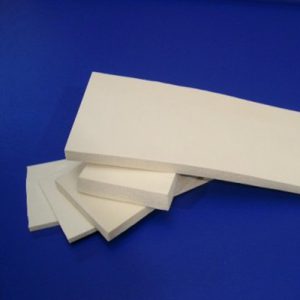
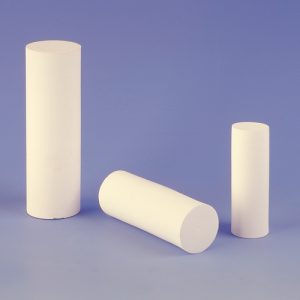
Another important parameter is apparent density. It depends on the amount of plastic processed and is regarded as a quality indicator. Foam materials with a higher apparent density therefore often have a longer service life.
Examples of open-cell foam materials include polyester and PU foams. By contrast, materials such as cellular rubber, sponge rubber and PE foams have closed cells and therefore absorb very little. Integral skin foams have an open-cell core with a closed outer skin.
Producing Foam in Chemistry
How does foam form from a chemical point of view? In chemical foaming, manufacturers usually add a blowing agent to the plastic. At elevated temperatures, this agent releases a gas that foams the melt.
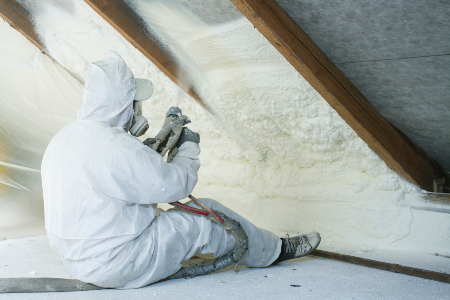
Construction or expanding foam is produced slightly differently, as the plastic only forms directly where it is used. Here, the starting materials polyol and isocyanate react to form polyurethane, which foams into PU foam in the presence of water. In physical foaming, by contrast, the gas is introduced directly into the plastic melt to create bubbles and thus foam.
Foam Control – Defoamers and Antifoaming Agents
In some processes, however, excessive foam formation is undesirable and can even become a problem. Papermaking, wastewater treatment and food production are examples where operators must actively combat foam. Depending on the application, they use defoamers or antifoaming agents. These molecules form a closed film at the interface between liquid and air. This film destroys the liquid foam walls or prevents them from forming. Defoamers and antifoaming agents usually work in similar ways, but the food industry specifically uses the term “antifoaming agent”.
Image sources:
Featured image | © Bowonpat – stock.adobe.com
Formation of spherical bubbles by surfactants | © The original uploader was Roland.chem at German Wikipedia, CC BY-SA 3.0 <http://creativecommons.org/licenses/by-sa/3.0/>, via Wikimedia Commons, labels translated into English
Close-up of bath foam | © André Karwath aka Aka, CC BY-SA 2.5 <https://creativecommons.org/licenses/by-sa/2.5>, via Wikimedia Commons
Kitchen sponges | © Moebius1, CC BY-SA 3.0 <https://creativecommons.org/licenses/by-sa/3.0>, via Wikimedia Commons
PUR foam as an insulating material | © ctvvelve – stock.adobe.com