 Reichelt Chemietechnik Magazine

In hose technology, hose connectors play an important role. They come in as many variants as the hoses they join. They extend, branch or repair hose lines and connect them to valves, taps or equipment. Our guide covers the shapes and types of hose connectors and explains where each type is used.
Shapes of Hose Connectors
Start with the golden rule: the number of hoses you want to join determines the shape of the hose and tube connectors.
- Connectors for two lines can be straight, right-angled or acute-angled. Accordingly, they are known as I-shaped, L-shaped or V-shaped connectors.
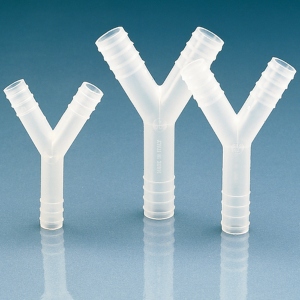
- To join three hoses, use T-shaped or Y-shaped connectors, or connectors with three ports at 120° to one another.
- Four hose lines are joined with a cross connector, whose ends are arranged at 90° to each other.
Types of Hose Connectors
The ends, or hose ports, of hose connectors come in many variations. A single connector can combine identical or different connection types and sizes. Connectors with a different diameter at each end are also known as reducers.
Threaded Adapters and Threaded Connectors
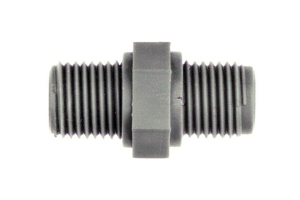
A nipple is a short piece of pipe that is smooth, corrugated or carries an external thread. Its counterpart is the socket, a short piece of pipe with an internal thread. If both ends are identical, the parts are called double nipples or double sockets.
Threaded joints do not necessarily need a sealant such as PTFE tape to stay leak-free. A taper R external thread and a parallel Rp internal thread form a self-sealing threaded connection because of the thread form. Parallel G threads, by contrast, seal against a flat shoulder, often fitted with an integrated elastomer flat gasket.
Barb Connectors and Hose Nipples for Soft Hoses
A barb connector is a nipple with a cylindrical or tapered shape and a smooth, corrugated or ribbed surface. To stop the hose slipping off, you can also secure it with a hose clamp or tubing clamp. The diameters of the hose and the barb must match to create a tight, secure connection.
In chemistry labs, barbs connect hose lines to glass apparatus. If the glassware has a glass thread, a direct hose or pipe connection is often not possible. In such cases, you need glass thread adapters. They allow plastic pipes and hoses to connect to GL threads.
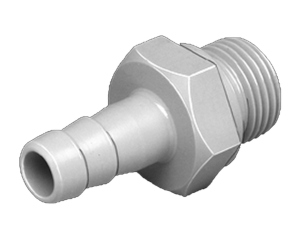
Double barb connectors, also called straight barb connectors, join two hose lines. A barb can also be combined with a thread. A connector may have a barb on one side and an external thread on the other. This is called a screw-in or threaded barb connector, and its name states the exact thread size. A barb combined with an internal thread is called a screw-on barb connector. This type of hose connector links hoses to valves, taps or equipment. In everyday life, you will find it on garden hoses or when topping up the water in a heating system.
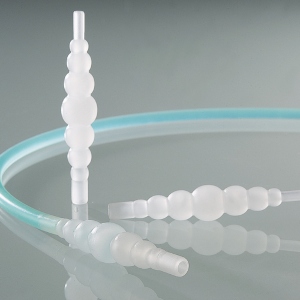
Special barb connectors for rigid hoses are available. Even so, barbs work best with soft tubes and hoses. Typical materials are silicone rubber, ethylene propylene diene monomer rubber (EPDM) and polyvinyl chloride (PVC). In everyday language, these hoses are often called “rubber hoses”.
Flange Connections
A flange connection combines a flange with a pipe stub or barb. Here, too, a hose clamp or tubing clamp secures the hose. You will often find this type of hose connector on pumps, shower hoses and flexible water supply hoses.
Cutting Ring Fittings and Compression Fittings for Rigid Hoses and Pipes
Cutting ring fittings consist of a body, union nuts and cutting rings, also known as ferrules. Slide the union nut and cutting ring onto the hose. Then push the hose into the body as far as it will go. The cutting ring has a sharp edge. When you tighten the union nut, the ring cuts into the hose or pipe surface. This creates a firm grip and a tight seal. Depending on the material and design, the cutting ring may deform as the nut is tightened. Some pipe connectors also contain an additional sealing ring that helps keep the joint leak-free.
Because cutting ring fittings withstand high pressures, they are also known as high-pressure fittings. Equipment engineers and laboratories use them to extend or connect metal or plastic lines.
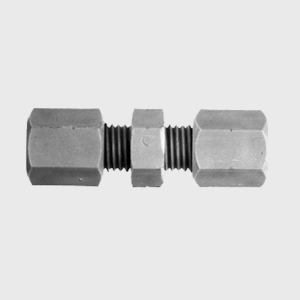
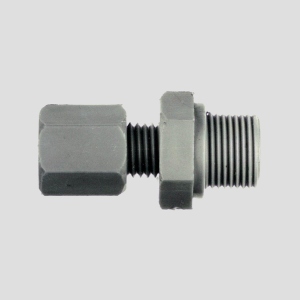
Compression fittings also consist of three parts: the body, the compression ring and a union nut. Unlike a cutting ring, the compression ring does not cut into the hose. Instead, it clamps onto it as you turn the nut, creating a tight seal. Soft hoses additionally require support sleeves. Typical applications include water, gas and heating oil installations, compressed air systems, process chemistry, medical technology and analytical instruments.
Quick-Disconnect Couplings Made of Plastics and Metals
Hose couplings, also known as quick-disconnect couplings, consist of a coupling body and a matching plug. Each part connects to the hose via a barb or a screw joint. Versions with internal or external threads are also available.
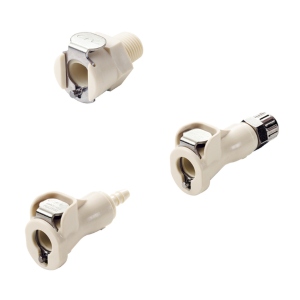
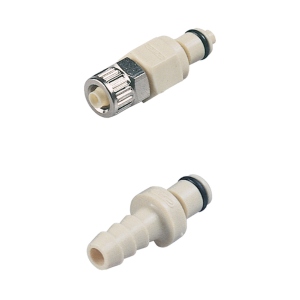
Couplings contain elastomer seals to keep the connection leak-free. They can also have valves that stop the medium escaping when you disconnect them. The advantage of quick-disconnect couplings is that you can separate and reconnect them quickly without tools. Typical uses include compressed air, chemical and water hoses.
Luer Lock Connectors for Medical Technology
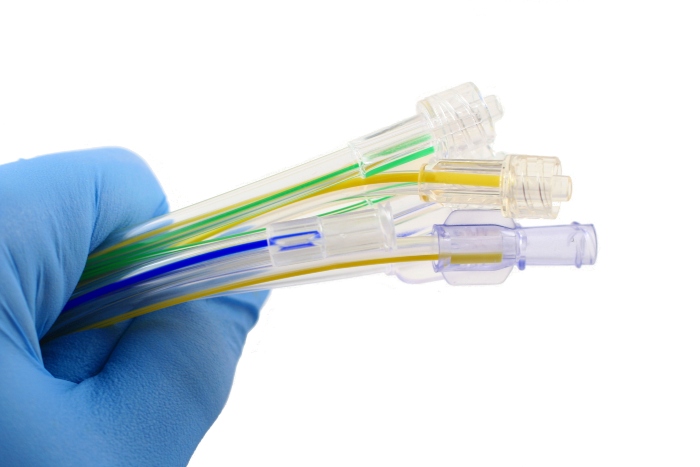
The Luer system is another connection that you can separate without tools. In the simple version, known as Luer slip, a tapered male end plugs into a matching female internal cone. If both parts also have a thread, they are called Luer lock connectors. You will find them mainly in medical technology, but also in laboratories that transport small volumes through micro tubing.
Materials for Hose Connectors
What material should a hose connector be made of? The choice depends on the process temperature and pressure at which the connector operates. Chemical compatibility with the medium it carries matters just as much.
Hose Connectors Made of Metal Alloys
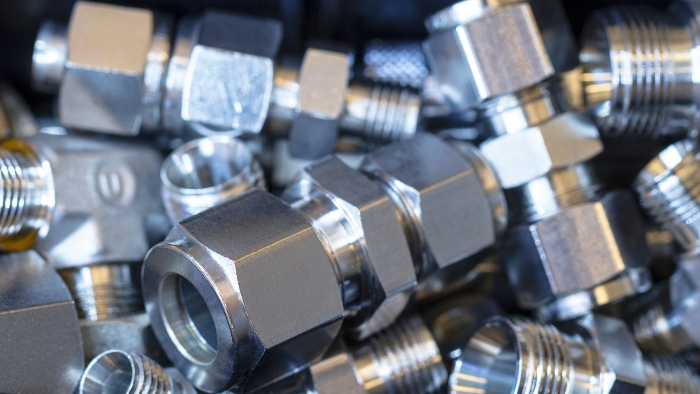
Metal hose connectors are made of stainless steel, aluminium, galvanised steel or brass, which may also be nickel-plated or chrome-plated. Metal connectors work across a wide temperature and pressure range. Stainless steel connectors offer good chemical resistance. Aluminium and brass connectors, by contrast, do not resist dilute acids and alkalis. Salt water also attacks brass connectors.
Hose Connectors Made of Polymers
Plastic hose connectors are available in the following materials:
- Polypropylene (PP)
- Unplasticised polyvinyl chloride (PVC-U)
- High-density polyethylene (HDPE)
- Polyamide 6 (PA 6)
- Polytetrafluoroethylene (PTFE)
- Perfluoroalkoxy alkane (PFA)
- Polyvinylidene fluoride (PVDF)
- Polyoxymethylene (POM)
- Polyether ether ketone (PEEK)
- Polymethylpentene (PMP, TPX®)
Hose connectors made of PP work from 5 °C to 110 °C (41 °F to 230 °F). PVC connectors cover -30 °C to 60 °C (-22 °F to 140 °F). PA 6, HDPE and POM remain stable from -50 °C to 100 °C (-58 °F to 212 °F). TPX connectors suit temperatures up to 120 °C (248 °F) and PVDF connectors up to 150 °C (302 °F). PTFE connectors are rated up to 200 °C (392 °F). Adapters made of PEEK and PFA handle temperatures up to 260 °C (500 °F). The fluoropolymers PTFE and PFA also withstand very low temperatures down to -200 °C (-328 °F).
When choosing a material, consider chemical resistance as well as thermal resistance. Hose connectors made of the commodity plastics HDPE, PA 6 and PP are adequate for many media.
Depending on the application, the material may also have to meet further requirements. Examples include USP Class VI certification for medical applications, or approval for food contact.
Image sources:
Featured image | © rodimovpavel – stock.adobe.com
Luer lock hose connectors | © Jacob Kearns – stock.adobe.com
Threaded adapters & hose screw joints | © Anatoly – stock.adobe.com