 Reichelt Chemietechnik Magazine
Insects that can walk on water? Fabrics that let dirt and water simply bead off? Interfacial tension explains many everyday phenomena. It also matters greatly in chemistry and engineering. Where different phases meet, regions with very special properties arise. „God made solids, but surfaces were the work of the devil. “Physicist Wolfgang Pauli (1900 – 1958) coined this line, often quoted in connection with surfaces and interfaces. A few examples show what he meant. They also reveal whether these fine domains truly deserve such a critical view.
What Are Phases?
A phase is a uniform region of a substance with homogeneous material properties. Depending on pressure and temperature, a substance or mixture can take on different phases. We distinguish solid, liquid and gaseous phases. For H2O, these are ice, water and water vapour. Physical boundaries such as interfaces can separate one phase from another.
What Is Interfacial Tension?
Several unusual effects occur at phase boundaries. Properties such as viscosity or thermal conductivity often change dramatically here. A distinct force also arises at these boundaries. We call this force interfacial tension.
The Difference Between Surface and Interfacial Tension
We speak of interfacial tension for a liquid/liquid or liquid/solid boundary. Surface tension, by contrast, refers to a liquid/gas or solid/gas interface. For a solid/gas boundary, people often use the term free surface energy instead.
Surface Tension of Water Explained
How does the surface tension of water arise, and why is it so high? A look at the molecular level provides the answer.
In every water molecule (H2O), the oxygen carries a slight negative charge. The hydrogen atoms hold a positive partial charge. This structure forms a dipole and creates a directed, electrostatic force. When these dipoles interact in water, we call the effect a hydrogen bond.
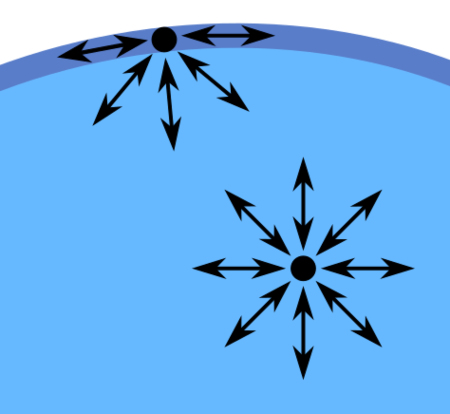
Inside the liquid, each molecule has neighbours on all sides, so the dipoles balance out on average. Molecules right at the surface lack a neighbour above them. As a result, they feel a force pulling them into the water. This inward pull keeps the surface small and effectively “tightens” it. Surface tension is the result.
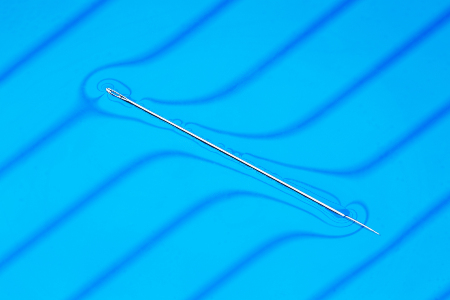
You can see this effect when you fill a glass slightly above its rim. The water does not spill at once. Instead, it forms a small bulge. The same force lets a paper clip float on the surface. It also allows insects such as the water strider to walk on water without sinking.
Defining Surface Tension
Enlarging a liquid’s surface requires energy. This energy works against the cohesion between the molecules.
Depending on the context, we use energy per area (joule/m²; J/m²) or force per length (newton/m). Values usually appear in millijoules per square metre (mJ/m²) or millinewtons per metre (mN/m).
Measuring Surface and Interfacial Tension
Various methods and tensiometers can determine surface and interfacial tension. These instruments either analyse the interface optically or measure the acting forces.
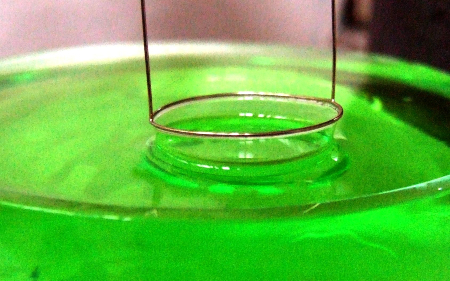
A ring tensiometer, for example, pulls a platinum-iridium ring out of a liquid. It measures the force on the resulting film. From this force, we can calculate the surface tension. The ring can also pass from one liquid directly into another. This yields the corresponding interfacial tension.
Similar tensiometers work with stirrups, plates or rods, depending on the application. The bubble-pressure method reads the surface tension from the internal pressure inside gas bubbles in a liquid. The pendant-drop method calculates surface tension from the shape of a hanging droplet. A further approach measures the contact angle between a droplet and a solid. This too yields the surface and interfacial tension.
Contact Angle and Wetting
At a liquid/solid interface, the contact angle can range from 0° to 180°. The better a liquid wets the surface, the smaller its contact angle to the solid. We call a liquid wetting when the contact angle stays below 90°. Above that value, it wets the surface poorly or not at all.
Oils and greases lower surface tension. A clean, grease-free surface therefore decides the quality of many materials. The test-ink method checks this quality using an ink of defined surface tension. If the ink wets the surface without contracting, the material’s surface tension equals or exceeds the ink’s. If the ink contracts, the material’s value lies below that of the ink.
Surface Tension in Chemistry – Applications
What does surface tension mean for practical applications? Knowing it helps predict how liquids behave on surfaces and how well they wet them. Coating technology, pharmaceutical manufacturing, medical technology and food technology all depend on this knowledge. It safeguards their product quality. Nanotechnology uses surface-tension effects to functionalise surfaces. On metal or plastic surfaces, it also reveals the degree of contamination.
Surface Tension of Different Substances
Most liquids fall between 20 and 100 mN/m at +20 °C (68 °F). Water measures 72.8 mN/m. Ethanol, at 22.6 mN/m, sits relatively low by comparison. The ethanol molecule (CH3CH2OH) also forms a dipole. Its organic group, however, makes this dipole weaker than that of H2O. As a result, ethanol mixes better with hydrophobic substances. Pharmaceutical manufacturers therefore often use it as a solvent.
Oils also lie well below water, at around 35 mN/m. They wet surfaces easily, which suits lubricants and penetrating oils. Mercury reaches 476 mN/m, an extremely high value for a liquid. When released, it therefore forms its familiar beads to minimise its surface. Its high surface tension also stops it from wetting the inner walls of thin capillaries. Together with its uniform thermal expansion, this made it a popular choice for older thermometers.
Capillary Forces
Capillary forces arise in thin tubes and capillaries with a very large surface relative to their volume. Here, surface tension can even exceed the pull of gravity.
A wetting liquid climbs upward against gravity. It rises until adhesion and gravity reach a balance. The thinner the capillary, the higher the liquid rises.
Plastics and rubbers often show surface tensions of 20 to 50 mN/m. PTFE (polytetrafluoroethylene) sits at the low end with 19 mN/m. PE (polyethylene), PS (polystyrene), PVC (polyvinyl chloride) and PUR (polyurethane) rank higher at 31 to 43 mN/m.
Silicone measures 24 mN/m, natural rubber 25 mN/m and butyl rubber 27 mN/m. Glass reaches a surface energy of about 250 mN/m, depending on its pretreatment. Metals show far higher surface energies, exceeding 1,000 mN/m.
Reducing Surface Tension
A high surface tension can cause problems in certain situations. During cleaning, pure water’s high surface tension wets greasy, dirty surfaces poorly. Here, an additive must lower the surface tension and raise the cleaning power.
So what lowers the surface tension of water? Surface-active surfactants such as ordinary washing-up liquid do the job. Their amphiphilic structure gathers at the water-air interface. There, they partly displace the water molecules. This weakens the force pulling into the liquid. Water with detergent or other surfactants therefore shows a lower surface tension than pure water.
Silicone Surfactants
Silicone surfactants form a group of surface-active substances. Even at low concentrations, they lower surface tension sharply. This gives them an edge over classic surfactants such as alcohol ethoxylates. Foam production, cosmetics and agriculture all value this advantage.
They control wetting, emulsification and foam formation very efficiently. They also serve as a substitute for fluorosurfactants, which environmental rules increasingly restrict.
Many industries need to control the surface tension of their liquids. In printing and coating, the coating solution must have a lower surface tension than the material. Otherwise, the coating contracts and beads off. Adhesives face this problem especially often.
Materials with low surface tension, such as rigid PTFE plastics, often need pretreatment. Manufacturers can also adjust the adhesive itself or add bonding agents. This ensures sufficient wetting and therefore strong adhesion.
Image sources:
Featured image | © stanislavi150886 – stock.adobe.com
Intermolecular forces in a water droplet | © Füsiahh, Public domain, via Wikimedia Commons
Platinum-iridium ring of a Du Noüy tensiometer | © Tibor Dubniczky, Department of Chemistry, University of Miskolc, Hungary, CC BY-SA 3.0 <https://creativecommons.org/licenses/by-sa/3.0>, via Wikimedia Commons
Needle floating on the water surface | © volff – stock.adobe.com