 Reichelt Chemietechnik Magazine
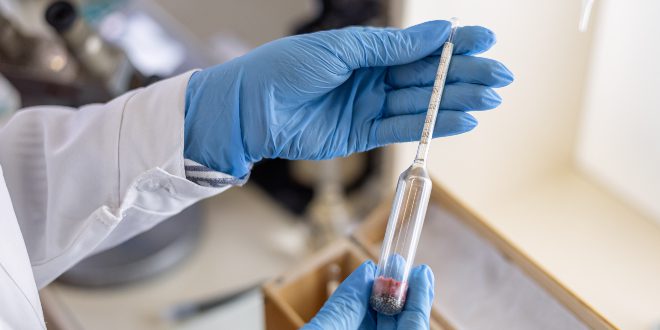
Determining the density of liquids plays an important role across many industries, for example in beverage and spirits production, the chemical industry, and oil extraction and refining. Density measurement helps identify substances, verify quality and purity, and monitor the concentration of mixtures.
We express density in g/cm3 or kg/m3, and for liquids also in g/ml or kg/l. Density decreases as temperature rises. Water, for instance, has a density of 0.999 g/cm3 at +0 °C (+32 °F), 0.998 g/cm3 at +20 °C (+68 °F), and 0.958 g/cm3 at +100 °C (+212 °F).
Air at a standard pressure of 760 Torr (1.013 bar) shows a density of 1.293 kg/m3 at +0 °C (+32 °F), 1.204 kg/m3 at +20 °C (+68 °F), and 0.972 kg/m3 at +90 °C (+194 °F).
The density of technically important polymers usually ranges from around 0.9 to 2.5 g/cm3. PTFE (polytetrafluoroethylene), for example, has a density of roughly 2.15 g/cm3 (2,150 kg/m3), silicone rubber around 1.2 g/cm3, and LDPE (low-density polyethylene) between 0.9 and 1.0 g/cm3. We determine a material’s density with density meters, which work on a range of measuring principles.
Density Measurement with a Hydrometer
The hydrometer’s measuring principle goes back to a discovery by the Greek mathematician and physicist Archimedes, and it carries his name as Archimedes’ principle. It states that a body sinks into a medium until its buoyant force equals the weight of the medium it displaces. Buoyancy and gravity act in opposite directions. When buoyancy exceeds gravity, the body floats; when it is smaller, the body sinks. When the two are equal, the body stays suspended.
Hydrometers, also called density meters or density spindles, are air-filled hollow glass bodies with a tapered upper end. The lower end has a larger diameter and is usually weighted with sand, mercury, or lead shot to ensure stable, upright floating.
Reading a Hydrometer Correctly
A scale runs along the body or the narrow, cylindrical neck – also known as the stem – together with the temperature at which that scale applies. Some stems also contain an integrated thermometer. You pour the liquid under test into a cylinder and bring it to the temperature marked on the spindle. Then you slowly lower the density meter into the liquid. Once the spindle floats freely and motionless, you read the liquid’s density off the scale.
In the laboratory, a set of 14 spindles typically covers a density range from 0.6 to 2.0 g/cm3. This range spans the densities of most chemical compounds: pentane, for example, measures 0.621 g/cm3 at +20 °C (+68 °F), acetone 0.799 g/cm3, and concentrated sulfuric acid 1.84 g/cm3.
Concentration Measurement with a Hydrometer
Because a solution’s density also depends on its concentration, hydrometers can measure concentration as well. Manufacturers therefore offer these density meters with dedicated scales for different applications.
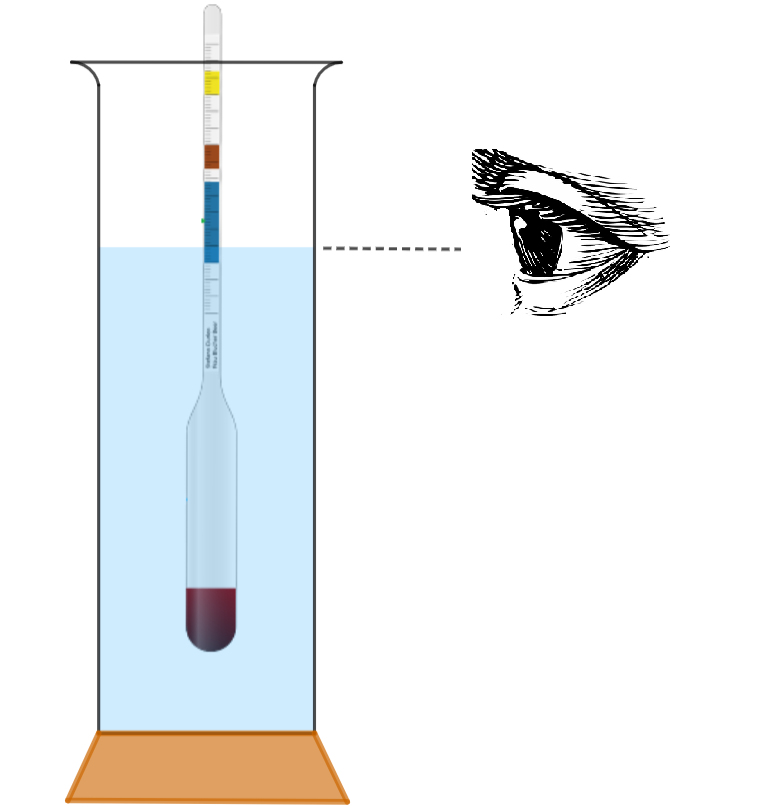
Wineries use must hydrometers to determine the sugar content of grape must. In German-speaking countries, the most common unit for sugar content is the degree Oechsle (°Oe). It is named after the German mechanic and inventor Christian Ferdinand Oechsle (1774–1852), who developed a method for measuring must weight in 1836. Internationally, the degree Baumé (°Bé, °Be, or °B) applies, honouring the French chemist Antoine Baumé (1728–1804). He invented graduated hydrometers for measuring alcohol content and for determining the density of sulfuric acid and electroplating baths. The sugar content of fruit juices, soft drinks, fruit, and vegetables is given in degrees Brix (°Bx). Distilleries and breweries use alcoholometers to measure alcohol content by volume. Dairies and cheese factories rely on lactodensimeters for quality control, using them to determine the fat content of milk, skimmed milk, buttermilk serum, or condensed milk.
Compared with other density meters, hydrometers are inexpensive. However, the scale is hard to read with dark or highly viscous liquids and with volatile compounds. Each measurement needs a liquid volume of at least 100 ml, and the measurement uncertainty is up to about 0.005 g/cm3 (5 kg/m3).
Density Measurement with a Pycnometer
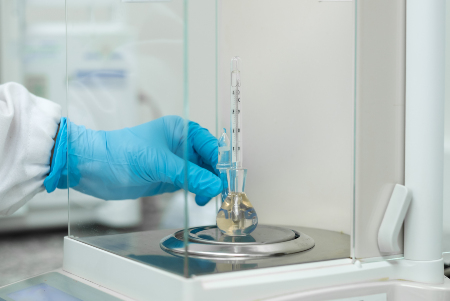
The Persian polymath Abu Raihan Muhammad al-Biruni (973–1048) developed the first pycnometer. A pycnometer is a pear-shaped glass vessel with a ground-glass plug that contains a capillary.
This instrument for measuring liquid density comes with calibrated and uncalibrated volumes between 1 and 100 ml. On the calibrated version, the volume is engraved on the glass. With this density meter, you can determine the density of both liquids and solids.
With the uncalibrated version, you first determine the volume using a liquid of known density. Before measuring, you weigh the empty, temperature-controlled density meter to establish its mass m0. You then fill it with the test liquid until, as you insert the glass stopper, liquid escapes through the capillary. Next, you dry the outside of the vessel. Make sure the vessel and capillary are completely filled and free of bubbles, and that the liquid and vessel are at the same temperature. Then you weigh the filled vessel and record the mass m1. From the difference between the filled and empty vessel and the known volume, you calculate the density using the following formula:
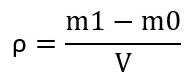
You can use pycnometers across a wide temperature range from +0 to +200 °C (+32 to +392 °F) and at pressures up to 100 bar. The measurement uncertainty is given as 0.02 to 0.5 g/cm3. You can also perform measurements with this density meter across a wider temperature and pressure range than with a hydrometer. They are, however, more time-consuming and require trained personnel.
Density Measurement with an Oscillating U-Tube
This method exploits how a body’s oscillation frequency depends on its mass. The Austrian physical chemist Otto Kratky (1902–1995) developed it, and in 1967 the Austrian company Anton Paar GmbH launched the first digital density meter.
An oscillating U-tube is usually a U-shaped capillary clamped at both ends. You fill the tube with a liquid sample and set it oscillating like a tuning fork. Here, though, the excitation is piezoelectric or magnetic. The resulting oscillation frequency depends on the liquid’s density and on instrument constants, and oscillation sensors record it. You obtain the instrument constants by calibrating the measuring cell with two standards, usually water and air. From the oscillation frequency, you can then calculate the density of liquids.
The greater the liquid’s density, the higher the oscillation frequency. The sample volume is around 1 ml. At a temperature accuracy of 0.5 °C (0.9 °F), manufacturers state a density measurement accuracy of 0.001 g/cm3, with temperature-control and measuring times between 0.5 and 4 minutes.
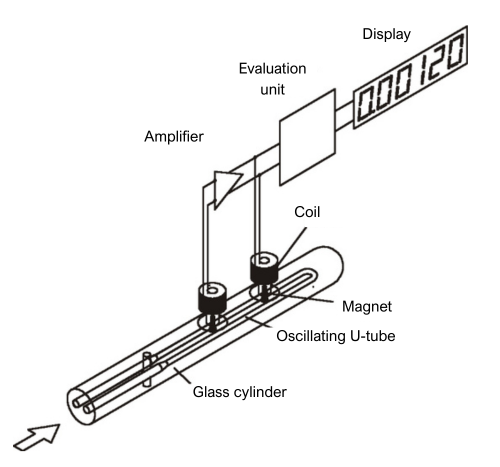
The advantages of this method lie in its ease of use and small sample volume. Depending on the model, these instruments measure liquid densities across a temperature range from -50 to +200 °C (-58 to +392 °F). Digital capture of the oscillation frequency avoids reading errors. Oscillating U-tubes can also operate within a flow process. Their purchase, however, involves higher costs.
Despite the higher purchase cost, oscillating U-tubes increasingly replace the more labour-intensive pycnometers. Which density meter you choose depends above all on the measurement accuracy each application demands.
For many hobby brewers and hobby winemakers, must hydrometers and alcoholometers are indispensable tools. Other accessories for hobby brewers include drinking-water hoses, plug-in connectors, and tri-clamp connectors.
For measuring the density of battery acid, the fat content of milk, or for monitoring electroplating baths, an accuracy of 0.1 g/cm3 is sufficient. The beer, spirits, and pharmaceutical industries, along with nuclear technology and research, demand accuracies of at least 0.01 g/cm3.
Image Sources:
Featured image | © 360VP – stock.adobe.com
Reading a hydrometer | © SG0039, CC0, via Wikimedia Commons
Weighing a pycnometer | © Sukjai Photo – stock.adobe.com
Schematic diagram of the oscillating U-tube | © Antonpaar, Public domain, via Wikimedia Commons