 Reichelt Chemietechnik Magazine
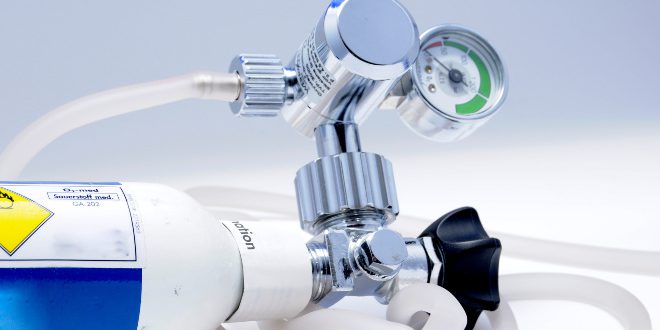
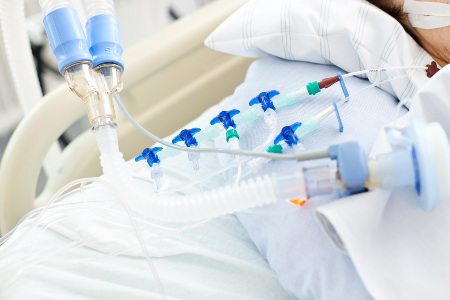
During surgery, after an accident or in the case of a serious illness such as a COVID infection, mechanical ventilation may be required. Surgical procedures are often performed under general anaesthesia, during which breathing is affected and therefore taken over by a ventilator. The ventilator is connected to the patient via a ventilation hose system and either a ventilation mask or an endotracheal tube.
Components of a Ventilation System
A ventilation system consists of many individual components such as the ventilator, breathing gas, hoses, sensors for temperature and volume measurement, and various filters.
Ventilation Hose Systems
Single-Limb Systems
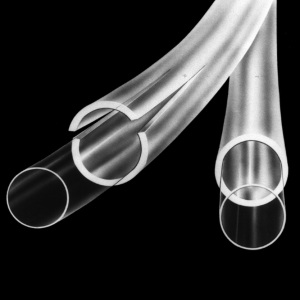
Ventilation systems may contain one or two ventilation hoses. In single-limb systems, breathing gas is supplied to the patient via the ventilation hose, while the exhaled carbon dioxide (CO2) is discharged through a longitudinal slit in the hose, known as a Bunsen valve, or via an integrated expiratory valve. In hose systems with a longitudinal slit, air continuously flows through the hose, causing the exhaled CO2 to be constantly flushed out.
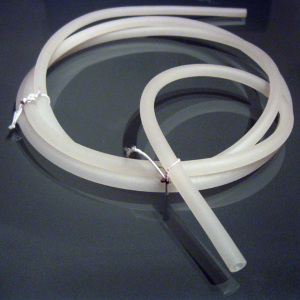
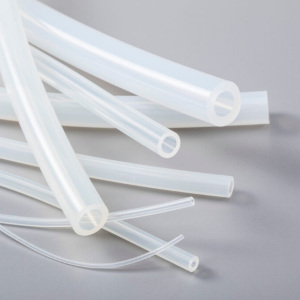
In ventilation hoses with an integrated expiratory valve, the valve is closed during inhalation and allows inspiratory air to reach the patient. During exhalation, it opens and the exhaled air is released in a controlled manner. The expiratory valve operates according to the principle of a check valve and is connected to the ventilator via a hose that controls the valve. These systems are often connected to the ventilator via a second, thin hose in which a sensor measures the pressure or volume of the inspiratory gas. Single-limb systems are frequently used for patients who are still able to breathe independently but require respiratory support, such as patients suffering from sleep apnoea.
Dual-Limb Systems
Dual-limb systems contain one ventilation hose for inhalation (inspiration) and one for exhalation (expiration). The illustration below shows a schematic representation of such a ventilation system.
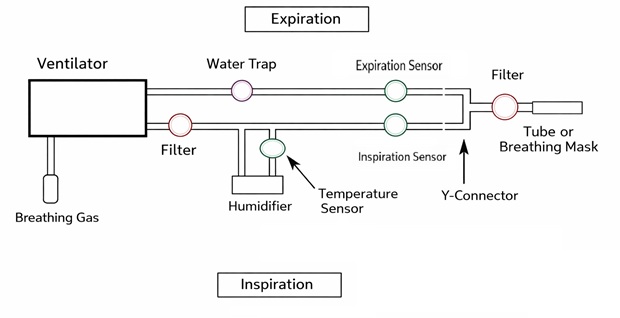
Both hoses are connected to the ventilator and can be joined via a Y-hose connector. A coaxial arrangement of the two hoses, where the usually colour-coded inspiratory hose runs inside the transparent expiratory hose, is referred to as a coaxial ventilation hose. On the expiratory side of the ventilator, an expiratory valve is installed. Upstream of the expiratory valve is a sensor that measures the expiratory volume. As with single-limb systems, the inspiratory hose is equipped with a sensor to measure the inspiratory volume. This allows a comparison between inspiratory and expiratory volumes. Dual-limb systems are primarily used in intensive care medicine or for ventilating very young children.
Designs and Materials of Ventilation Hoses
Hoses for medical technology must be physiologically safe and comply with relevant medical regulations.
Ventilation hoses are manufactured from materials such as silicone (SI), polyethylene (PE), specific polyvinyl chloride compounds (PVC), polypropylene (PP), or thermoplastic elastomers. They are available as extendable corrugated hoses, also known as bellows hoses, or as smooth hoses made from solid material. In medical technology, silicone tubing and polyethylene tubing are particularly common.
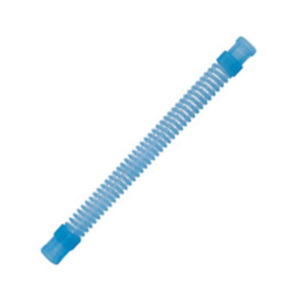
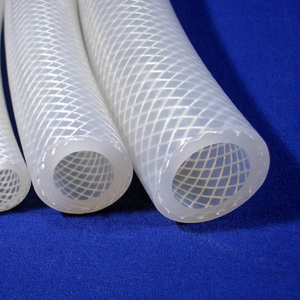
The inner surface of ventilation hoses is smooth to ensure the drainage of condensed moisture. A reinforcing spiral may be integrated on the outer surface to prevent kinking. To avoid condensation caused by humidified breathing gas and the associated risk of microbial growth, heated ventilation hoses are also used. Heating is provided by integrated heating wire coils. In non-heated hose systems, a condensate trap, known as a water trap, is attached to the ventilation hose to collect condensed moisture.
The Breathing Gas
In healthy individuals, the mouth and nose are responsible not only for transporting breathing gas but also for cleaning, warming and humidifying it. When a patient is mechanically ventilated, the breathing gas must therefore be conditioned accordingly. This means it must be cleaned, warmed and humidified to prevent drying of the mucous membranes and reduce the risk of infection.
The term “oxygen” commonly used in medical practice actually refers to “synthetic air”, which is produced by mixing pure nitrogen and pure oxygen and is free from trace gases. Breathing gas is considered a finished medicinal product for which quality and safety must be proven. It must be filled into cleaned gas cylinders in dedicated facilities, and the entire manufacturing process must be fully traceable.
How Breathing Gas Is Conditioned
Both passive and active humidifiers are available for humidifying breathing gas. Passive humidifiers are also known as HME filters, short for “heat and moisture exchanger”. These filters consist of a plastic housing containing a plastic filter that adsorbs moisture. During exhalation, the filter stores moisture and heat from the expiratory air and releases them again during inhalation. The inspiratory air can only contain as much moisture as was released during exhalation. When exhaling through the nose, expiratory air has a temperature of approximately +32 °C and a moisture content of 34 mg/l[1]. HME filters are frequently used in patients with a tracheostomy and are positioned between the ventilation hose and the tracheal cannula – a plastic tube inserted into the tracheostomy.
Active humidifiers consist of a heated water chamber. The chamber is filled approximately halfway with water, which is then heated in a controlled manner to a temperature between +37 °C and +39 °C. At this temperature, the air in the chamber contains 44 mg/l of water vapour[1]. The inspiratory gas is introduced into the water chamber, where it is warmed and humidified. The heated and humidified gas is then delivered to the patient. A temperature sensor integrated into the ventilation hose via a connector measures the temperature of the breathing gas. To prevent moisture contained in the breathing gas from condensing in the ventilation hose, heated hoses are used for inspiration. With active humidification, temperature and moisture levels can be kept constant, whereas in passive humidification they depend on the expiratory air.
Additional Components of a Ventilation System
To prevent contamination of the patient by the ventilator and contamination of the ventilator by the patient – so-called cross-contamination – bacterial and viral filters are positioned between the tube or mask and the hose system, as well as between the ventilator and the hose system.
In certain indications, the administration of medication is required. A nebuliser is used to introduce liquid medications in aerosol form into the ventilation circuit via an additional connector. In anaesthesia, additional ports are required for the administration and monitoring of nitrous oxide.
Single-Use or Reusable Hoses?
Ventilation hoses are available as single-use or reusable products. In 2001, the Austrian Institute of Ecology published a catalogue of criteria for ventilation hoses[2]. According to this catalogue, silicone hoses can be sterilised up to 250 times, while Hytrel® hoses (thermoplastic elastomers based on polyester) can be sterilised up to 20 times. This means that between 20 and 250 single-use hoses would need to be manufactured, transported and disposed of in order to replace one reusable hose.
The reprocessing of ventilation hoses includes cleaning in a hose washing machine followed by steam sterilisation at +121 °C or +134 °C. The ventilation hoses are then packaged in a sterile manner and delivered to the wards. Single-use products are marketed as preventing cross-contamination; however, with proper reprocessing, cleaning and sterilisation of ventilation hoses, this should also be ensured.
The development of ventilators and the introduction of intensive care units have made modern intensive care medicine possible. As mechanical ventilation is always associated with risks, it should be used for the shortest possible duration.
Sources:
[1]: https://www.thieme-connect.de/products/ebooks/lookinside/10.1055/b-0037-145723#
[2]: https://ecology.at/files/pr223_1.pdf
Image sources:
Feature image | © herbert frost – stock.adobe.com
Dual-limb ventilation system with Y-connector | © CMP – stock.adobe.com