 Reichelt Chemietechnik Magazine

The German term “Duroplaste” derives from the Latin “durus”, meaning hard. English uses the name thermosets, which reflects how these plastics set permanently during curing. The international standard ISO 472:2013, Plastics – Vocabulary, provides the formal definition. Here, a thermoset is a “plastic which, when cured by heat or other means, changes into a substantially infusible and insoluble product”[1]. This guide covers the properties and applications of thermoset plastics.
What Is a Thermoset?
Materials scientists divide plastics into three classes by structure and resulting properties: thermoplastics, elastomers and thermosets. Thermosets also go by the names thermosetting plastics and duromers.
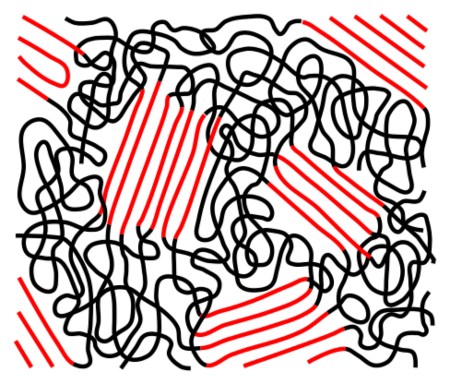
Thermoplastics consist of linear or branched polymer chains with no chemical crosslinks between them. When heated, these chains slide past one another. This makes thermoplastics meltable and reversibly mouldable within a defined temperature range. The thermoplastics include the commodity plastic polyethylene (PE) and the high-performance plastic polytetrafluoroethylene (PTFE). Manufacturers use both to produce rigid plastic tubing, plastic sheets and tube and hose connectors.
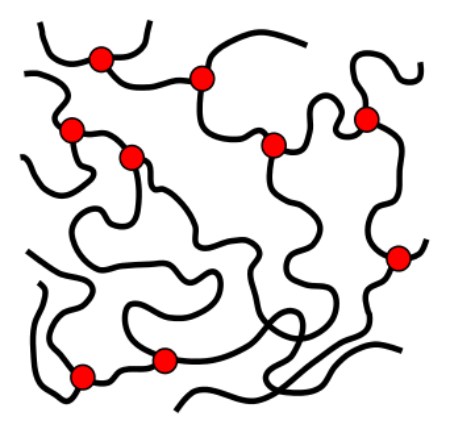
Elastomers, by contrast, consist of tangled polymer chains joined by wide-meshed crosslinks. These crosslinks prevent elastomers from melting. Under mechanical load, the polymer chains straighten out and the material stretches. When the load eases, the material contracts again. Well-known elastomers include the rubbery polymers ethylene propylene diene monomer rubber (EPDM) and acrylonitrile butadiene rubber (NBR). Manufacturers turn these polymers into rubber tubing, seals and closure elements, among other products.
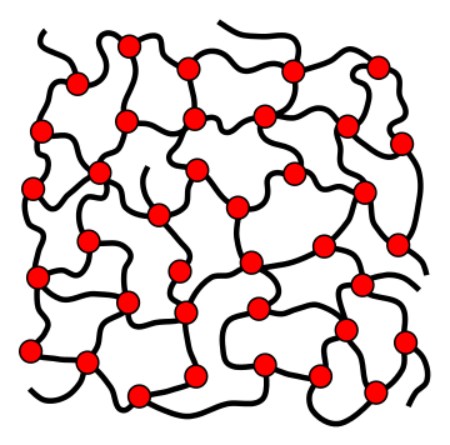
Thermosets consist of polymer chains locked into a dense, close-meshed network. As a result, thermosets do not melt, and they fracture under excessive mechanical load.
The German Plastics Museum (Deutsches Kunststoff-Museum) compares the three classes of plastic to sweets. In this vivid analogy, chocolate behaves like a thermoplastic. It melts, cools and takes on a new shape. Gummy bears act like elastomers: they stretch and then spring back to their original shape. Thermosets resemble biscuits: baking turns a liquid batter into a firm, brittle solid.
How Thermosets Are Made
Thermosets start out as synthetic resins, which manufacturers produce from monomers. The International Union of Pure and Applied Chemistry (IUPAC) gives the following definition. It describes a resin as a “soft solid or highly viscous substance, usually containing prepolymers with reactive groups”[2].
Resin makes up between 40 and 60 % of the mixture and determines its viscosity. Because thermosets cannot melt, processors must shape them before curing. They transfer the mixture of resin and additives into a mould of the required shape. Inside the mould, crosslinking and thus curing then take place under heat, pressure, or UV or infrared radiation.
Crosslinking can proceed by polycondensation, polyaddition or free-radical polymerisation. Depending on the crosslinking reaction, resins fall into two groups: condensation resins and reaction resins. The condensation resins include phenoplasts such as phenol-formaldehyde resins (PF). Aminoplasts such as melamine-formaldehyde resins (MF) and urea-formaldehyde resins (UF) also belong to this group.
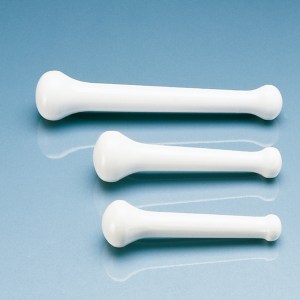
As condensation resins cure, they release a by-product, often water. Manufacturers therefore run the polycondensation at elevated temperature and high pressure. This lets the by-product escape and reduces cracking and internal stresses during curing.
The reaction resins include epoxy resins (EP), unsaturated polyester resins (UP) and crosslinkable polyurethanes (PUR). Many of them cure at room temperature or with mild heat, and at atmospheric pressure.
Curing causes shrinkage: the finished thermoset part occupies less volume than the moulding compound it started from. In practice, the term thermoset often covers both the resins and the cured products. Strictly speaking, English distinguishes thermosetting resins before curing from thermosets after curing.
Properties of Thermosets
Because thermoset polymers are densely crosslinked, they offer high resistance to heat and chemicals.
Thermosets make good electrical insulators and offer high tracking resistance. Their low coefficient of thermal expansion ensures good dimensional stability, even at elevated temperatures.
Applications of Thermosets
Thermosets serve as adhesives and as casting and laminating resins. Their main use, however, lies in fibre-reinforced composites, often simply called composites. These materials consist of a plastic matrix with embedded fibres or fabrics. Inorganic options include glass, ceramic and carbon fibres. Organic options include aramid, polyester, nylon, polyethylene and polymethyl methacrylate fibres. Natural fibres such as wood, hemp, flax and sisal are also suitable.
Combining fibres and matrix creates a new material with modified properties. Examples include glass-fibre-reinforced plastic (GRP) and carbon-fibre-reinforced plastic (CFRP).
Phenoplasts – The First Thermosetting Plastics
Phenol-formaldehyde resins form from phenol and formaldehyde. They are the oldest synthetic thermosets. The Belgian-born chemist Leo Hendrik Baekeland invented them in 1907. They entered the market under the trade name Bakelite®, derived from his name.

Manufacturers turned these brown-black plastics into household and kitchen items, jewellery and light switch housings. The same materials gave shape to plugs, sockets, radios, telephones, insulators and much more. Even the Trabant, the small car built in East Germany (GDR) from 1957 to 1991, relied on them. Its body panels consisted of cotton fibres impregnated with phenolic resin, a material known as Duroplast. Phenolic resins have largely vanished from everyday life. Yet they remain in use wherever applications demand electrical insulation, mechanical and thermal strength, and low flammability. Typical examples include printed circuit boards, electrical components, brake linings and grinding wheels. Phenolics also act as flame-retardant binders for hardboard and foams.
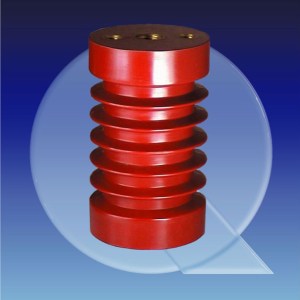
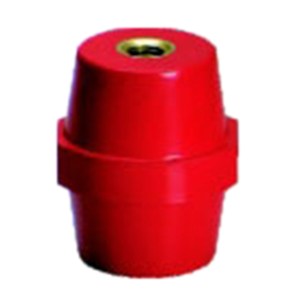
Manufacturers use phenolic resins, epoxy resins and glass-fibre-reinforced polyesters to produce medium-voltage insulators, insulating spacers and other electrical insulators.
Aminoplasts – The Adhesives of the Wood Industry
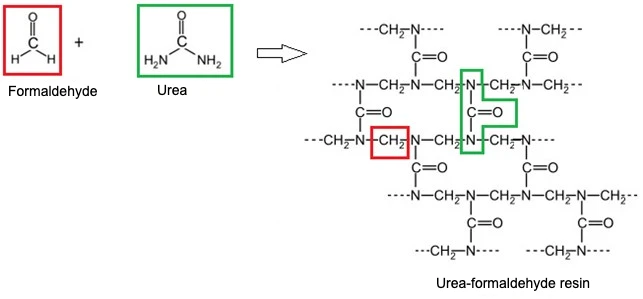
Aminoplasts start from carbonyl compounds such as formaldehyde. These react with compounds carrying at least two amino groups, such as urea. Melamine resins and urea resins both belong to the aminoplasts.
Unlike phenolic resins, aminoplasts accept light colours and offer good lightfastness. In the 1950s and 1960s, melamine resin worktops found their way into German kitchens. They carried the trade name Resopal®, Germany’s counterpart to Formica®. Aminoplasts serve mainly as adhesives in the woodworking industry. Manufacturers also use them for plugs, switches, lamp holders and kitchen appliance housings. They also appear in tableware, drinkware and table tennis table surfaces. The figure below shows the starting materials formaldehyde and urea. It also shows the structure of the resulting urea-formaldehyde resin. Dashed lines mark further crosslinking points.
Epoxy Resins – Versatile Plastics
Manufacturers produce epoxy resins mainly from epichlorohydrin and polyhydric phenols such as bisphenol A. As casting resins, epoxies form components for electric motors. They also go into insulators, capacitors and high-voltage bushings. Thanks to their chemical resistance, epoxies coat the inside and outside of tanks, vessels and pipes. Valves and fittings, ships, steel structures and industrial floors also receive epoxy coatings.
Epoxy resins have also established themselves as adhesives. They bond metals, wood, glass, porcelain, stone, concrete and many plastics. In fibre-reinforced composites, epoxy resins appear in structural components of gliders and passenger aircraft. Rotor blades for wind turbines use them as well. In sports equipment, they feature in kayaks, skis, tennis rackets, golf clubs and hockey sticks.
Unsaturated Polyester Resins
Unsaturated polyester resins (UP resins) consist of unsaturated polyesters dissolved in an unsaturated monomer such as styrene. During curing, this monomer helps build the high crosslink density. Unlike epoxy resins, UP resins shrink considerably during curing. Inorganic fillers reduce this shrinkage.
With short glass fibres or similar short-fibre fillers, UP and melamine resins achieve the best tracking resistance. Like melamine and urea resins, UP resins offer high lightfastness. As casting resins, they encapsulate electrical components. As laminates, they form car body parts as well as fairings for boat hulls and gliders.
Crosslinkable Polyurethanes
Polyurethanes form from polyisocyanates and polyols. The choice of starting materials and process parameters controls the degree of crosslinking. Highly crosslinked grades show thermosetting behaviour.
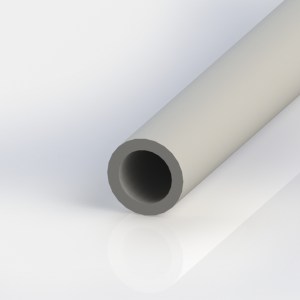
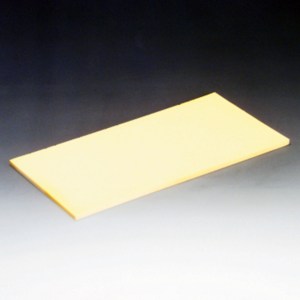
PUR rigid foam boards insulate refrigeration appliances, heat and cold storage systems and pipe jackets. In construction, PUR boards insulate roofs, floors and walls. As a casting resin, PUR serves as a potting compound in the electrical industry. It also coats floors and helps refurbish flat roofs. Manufacturers also make roller coverings and damping and spring elements from it. The same applies to wear parts such as seals and wipers, which protect hydraulic and pneumatic cylinders against contamination. As an adhesive, PUR bonds large areas of metal, wood, plastics, natural stone, gypsum fibreboard and plasterboard.
Thermosets combine hardness, chemical resistance and heat resistance with low density. This combination makes thermoset materials important in industry, and not only as a substitute for metals.
Sources:
[1] https://www.iso.org/obp/ui/#iso:std:iso:472:ed-4:v1:en
[2] https://goldbook.iupac.org/terms/view/RT07166

Image credits:
Featured image | © dieter76 – stock.adobe.com
Polymer structure, semi-crystalline | © Roland.chem, CC0, via Wikimedia Commons, https://commons.wikimedia.org/wiki/File:Polymerstruktur-teilkristallin.svg
Polymer structure, loosely crosslinked | © Roland.chem, CC0, via Wikimedia Commons, https://commons.wikimedia.org/wiki/File:Polymerstruktur-weitmaschig_vernetzt.svg
Polymer structure, densely crosslinked | Roland.chem, CC0, via Wikimedia Commons, https://commons.wikimedia.org/wiki/File:Polymerstruktur-engmaschig_vernetzt.svg
Bakelite telephone | © Iliya Mitskavets – stock.adobe.com