 Reichelt Chemietechnik Magazine

Thermal Conduction Simply Explained
Alongside thermal radiation and convection, thermal conduction is one of the mechanisms that transfer energy in the form of heat. It is also called conduction or thermal diffusion and occurs mainly in solids, but also in liquids and gases. Convection transfers heat through flowing particles, while thermal radiation transfers it through electromagnetic waves. Thermal conduction, by contrast, transfers heat without transporting particles. In practice, the different heat transport mechanisms frequently overlap. This article explains exactly how thermal conduction works and what heat transport mechanisms are!
What Does Thermal Conduction Mean?
Thermal diffusion is based on a heat flow Q̇. Within a given time t, this heat flow transfers a quantity of heat Q from a warmer point to a colder one.
Thermal diffusion also depends on the thickness of the conducting body: the thicker the body, the lower the diffusion. The wall thickness of a building illustrates this well. Buildings with thick walls, such as castles and palaces, stay pleasantly cool in hot summers because the heat cannot diffuse through the masonry. The heat flow is also proportional to the surface area of a body. Fourier’s law of thermal conduction describes the heat flow Q̇, which is expressed in watts (W):
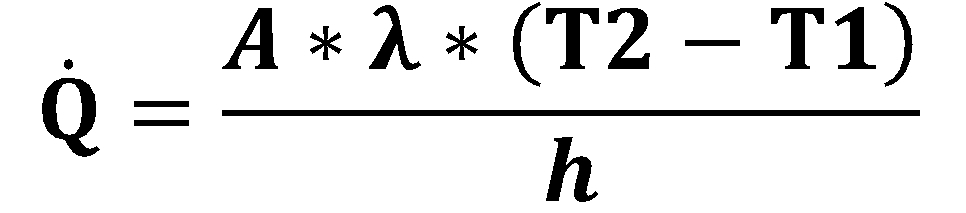
The heat flow is inversely proportional to the thickness h. It is proportional to the plate area A, the temperature difference (T2-T1) and the proportionality factor λ. The factor λ is a material constant known as thermal conductivity, thermal conductivity value or thermal conductivity coefficient, with the unit W/m*K.
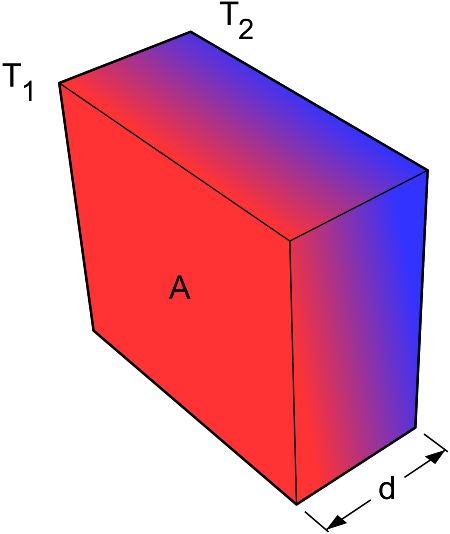
What does thermal conductivity mean? This physical term indicates how well or how poorly a material transports heat. It applies only to heat transfer by conduction, not by convection or radiation.
How does Thermal Conductivity work?
A higher number of conduction electrons produces a correspondingly higher thermal conductivity. Good electrical conductors are usually good thermal conductors as well, and electrical insulators are also good thermal insulators. Diamond is an exception: it is an excellent electrical insulator and at the same time has the highest thermal conductivity value, at around 2200 W/m*K. Good metallic electrical conductors such as copper with 400 W/m*K or silver with 430 W/m*K reach higher thermal conductivity values. Poor electrical conductors such as iron with 80 W/m*K or lead with 35 W/m*K stay well below them.
Because metals conduct heat well, manufacturers use them for radiators and cooling fins. House construction, by contrast, uses materials with low thermal conductivity values, such as concrete with 2 W/m*K or wood with 0.15 W/m*K.
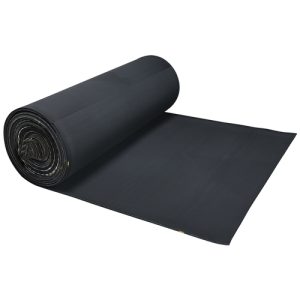
Thanks to their low thermal conductivity value, plastics such as polystyrene (0.17 W/m*K) or polyurethane (0.245 W/m*K) serve as thermal insulators. Their good insulating effect and dimensional stability make plastic protective hoses and insulating hoses a frequent choice. They often come in foamed form with air inclusions, as do foam plates or foam rubber sheets.
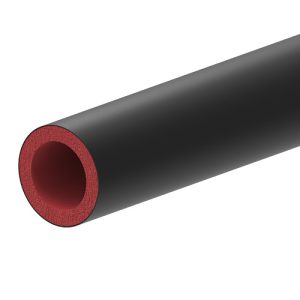
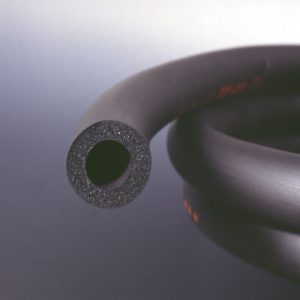
Closure elements made from elastomers, such as rubber caps and rubber plugs, even withstand use at high temperatures.
Light atoms or molecules such as hydrogen (0.186 W/m*K) have higher thermal conductivity values than heavy ones such as air or nitrogen (0.026 W/m*K), because they move faster at the same energy content. Insulation boards foamed with air and hoses for thermal insulation also exploit the low thermal conductivity of gases; they can consist of more than 98% air. In a vacuum, thermal conduction is not possible, and double-walled vacuum flasks and Dewar vessels use this effect to prevent heat transport.

Liquids conduct heat in the same way as gases, through collisions between atoms or molecules. Because the particle density in liquids is higher than in gases, the molecular interactions occur more often and more strongly. Liquids therefore reach thermal conductivity values about ten times higher than gases.
The Link Between Thermal Conductivity and Temperature Conductivity
Thermal conductivity indicates how quickly heat can spread through a substance. Temperature conductivity, also known as thermal diffusivity and denoted by the symbol α, measures how quickly a substance responds to a change in temperature. It depends on the substance’s thermal conductivity coefficient, its specific heat capacity and its density. The specific heat capacity cp determines how much heat a substance can store per unit mass.  The lower the thermal diffusivity of a substance, the more slowly its temperature changes. Thermal diffusivity falls as the thermal conductivity value decreases and as density and specific heat capacity increase. After helium and hydrogen, water has the highest specific heat capacity at 4.18 kJ/kg*K. Its availability and easy handling therefore make it a common heating or cooling medium.
Air, with a lower specific heat capacity of 1 kJ/kg*K, heats up more strongly. In a radiator system, the air temperature therefore rises more than the water temperature falls for the same amount of energy supplied.
Temperature conductivity is an important parameter in the construction industry and in the assessment of heating and cooling processes. Builders use materials with low thermal diffusivity, such as concrete, clay, sand-lime brick, brick and wood, while glass wool, cellulose or polystyrene serve as thermal insulators. Applications that require rapid temperature equalisation, such as temperature measuring instruments and temperature controllers, use materials with high thermal diffusivity, such as metals or graphite.
Thermal Conductivity Coefficient – Heat Transfer Coefficient
Both thermal conductivity and thermal diffusivity refer to heat transport by conduction within a solid or a substance. In practice, however, heat transport also frequently occurs at interfaces, for example between a house wall and the indoor and outdoor air, or between a radiator and the room air. In this case, convection also contributes to the heat transfer.
During convective heat transport between a solid and a flowing medium, the heat flow is proportional to the temperature difference and the interface area. The following equation describes it:
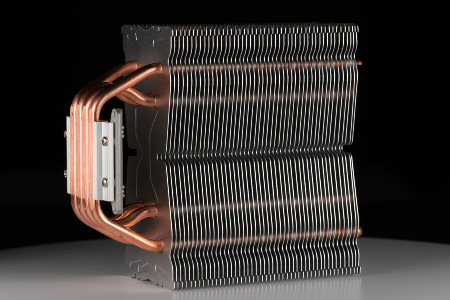
The proportionality factor α is known as the heat transfer coefficient or film coefficient and is expressed in W/m2*K (watts per square metre and kelvin). Instead of the letter α, many texts use the letter h, from the English term “heat transfer coefficient”. Radiators and heat sinks exploit this dependence of the heat flow on the interface area. Both consist of many fins, which offer a larger area than a flat plate and can therefore transport a greater quantity of heat. As a result, the home warms up faster and electronic components cool more efficiently.
The unit W/m2*K is also called the U-value. It describes the heat loss through a wall or a window per square metre of area when a temperature difference of 1 kelvin exists between the two sides. The U-value therefore reveals the insulating properties of a building component. Heat transfer processes make everyday life more comfortable, whether in air conditioning, heating or cooling. They are also indispensable in science and research and in the manufacture of countless products.
Image sources:
Featured image | © bigguns – stock.adobe.com
Thermal conduction through a body | © MikeRun, CC BY-SA 4.0 <https://creativecommons.org/licenses/by-sa/4.0>, via Wikimedia Commons
Cooling fins and heat pipes of a modern CPU heat sink | © bigguns – stock.adobe.com