 Reichelt Chemietechnik Magazine
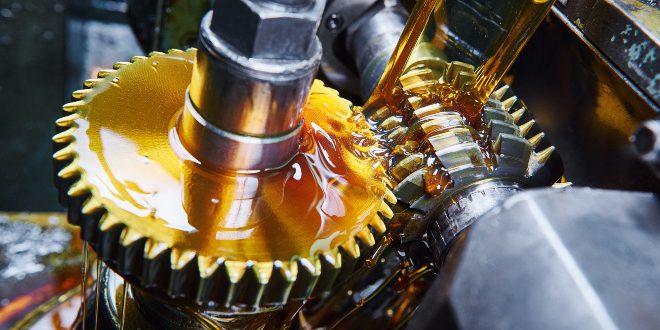
Hardly any device with moving parts can do without lubricants – from the simple hinge on a fridge door to a bicycle chain or the ball bearings in castors and wheels. But what exactly are greases and lubricating oils? Find out all about their chemical structure and why they reduce friction.
What are greases and lubricating oils?
The sheer variety of compositions and applications makes a single, all-encompassing definition of lubricating oil and grease impossible.
Lubricating oils are viscous, water-repellent (hydrophobic) liquids with a high boiling point. They lubricate hinges, ball bearings, shafts, chains and other moving machine components.
Greases are suspensions: mixtures of a liquid phase – a lubricating oil – and at least one solid phase. ASTM International (formerly the American Society for Testing and Materials) defines grease as a highly viscous dispersion of a thickener in a liquid lubricant.
Greases may also contain other additives that modify and fine-tune their properties. DIN 51825 describes greases as semi-solid lubricants made from mineral or synthetic oils and an added thickener.
Properties and structure of lubricating oils
The specific properties and composition of greases and lubricating oils vary widely.
By origin, lubricating oils fall into four types: vegetable oils, animal oils, mineral oils and synthetic oils, which include silicone oils. Most lubricating oils in use, however, are mineral (i.e. petroleum-based) or synthetic oils. Viscosity offers a further way to classify them.
Lubricating oils can also be classified by application: engine oils, chain oils and oils for precision instruments such as sewing machines or watches.
Properties such as viscosity, density, flash point, oxidation stability and wetting properties depend heavily on composition. The hydrocarbons in mineral oils, for example, interact with one another mainly through van der Waals forces arising from induced dipoles. The type and strength of these interactions depend on the chemical structure of the hydrocarbons.
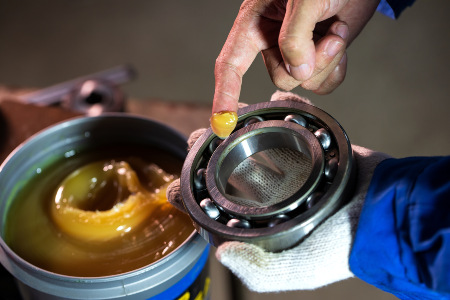
As a lubricating oil flows, lubricates and spreads, its molecules slide past one another. The stronger the intermolecular forces, the harder this becomes. Longer-chain hydrocarbon molecules attract each other more strongly than shorter-chain ones. Higher-viscosity lubricating oils therefore contain longer-chain hydrocarbons.
Paraffinic lubricating oil, which consists mainly of saturated open-chain hydrocarbons, has a low density, a high flash point and good oxidation stability, but only moderate wetting properties.
Olefinic mineral oil is a mixture of open-chain hydrocarbons with one or more double bonds. These oils have a medium density and flash point, as well as good oxidation stability and wetting properties. Aromatic lubricating oils contain ring-shaped aromatic hydrocarbons and have a high density and very good wetting properties. Compared with the other oils, however, they have a relatively low flash point and poor oxidation stability.
Properties and classification of greases
Put simply, greases are lubricating oils that a thickener prevents from flowing, so they can do their job exactly where they are needed. Importantly, the oil used as the base oil provides the actual lubrication. Greases contain 70 to 95% base oil, 3 to 30% thickener and 0 to 10% additives. The thickener turns the initially liquid oil into a highly viscous paste. Further additives and active ingredients can give the grease special properties, such as electrical conductivity.
The base oil determines the grease’s viscosity and temperature behaviour as well as its general performance and lubricating properties. Most greases use mineral or synthetic base oils; only a few use vegetable oils. Common synthetic base oils include polyalphaolefins, silicone oils such as polydimethylsiloxane, polyphenyl ethers, polyglycol oils and perfluoropolyether oils.
The thickener’s main task is to bind the base oil into a paste and give the grease its desired consistency. The oil stays in this matrix until movement and vibration – known as working – or temperature changes release it at the lubrication point.
Thickeners fall into two types: metal soaps and non-soap thickeners. Metal soaps include aluminium, barium, calcium, lithium and sodium soaps. They are metal salts of fatty acids. Their molecules have both a hydrophilic and a hydrophobic part, which allows them to bind the oil and release it gradually under external stress. Non-soap thickeners include bentonite (a clay composed of various clay minerals), polyureas, silica gel and polytetrafluoroethylene (PTFE).
Grease additives
Besides the base oil and thickener, greases can contain additives that give them extra properties. Antioxidants extend a grease’s service life by reducing the effects of oxidation and heat, which prevents the build-up of contaminating oxidation products. Corrosion inhibitors improve corrosion protection by forming a watertight protective film on the lubricated surface.
Other additives can improve adhesion or enable the grease to withstand particularly heavy shock loads. For the latter, manufacturers add solid lubricants such as polytetrafluoroethylene (PTFE), molybdenum disulphide (MoS2) or graphite. Greases with a solid lubricant content above 40% are also known as pastes.
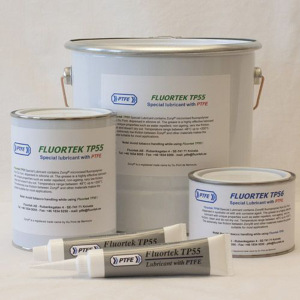
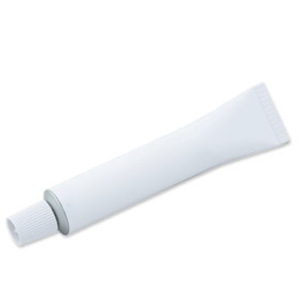
PTFE greases and PTFE pastes are high-performance lubricants for applications that require good sliding properties and high thermal and chemical resistance. They can be used at temperatures up to +260 °C and consist of equal parts of a base oil, such as silicone oil, and high-quality PTFE micropowder.
How greases and lubricating oils work
Lubricating oils and greases reduce mechanical wear wherever parts rub against each other. Moving metal parts should run smoothly, with as little friction as possible and without heating up significantly. Greases and lubricating oils help by dissipating heat and lowering the coefficient of friction.
The coefficient of friction is the ratio of the friction force to the normal force pressing two surfaces together. A film of lubricating oil reduces direct contact between the surfaces and therefore the friction between them. The coefficient of friction falls and the parts move more freely. Greases and lubricating oils work in the same way, because movement (working) releases the base oil from the grease. With their much lower viscosity, however, lubricating oils are better at carrying away heat and contaminants. Greases, on the other hand, adhere better and stay at the lubrication point thanks to their paste-like consistency and additives. They also seal off the lubrication point, protecting machine parts from corrosion and premature wear.
Applying greases and oils
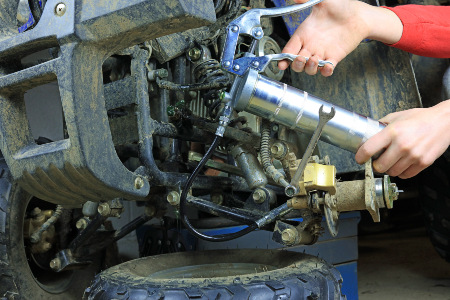
At home, relubricating small parts usually takes no more than a spatula and a few minutes. For applying greases and lubricating oils on an industrial scale, accessories such as drum pumps and grease guns are the better choice. Fitted with hoses, they deliver the lubricant exactly where it is needed and connect to existing grease nipples.
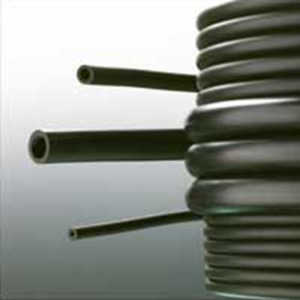
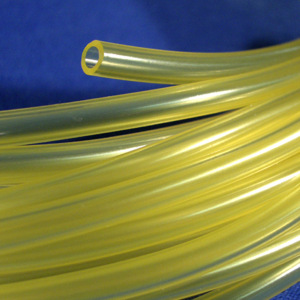
The right grease or oil hose depends above all on the composition of the lubricant. Elastic fuel hoses made of fluororubber (FPM) or nitrile rubber (NBR) also suit many greases and oils based on mineral or silicone oil. Rigid plastic hoses made of fluoropolymers such as polytetrafluoroethylene (PTFE) or perfluoroalkoxy polymers (PFA) offer almost universal chemical resistance and suit most lubricants. They are flexible but not elastic.
Image credits:
Featured image | © Kadmy – stock.adobe.com
Ball bearings with grease | © surakit – stock.adobe.com
Grease gun and hose | © dean – stock.adobe.com