 Reichelt Chemietechnik Magazine
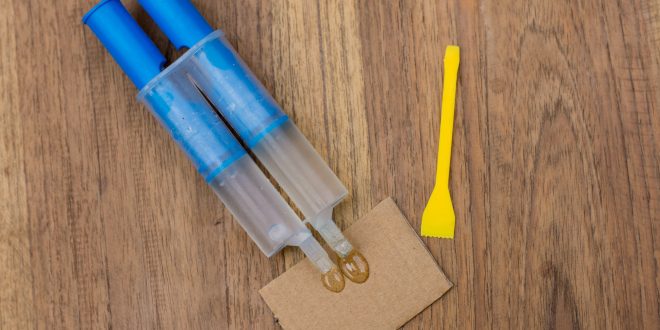
Epoxy Resin is a sought-after material used in industry, everyday life, and even in art. It is a synthetic resin which, when mixed with a hardener, forms a thermosetting plastic.
History
The first epoxy resin was developed in 1936 by the Swiss chemist Pierre Castan (1899–1985), with the goal of finding an alkali-resistant binder for coatings. It soon became clear, however, that these resins possessed many other valuable properties. His invention was patented seven years later, and in 1946 industrial production and continuous further development began.
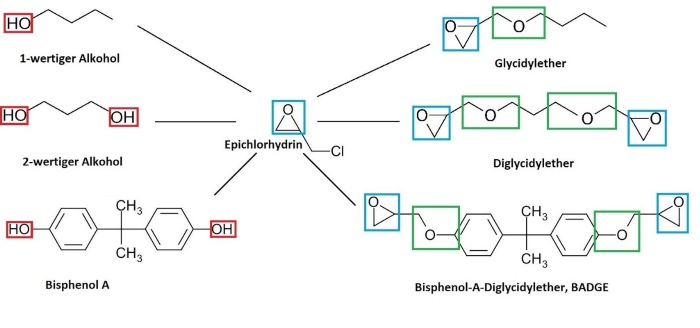
At the same time, the American chemist Sylvan Greenlee developed an epoxy resin by reacting epichlorohydrin with bisphenol A, the condensation product of phenol and acetone. This resin is still available today under the abbreviations DGEBA or BADGE for bisphenol-A–diglycidyl ether.
Production of Epoxy Resin
Epoxy resins are produced from organic compounds with hydroxyl groups (–OH groups) and 2-(chloromethyl)oxirane, also called epichlorohydrin. They contain epoxy groups – a three-membered ring consisting of one oxygen atom and two carbon atoms – and ether groups [(–O–)].
If monohydric alcohols – alcohols with only one hydroxyl group – are used for production, the reaction product contains one epoxy group and one ether group and is referred to as a glycidyl-based synthetic resin. If polyhydric alcohols with at least two hydroxyl groups are used, the result is a synthetic resin with at least two epoxy groups and at least two ether groups. This is called a diglycidyl ether. The best-known and most common representative of this group is bisphenol-A-diglycidyl ether.
The number of epoxy groups is important for determining the required amount of hardener that must be added to crosslink the resin. The epoxy value indicates how many grams of epoxy groups are contained in 100 g of resin.
These hardeners used are usually polyfunctional amines, compounds that contain at least two amino groups [(–NH2)].
This means that all functional groups – the epoxy groups of the resin and the amino groups of the hardener – must take part in the crosslinking reaction. If one component is added in excess, the result is a soft product with a sticky surface. The pot life, also called processing or working time, depends on the starting products, batch size, and processing temperature. It can range from a few minutes to several hours.
It should be noted that curing is an exothermic reaction, meaning that heat is released. For this reason, it is important to select the right resin for the specific application.
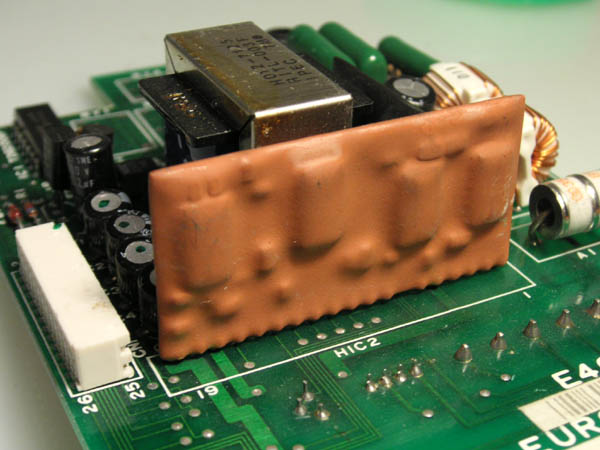
Epoxy resins are characterized by good electrical insulation, very high adhesion, low shrinkage, heat resistance, chemical resistance, corrosion resistance, and low moisture absorption. Their color ranges from clear to yellow. The properties can be modified by adding fillers, which opens up many different fields of application.
Epoxy Resin – a Versatile Adhesive
Unlike cyanoacrylate-based adhesives, commonly known as superglues or instant adhesives, which are one-component adhesives, epoxy resin adhesive is a two-component adhesive. Both components – resin and hardener – must be stored separately and only mixed shortly before use. For small quantities, the two-component adhesive is available in dual-syringe dispensers, ensuring the correct mixing ratio of resin to hardener. Epoxy resin adhesives are suitable for many applications.
While instant adhesives cure very quickly, the pot life of epoxy adhesives can range from several minutes to hours. During this time, the bonded parts can still be adjusted. Unlike instant adhesives, this adhesive can be sanded, painted, and drilled after curing.
Epoxy Resin as a Floor Coating
Compared to other floor coverings such as tiles or carpets, epoxy resin coatings have the advantage of being easier to apply. They do not need to be cut to size, which reduces labor time and prevents waste. They are waterproof, heat resistant, non-slip, and drivable. Due to these properties, they are widely used in industrial flooring, warehouses, and laboratories.
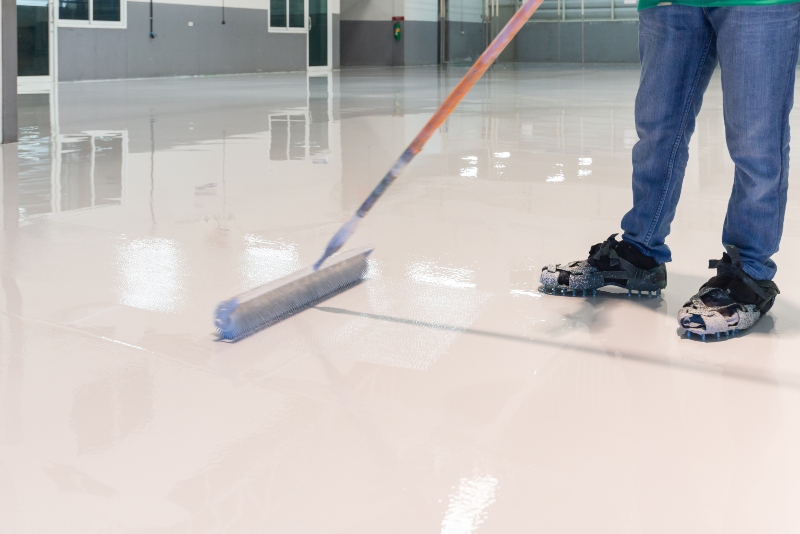
These types of coatings are also used in spaces subject to heavy foot traffic, such as gyms, hospitals, workshops, or department stores. In private settings, epoxy floors can be applied indoors and outdoors. In bathrooms, they provide reliable sealing and easy cleaning. Laminate and parquet floors with epoxy coating are easy to maintain and durable. Resins can also be colored, giving floor coverings a unique appearance.
Use in the Electrical Industry
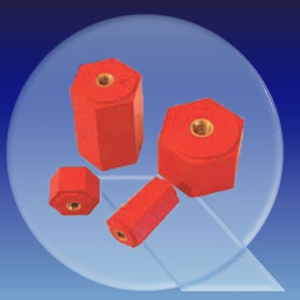
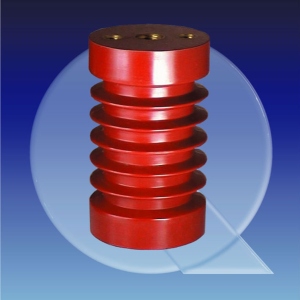
Due to their insulating properties, epoxy resins are widely used in the electrical industry. As casting resins, they are used in the production of components for electric motors, high-voltage bushings, insulators, and capacitors. As laminates, they form the base materials for printed circuits and circuit boards. And as molding compounds, they serve as insulators for encapsulating sensitive electronic components such as capacitors, collectors, resistors, and armatures. These materials are also used in connectors and commutators.
Use in Wind Turbines
Epoxy resins are used in wind power systems as coatings and in composites. Steel and concrete towers of wind turbines, as well as offshore turbine masts, are coated with this material.
This enables the use of longer rotor blades, which in turn increases energy output. In 1980, the maximum rotor diameter was still 17 meters, while in 2010 wind turbines with diameters of up to 100 meters were built. This means fewer turbines are needed to generate the same amount of energy.
Synthetic Resin in Aviation
Epoxy resin components also play an important role in aviation. Their use began in the 1970s in military aircraft. Initially, only secondary components such as tail unit shells were made from epoxy composites, but soon wings and fuselage parts followed. After becoming established in the military sector, these materials also entered civil aviation. They are used as corrosion-resistant coatings, structural components, and adhesives. By reducing weight, they help lower CO₂ emissions in air transport.
Sports and Leisure
A wide variety of sports equipment such as fishing rods, kayaks, pole vault poles, bows and arrows are made from epoxy resin. Skis, tennis, golf, and hockey equipment also incorporate these resins. They make products lighter, more durable, more reliable, and more resistant to wear than in the past. In addition, because of its outstanding adhesion and strength, low shrinkage, and water resistance, epoxy resin is ideal for boat and shipbuilding, where it is used, for example, as a protective underwater coating.
They are used in the repair of damaged polyester boats as well as in the restoration of historic wooden ships.
Synthetic Resin in Art
The first resins were highly viscous and yellowed quickly, which made them unsuitable for certain applications in glass art and restoration. Today, resins with UV filters are available and can be mixed with color pigments or additives such as glitter particles. Artworks, jewelry, and decorative items are also created using this material.
Service Life and Recycling
Epoxy resins are versatile plastics used in many industrial and consumer goods. Their long service life and reduced energy consumption due to lower weight contribute to sustainability. However, recycling resin products is difficult due to their highly cross-linked structure and remains in its early stages. In addition to incineration in waste-to-energy plants, cement kilns, or steel foundries, epoxy-based products are ground and used as fillers.
Image sources:
Cover image | © Jakkapong – stock.adobe.com
Epoxy resin as floor coating | © bhakpong – stock.adobe.com