 Reichelt Chemietechnik Magazine
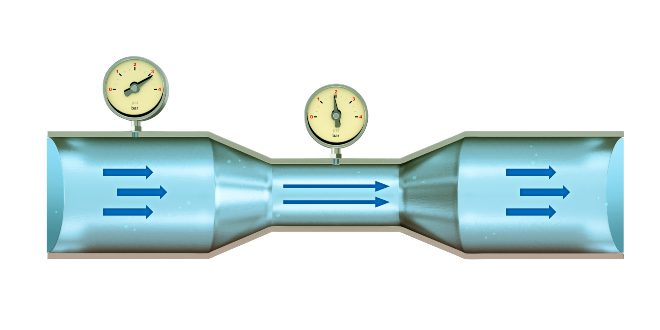
Some physical effects influence everyday life without people being aware of them. At the same time, their value for industry and technology is immense – as in the case of the Venturi effect, which is used in many suction pumps and pneumatic atomisers. But what is behind this flow phenomenon? Which technical applications exist, how does it enrich everyday life, and which innovative fields of application are available?
The Venturi Effect Simply Explained
The Venturi effect is named after the Italian physicist Giovanni Battista Venturi (1746–1822), who studied this phenomenon in the 18th century.
Good to know: The Venturi effect is a special case of flow in a narrowed pipe. The general relationship between pressure, flow velocity, and height, however, is described by the Bernoulli equation, which was also formulated in the 18th century by the Swiss mathematicians Daniel Bernoulli (1700–1782) and Johann Bernoulli (1667–1748). The Bernoulli equation defines a fundamental relationship between different velocity and pressure ranges in a one-dimensional system such as a pipe.
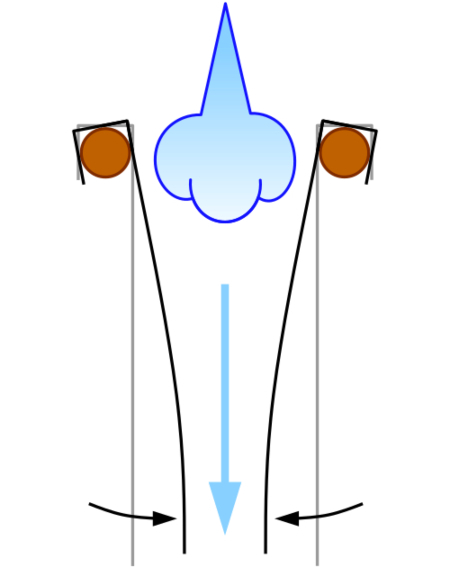
The equation describes flow phenomena that may appear contradictory. For example, the Bernoulli effect can be illustrated using two sheets of paper hanging parallel to each other. If an air stream is blown between the sheets (see Figure 1), the velocity between the sheets of paper increases and the decreasing pressure pushes them together.
Technical Applications of the Bernoulli Equation and Venturi Effect
In fact, the Bernoulli equation and the Venturi effect[1] are encountered very frequently both in everyday life and in many technical applications. The following examples illustrate how the effect is harnessed in four common types of Venturi device.
Venturi Tube for Precise Flow Measurement
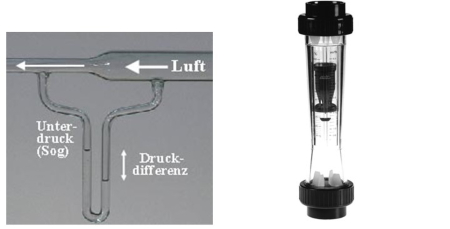
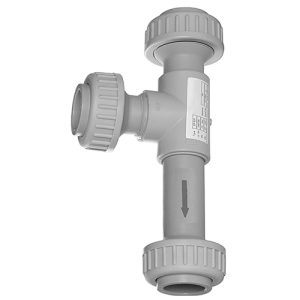
For example, the Venturi tube is used, among other things, for the precise flow measurement of fluids (liquids or gases). At the narrowest point of the tube, the flow velocity of the fluid increases, while the static pressure decreases. A pressure gauge measures the pressure difference between the normal and narrowed sections. In combination with the known density of the medium and the cross-sectional areas of the tube sections, the flow velocity can be calculated. The principle of Venturi flow measurement and an example of such flow measurement systems are shown in Figure 2.[2] These devices are connected via hoses or pipe systems to which suitable hose connectors and pipe connectors can be adapted.
Venturi Nozzle for Mixing and Spraying Media
Another technical application is the Venturi nozzle. In contrast to the Venturi tube, the cross-sectional constriction is much more pronounced, resulting in a stronger pressure drop and a very high flow velocity. Here, too, the operating principle of the Venturi nozzle can be easily explained using the Bernoulli equation, while the Venturi effect can be clearly illustrated: the air flow at a conical constriction increases in velocity, creating negative pressure. This can be used to mix additional media, such as chemicals and water, with the air flow and, for example, to spray them.[2]
One example is air amplifiers, which generate a high-velocity air stream from a small amount of compressed air. This air stream is used for cleaning or drying surfaces, for example those of plates, foils, and other semi-finished products.[3]
Venturi Valve and Water Jet Pump in the Laboratory
The Venturi valve is also based on the fundamental Bernoulli equation. This valve requires no moving parts and is therefore cost-effective and low-maintenance, while still allowing the flow rate to be precisely controlled. Last but not least, the Venturi effect is applied in the Venturi pump. The simplest version is the water jet pump, which is frequently used in the laboratory.
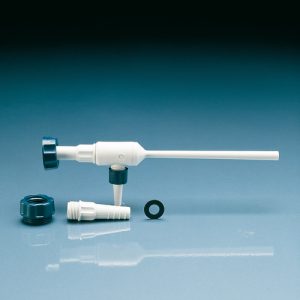
In this case, a strong water flow is directed through the water jet pump screwed onto a tap. A lateral opening is then connected to a suction flask. The water flow at the constriction generates negative pressure at the lateral opening and therefore a suction effect. This can be used, for example, to dewater filters together with the filter cake, which is a typical laboratory task.[4]
Venturi Vacuum Pump for Vacuum Gripping
A more complex application is the Venturi vacuum pump. The air flow is guided through a sharply constricted nozzle, which draws in ambient air as it exits and conveys it further into the mixing chamber. The continuous intake of surrounding air into the pump generates a vacuum. Such systems are highly suitable for a wide range of vacuum gripping applications – for example with suction cups.[5]
Bernoulli Equation and Innovation
This article shows the diverse applications of the Bernoulli equation and the Venturi effect in both private and industrial everyday life.
Here, façades have openings that enable optimum air circulation. The air flowing through them is accelerated, creating suction and thus a cooling effect on the building envelope.[6]
Another innovative idea comes from South Korea, which consists largely of mountainous terrain. Numerous tunnel systems run through the mountain landscape – unfortunately also associated with accidents that can lead to fires in tunnels and heavy smoke generation. Conventional tunnel ventilation systems with smoke extraction fans are often not efficient enough. This is where the Venturi effect comes into play: special nozzle inlets significantly amplify the air flow, resulting in much faster tunnel ventilation and potentially saving lives.[7]
The latest creative application of the flow phenomenon comes from wind technology. In recent years, triboelectric nanogenerators have been developed. Triboelectric means that materials become electrically charged, for example through wind-induced friction. Wind energy can therefore be converted into electrical energy. The efficiency of such generators is based on the Bernoulli equation: the significantly increased velocity of the wind flow in such a system due to the Venturi effect increases friction and thus leads to efficient energy conversion.[8]
As a result, the Venturi effect and the underlying Bernoulli principle continue to make a relevant contribution to sustainability, innovation, and social progress even 200 years after their discovery. At the same time, this flow phenomenon is so versatile that further innovations will certainly emerge in the coming years for both industry and domestic settings.
Sources:
[1] https://de.wikipedia.org/wiki/Bernoulli-Gleichung, accessed: 16 April 2025.
[2] https://de.wikipedia.org/wiki/Venturi-D%C3%BCse, accessed: 16 April 2025.
[3] https://www.primairo.de/luftduesen/luftstromverstaerker/?gad_source=1&gclid=EAIaIQobChMIxo67hufbjAMVP5iDBx1PxSNuEAAYASAAEgIqq_D_BwE, accessed: 16 April 2025.
[4] https://de.wikipedia.org/wiki/Wasserstrahlpumpe, accessed: 16 April 2025.
[5] https://www.coval-germany.com/Vakuumtechnik/Leitfaden-f%C3%BCr-das-Greifen-mit-Vakuum/Verfahren-zur-Vakuumerzeugung/, accessed: 16 April 2025.
[6] https://www.baunetzwissen.de/nachhaltig-bauen/fachwissen/gebaeudetechnik/natuerliche-kuehlung-von-gebaeuden-9653573, accessed: 16 April 2025.
[7] S. B. Hong, H. S. Yun and M. K. Cho, "Application of the Bernoulli Effect for Improving Smoke Exhaust Efficiency in Tunnel Fires," in IEEE Access, vol. 11, pp. 107685-107702, 2023, doi: 10.1109/ACCESS.2023.3318864
[8] Chen, Xin et al. Cell Reports Physical Science, Volume 1, Issue 9, 100207
Image Sources:
Featured image | © Andrea Danti – stock.adobe.com
Figure 1: Experimental model for the Bernoulli equation | © Pedalito, CC0, via Wikimedia Commons
Figure 2: Application of the Venturi effect for flow measurement (figure on the left) | © Geof 17:05, 17 Sep 2004 (CEST), CC BY-SA 3.0 <http://creativecommons.org/licenses/by-sa/3.0/>, via Wikimedia Commons
Figure 2: Example system for measuring gas flow (figure on the right) | © RCT Reichelt Chemietechnik