 Reichelt Chemietechnik Magazine

The “Archimedean screw,” invented by the ancient mathematician and engineer Archimedes of Syracuse (c. 287–212 BC) and named after him, was used for irrigating fields and can be regarded as the first thread in human history. However, not all threads are the same. Different materials and sometimes cryptic designations make it difficult to gain an overview. The following article briefly outlines the more recent history of threads and the many areas where glass threads are used today.
The Thread and the Introduction of Standardization
At the end of the 17th century, the production of screws and nuts began in the town of Velbert, located about 20 km northeast of Düsseldorf in Germany. Threaded fastening proved far more secure for mounting on wooden substructures than simple nailing, and it also enabled assembly on metal bases in the first place.
Although fundamental knowledge about threads spread quickly, screws and nuts produced by different manufacturers were generally not interchangeable. Their dimensions were tailored to specific applications, meaning that almost every piece was effectively unique.
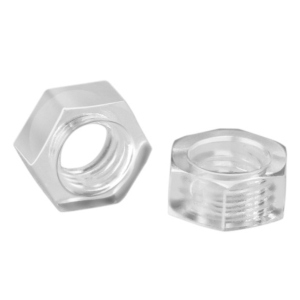
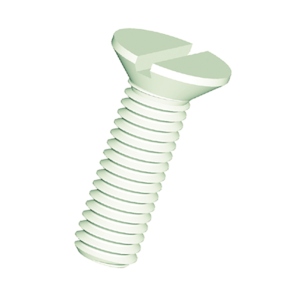
It was not until the mid-19th century that the English engineer Sir Joseph Whitworth (1809–1887) proposed standardizing different thread types according to defined parameters to ensure uniform use. The standardized Whitworth threads named after him quickly became established throughout Europe. Their characteristic dimensions were specified in imperial units, which is why Whitworth threads are also referred to as “inch threads.” Today, however, the metric system has largely prevailed for thread sizes.
… and the Glass Thread
Glass production has a long tradition dating back to antiquity. With the development of the chemical industry in the mid-19th century, demand grew for laboratory glassware that could be assembled from standardized components.
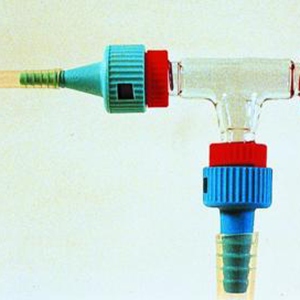
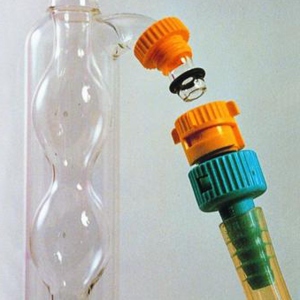
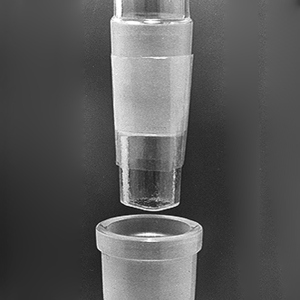
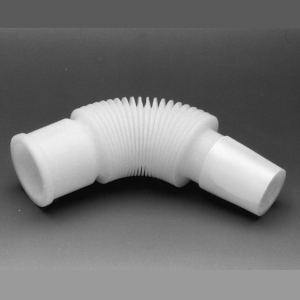
In addition to two-part ball and flat joints, paired conical ground joints are now among the most commonly used connections. They enable tight and even vacuum-resistant plug-in connections between glass components, allowing the straightforward assembly of larger systems. In more recent times, threaded connections using glass threads have also become successfully established in chemical laboratories.
Because their production is significantly less complex than that of ground joints, the manufacture of specialty glass components with glass threads has experienced a real boom over the past 50 years, driven by companies such as SCHOTT AG (Mainz, Germany), Normag Labor- und Prozesstechnik GmbH (Thuringia, Germany), and Corning Inc. (USA).
Nevertheless, none of these manufacturers could market their products successfully if the glass threads of one producer were not compatible with those of another.
Classification of Threads
It was not until the 1960s that, in addition to the existing imperial system, the metric system, which had developed alongside industrialization, was incorporated into ISO standards for mechanical fasteners. This 1963 standardization was later superseded in 1996 by ISO 1502 and the corresponding German standards DIN 13 and DIN 14, which defined what is known as the “metric ISO thread.”
Despite differing units of measurement, all threads – whether made of metal or glass – share many similarities.
A distinction is made between internal and external threads, as well as between right-hand and left-hand threads, designated RH and LH. The majority are right-hand threads (RH). Further identification regardless of material (metal, plastic, or glass) is provided by letters, numbers, and the so-called double prime (″), indicating inches. But what do these abbreviations mean?
The G 1/2″ Thread
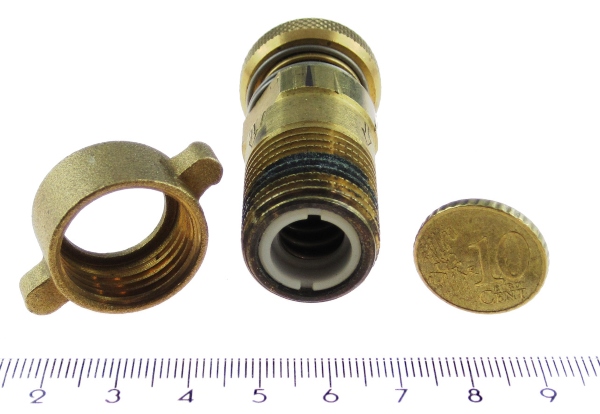
The letter G stands for BSP (British Standard Pipe), an imperial Whitworth pipe thread. The fraction 1/2 indicates the nominal size in inches, while the superscript double prime symbol (″) denotes the unit “inch.” In this example, it is therefore a half-inch Whitworth pipe thread. Due to its cylindrical design, this thread type is not self-sealing.
The GL 14 Thread
The abbreviation GL stands for a round thread according to German standard DIN 168. The number following it, here 14, indicates the outer diameter of the thread in millimeters. In this case, external and internal threads differ in their flank angles. The flank angle, also known as the thread profile angle, describes the angle between the thread flanks. For external threads, it is 60°, while for internal threads it is 30°. Glass threads with the GL designation fall into this category.
The GL Glass Thread
Round glass threads (GL) according to German standard DIN 168, which replaced the earlier German standard DIN 40450, feature rounded rather than sharp thread flanks. This offers decisive advantages both in manufacturing and in function. On the one hand, this thread type can be easily produced by molding molten glass. On the other hand, due to its relatively large pitch and broad flanks, it provides comparatively high load-bearing and tensile strength.
Compared to other thread types, the rounded geometry of glass threads results in more resilient thread clearance, improved resistance to contamination, and reduced sensitivity to mechanical damage.
Glass Threads and Their Advantages …
A key advantage of glass threads lies in the material itself. Glass is easy to clean and can be sterilized using all common methods where required.
Glass thread connections are easily detachable screw fittings and, unlike ground joints, do not require grease for sealing. Grinding grease can cause contamination and may harden under the influence of temperature and chemicals, making especially conical ground joints difficult or even impossible to separate. Ground joints, however, are highly vacuum-resistant – a performance level that threaded connections cannot achieve.
The “classic” glass thread connection requires plastic screw caps on both sides and an elastic compression ring that ensures sealing. Proven materials for the caps include acetal resin (POM), polyether ether ketone (PEEK), and polybutylene terephthalate (PBT), often reinforced with glass fibers. For sealing elements, chemically resistant plastics are required, frequently polytetrafluoroethylene (PTFE) or other fluoropolymers. In this respect, glass thread connections resemble the conical sealing connectors known from liquid chromatography, such as ferrules.
Applications of Glass Threads
The simple production technologies required for glass threads have opened up a wide range of applications – not only in laboratories.
In laboratory engineering, they are widely used to connect components into more complex glass assemblies, where they can replace rigid and therefore failure-prone conical ground joints. In addition, glass threads with plastic screw caps have proven effective for glass laboratory bottles used for transporting or storing solutions and solvents, which previously had to be sealed exclusively with ground stoppers.
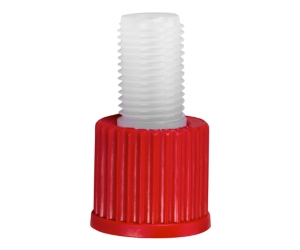
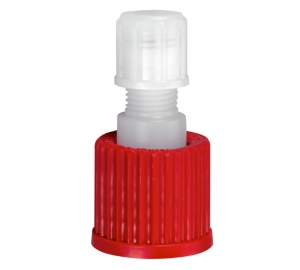
Pharmaceutical vials and flacons, and above all the countless glass bottles and containers used in households, are also equipped with glass threads, allowing them to be resealed repeatedly with screw caps. These applications likely represent the largest field of use for glass threads, which have even become established in wine bottles.

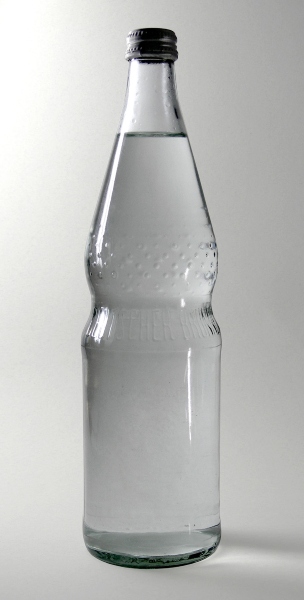
Glass threads with screw caps and plastic sealing inserts can even withstand slight internal pressure. A well-known example is the standardized 0.7-liter reusable mineral water bottle introduced in Germany in 1967. According to manufacturers, it can be cleaned and reused up to fifty times and is fully recyclable at the end of its service life.
It is marketed with lightweight metal screw caps or, increasingly, with the distinctive blue caps made of acetal resin (POM-C). However, the almost identical single-use PET bottle appears to be gaining ground, likely because it is significantly lighter than the reusable glass bottle.
Image Sources:
Standard mineral water bottle | © Rainer Zenz – de.wikipedia.org
Whitworth pipe thread | © Abrev – commons.wikimedia.org