 Reichelt Chemietechnik Magazine
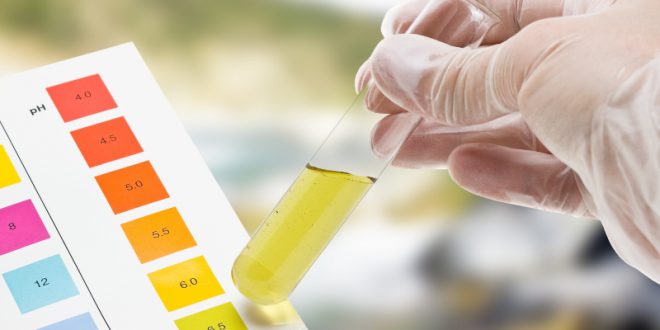
Acids and bases matter far beyond the laboratory and the chemical industry. In many other fields, the acidic or basic nature of aqueous solutions and mixtures shapes our everyday world. The pH value measures how acidic or basic an aqueous solution is. Here is everything worth knowing about pH measurement in the laboratory.
What Is the pH Value?
The pH value is a unit of measurement defined in 1909 by the Danish chemist Søren Sørensen (1868–1939). It describes whether an aqueous solution is acidic or basic. The value reflects the concentration of hydrogen ions (H+), or oxonium ions (H3O+), in the solution. These ions arise from the self-dissociation of water:
H2O ⇆ H+ + OH–
2 H2O ⇆ H3O+ + OH–
In pure water, only a tiny fraction of the molecules dissociate. The equilibrium lies far to the left. The pH value derives from the exponent of the H+ ion concentration:
pH = – log10 c [H+]
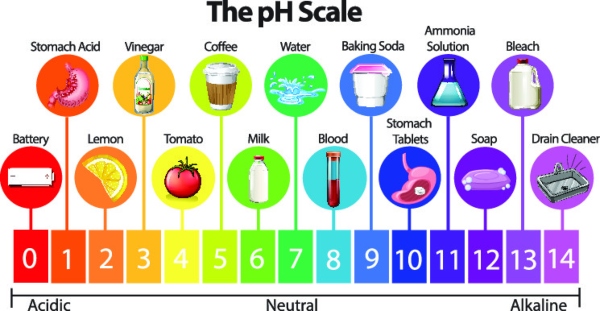
For pure water, this value is pH 7. It marks the neutral point on the pH scale, which runs from 0 to 14.

The pH scale runs from 0 for strongly acidic solutions to 14 for strongly alkaline ones. One-molar hydrochloric acid (36.5 g HCl/L), for example, has a pH of 0. One-molar sodium hydroxide solution (40 g NaOH/L) reaches pH 14. Our skin, by contrast, sits at around pH 5.5. Classic soaps range from pH 9 to 10. Distilled water almost always stays below pH 7, because it absorbs carbon dioxide from the air.
Simple Methods of pH Measurement
Several methods exist for measuring the pH value. Colour indicators offer a quick but less precise option. These are water-soluble organic dyes whose colour depends on the pH of the solution. They allow a colorimetric estimate of the pH value.
Several colour indicators are well known. Litmus is a natural dye extracted from lichens. It turns red in acidic solutions and blue in alkaline ones. Methyl orange, an azo dye, shifts from red to yellow as the pH rises. Phenol red, in turn, moves from yellow through red to violet as the pH rises. This non-toxic triphenylmethane dye is therefore also common for pH measurement in swimming pools and spas.
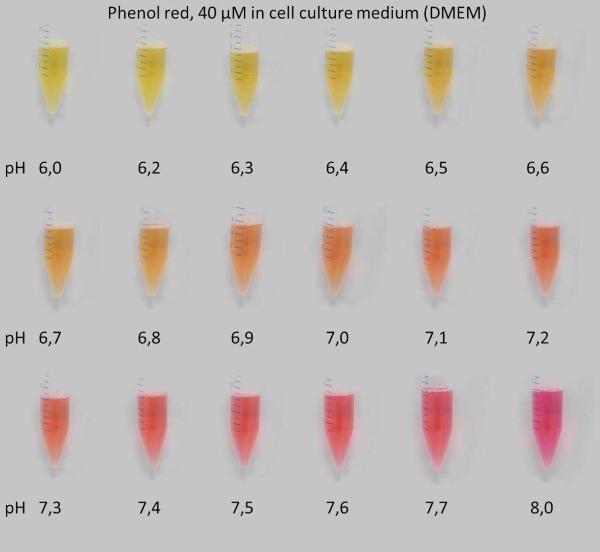
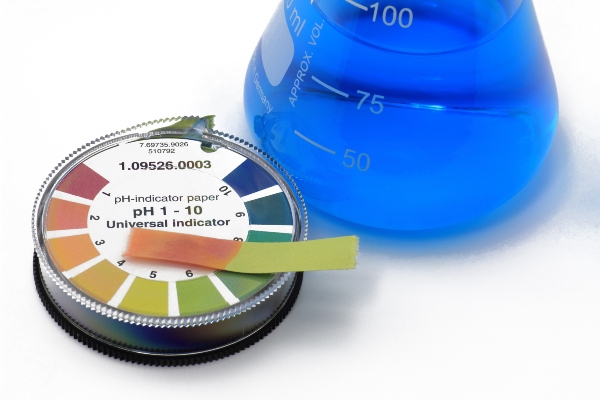
The so-called “universal pH indicator” combines several dyes. It changes from red to deep blue across the full range from pH 1 to pH 14. Filter-paper strips soaked in this dye mixture form “pH paper”. You dip a strip into the sample and compare it against a reference colour chart. This gives a rough estimate of the pH value. For more accurate results, a photometer evaluates the colours in solution against standards with known pH values.
Electrochemical pH Measurement
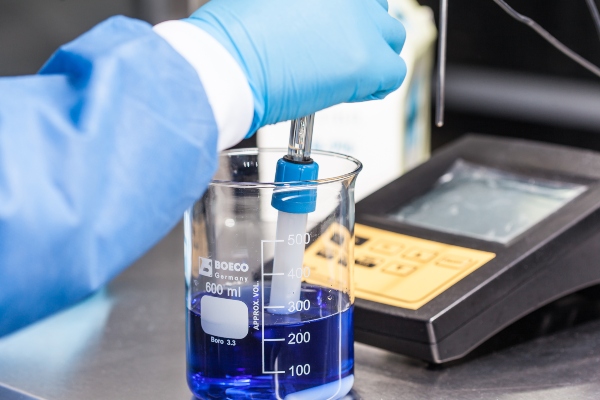
Precise, continuous or automatic measurements rely on potentiometric methods. These methods use a pH measuring chain built from two half-cells. The first half-cell is a glass-membrane electrode, or glass electrode for short. It dips into the solution being measured.
Hydrogen ions then accumulate on the surface of the silicate glass. This builds an electrical potential that depends on the H+ concentration. A reference half-cell provides the comparison potential. It is usually a silver/silver chloride (Ag/AgCl) or a mercury/mercury chloride (calomel, Hg2Cl2) half-cell. A conductive salt bridge links the two half-cells, and the resulting voltage is measured.
According to the Nernst equation, this produces a linear signal at +25 °C (77 °F). Between pH 0 and pH 14, the theoretical slope is -59 mV per pH unit. Today, both half-cells usually sit in a single combination electrode. This makes electrochemical pH measurement in the laboratory very straightforward.
pH Electrodes for Special Applications
The glass electrode is not the only option. For special applications, pH electrodes also use antimony (Sb) or bismuth (Bi). Antimony and bismuth electrodes suit low pH values in chemically aggressive solutions, such as hydrofluoric acid. The glass membrane has a very high electrical resistance. Its signal therefore needs a pH meter to read it. A pH meter is a voltmeter with a very high input resistance above 1012 Ω.
Ion-sensitive field-effect transistors (ISFETs) work in a similar way to glass electrodes. pH meters based on them are robust in daily use. However, their sensors have a shorter service life than glass electrodes. Their readings also often differ markedly from glass-electrode values. ISFETs therefore mainly serve overview and routine measurements. Typical fields include the food and beverage industry and medical or biological laboratories.
Measurement Accuracy of the pH Electrode
The accuracy of a pH electrode depends on the medium and on the conditions at the measuring site. You therefore need to choose the right electrode type for each task. Stable temperature, pressure and flow conditions are equally important.
Under real conditions, electrodes never reach the theoretical slope of -59 mV per pH unit. This slope also declines further as the electrode ages. You should therefore check pH meters regularly with calibrated buffer solutions. Adjust them whenever the readings call for it.
In the simplest case, a single-point calibration uses one buffer near the target pH value. Meters that must stay accurate across a wider range need two- or three-point calibration. These calibrations rely on buffer solutions with pH values between 4 and 10.
Maintenance and Care of pH Electrodes
Repeated use or continuous operation makes pH electrodes age. How fast they age depends on the operating conditions. “Chemical” wear is a common cause. It occurs when components leach from the sensitive glass layer. Contamination can also play a role, for example through a build-up of foreign ions or deposits.
Ageing shows up in several ways. Signals may fluctuate strongly, the slope may fall, or the display may drift noticeably. A drifting display often points to electrolyte loss in the reference electrode. Changing the electrolyte or replacing the electrode usually fixes this. Sudden or rapidly shifting readings suggest a different problem. They point to an electrical fault in the signal processing. Electromagnetic fields are a frequent cause. Nearby electrically powered machines often generate them.
Regular calibration reveals unacceptable deviations early. Often, though, simply rinsing the electrode with warm water is enough. Vinegar, citric acid or dilute hydrochloric acid removes many deposits well. With glass electrodes, you must protect the delicate glass membrane during cleaning. Never clean it mechanically. Use only deionised or distilled water.
And When the Electrode Is Not in Use…
When not in use, pH electrodes should not stay connected to the meter. Metal electrodes, such as antimony and bismuth types, are easy to store. You simply keep them dry after cleaning. Electrolyte-filled electrodes, such as calomel electrodes, can also sit dry for longer periods after cleaning. This works only if you can rule out electrolyte loss from drying out.
Glass electrodes and combination electrodes, by contrast, always need an electrolyte solution. A one-molar potassium chloride solution (KCl) works well and keeps them functional. After all, accurate pH measurement is essential for much of the work in a chemical laboratory.