 Reichelt Chemietechnik Magazine
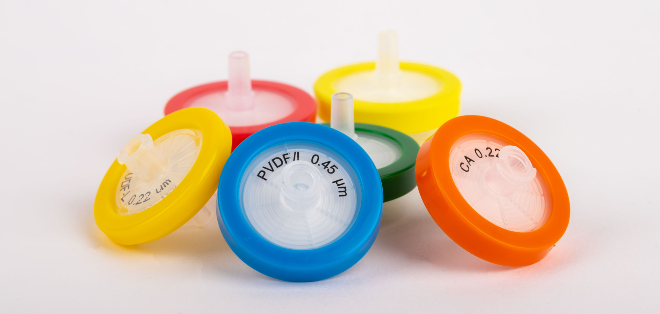
Many industries rely on filtration as a key separation technique. When particles and substances are removed from liquids and gases using a membrane, membrane filtration comes into its own. Depending on pore size, it works through its variants: microfiltration, ultrafiltration and nanofiltration. This article sets out the benefits for users, along with the limiting aspects of the technology.
Filtration occurs everywhere in nature. Water is purified as it passes through various layers of rock, which is why a spring can yield very clean drinking water. Natural soil layers such as sand, gravel and clay act as filters in the ground. Microorganisms do the same, helping to treat our drinking water.
How Membrane Filtration Works
In engineering, filtration is an umbrella term for numerous processes. In chemical engineering, microfiltration, ultrafiltration, nanofiltration and reverse osmosis are particularly relevant. Collectively, these techniques are known as membrane filtration. The method was invented in 1916 by the German chemists Richard Zsigmondy (1865–1929) and Wilhelm Bachmann (1885–1933).
As a result, some particles are retained in the retentate. Water and the remaining substances pass through the membrane to form the permeate. Membrane technology is used above all in fields such as chemistry, biology, environmental engineering, the food industry and pharmaceuticals.
In membrane filtration, a membrane separates two spaces or substances and selects materials by specific properties. This requires a driving force. That force is the pressure difference between inlet and outlet, which can range from 0.1 to 10 bar. It pushes the medium through the filter. The term flow describes how fast the medium moves through the filter membrane. A controlled flow is crucial for separating substances effectively without damaging the membrane.
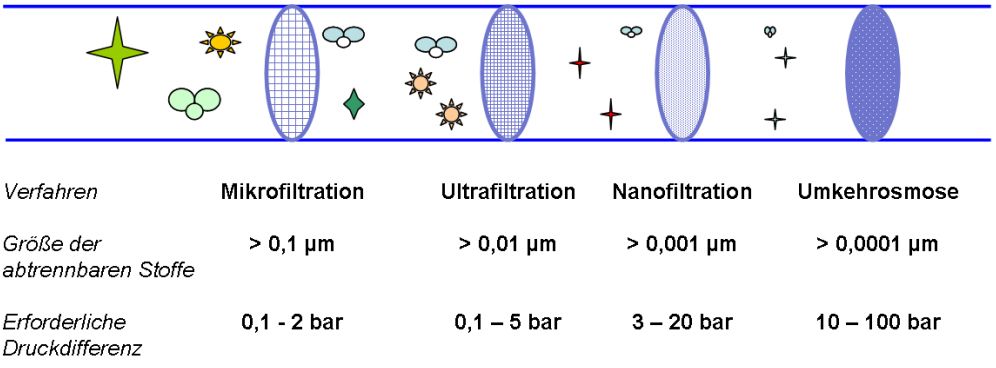
Membrane Filtration Pore Sizes and Filter Materials
Membrane filtration techniques differ in the pore size of the filter membrane used.
Pore size varies between:
- < 1 nm (nanofiltration)
- 0.001 to 0.1 µm (ultrafiltration)
- >0.1 µm (microfiltration)
The pore size determines which substances the filter membrane can retain. In this sense, membrane filters resemble a filter cloth, which holds back substances of a certain grain size depending on its cloth width.
A key advantage of membrane filtration is fractionation. Several successive filtration steps recover multiple fractions of the retentate, each containing particles of a particular size. Cellulose nitrate and cellulose acetate are the classic membrane materials, especially for membrane filter discs.
Other formats serve different filtration techniques, including filter housings, filters in centrifuge tubes or membrane cartridges, and pre-filters and filter holders. These are made from borosilicate glass, (sintered) plastics and other materials.
Microfiltration
In microfiltration, the membrane filters usually have a pore diameter of 0.1 to 10 µm. The process is used in the food sector, pharmaceuticals, the oil and gas industry and water purification, for example. Microfiltration mostly serves to clarify liquids by filtering out coarser particles and suspended solids. This includes turbidity that would otherwise render a product unusable. Bacteria, algae and other living components can also be separated from the medium. Microfiltration can therefore decontaminate a medium as well.
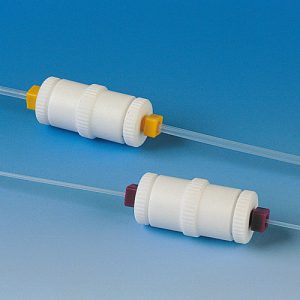
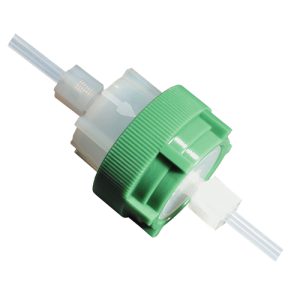
Perhaps the most important application of microfiltration is treating drinking water sources. The membranes are crucial for the primary disinfection of drinking water, which may contain pathogens. A key benefit is that pathogens cannot build up resistance, unlike with traditional disinfectants such as chlorine. Clarification and disinfection thus happen in a single step, which helps cut costs.
Microfiltration also improves on classic sterilisation, as there is no risk of heat degrading product quality. The pharmaceutical and food industries make particular use of this benefit. In dairy processing, microfiltration first removes fungal spores and bacteria before the milk is pasteurised. Because no heat is involved, decontamination by microfiltration is also called cold sterilisation. Membrane filtration is therefore an essential part of microbiology too.
Ultrafiltration
Ultrafiltration membrane filters have a pore diameter of 0.001 to 0.1 µm and can retain proteins, endotoxins, viruses and silicates. Ultrafiltration follows the same principle as microfiltration and differs only in pore size. It is indispensable in medicine, biotechnology and the preparation of analytical methods such as liquid chromatography.
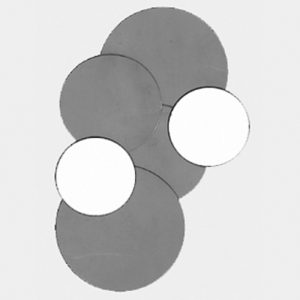

In haemodialysis, blood is “filtered” by diffusion across a semipermeable membrane, which acts as the filter. It retains proteins and blood cells, while small molecules such as water, electrolytes and urinary waste products diffuse freely. A concentration gradient between the dialysis fluid and the blood purifies the blood. The two fluids flow past each other in a countercurrent arrangement.
Traditionally, haemodialysis is a two-stage process: a pre-treatment followed by ultrafiltration of the blood. More modern applications use hollow-fibre bundles with a highly porous, bioactive surface for single-stage microdialysis, which cleans the blood.
Nanofiltration
Nanofiltration uses filter materials with pore sizes in the nanometre range. These pores are small enough to selectively separate dissolved ions, organic compounds and certain molecules. In water treatment, for example, this makes it possible to remove excess salts and so adjust water hardness. The pharmaceutical industry uses nanofiltration to separate chemicals and control the purity of manufactured products.
What Are the Limitations of Membrane Filtration?
A filter cake often forms here, particularly with heavily contaminated liquids, a process known as fouling. As a result, microfiltration can effectively turn into ultrafiltration, an effect known as the pinch effect.
For this reason, dead-end filtration tends to be used in smaller laboratory applications. Industrial processes instead use the more energy-intensive cross-flow filtration, also called tangential flow filtration. Here the suspension flows parallel to the membrane surface, which removes contaminants. At the same time, this prevents a filter cake from forming. The membrane surface can therefore be cleaned efficiently.
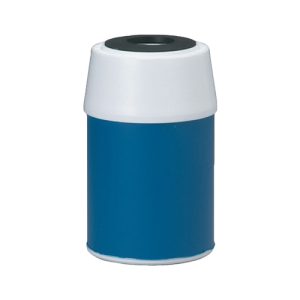
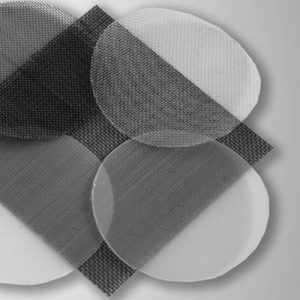
One direct way to avoid filter cake formation, and the associated pinch effect in dead-end filtration, is multi-stage filtration using membrane filters of different pore sizes. A multi-stage process also offers the advantage of fractionation, which in turn allows the filtered substances to be recovered. The choice of technique should therefore depend on the specific application.
Membrane filtration is also limited in the selectivity of the substances it can filter, as certain substances may not be retained completely. Fractionating molecules of similar size cannot be reliably guaranteed either. Non-mechanical methods therefore exist to supplement it. A membrane may be selectively permeable to particular ions, for example, or chemically affine to certain molecules. One example is adsorption filters with activated carbon granules, which filter only the adsorbable components out of a liquid.
Membrane Filtration and Other Separation Methods
Although membrane filtration has an extremely broad range of applications, it is always worth checking which other separation methods are available and could serve the purpose at hand. In environmental analysis, membrane filtration is better understood as a preliminary step before chromatography. Meaningful environmental analyses require a suspension to be separated in a chromatography column.
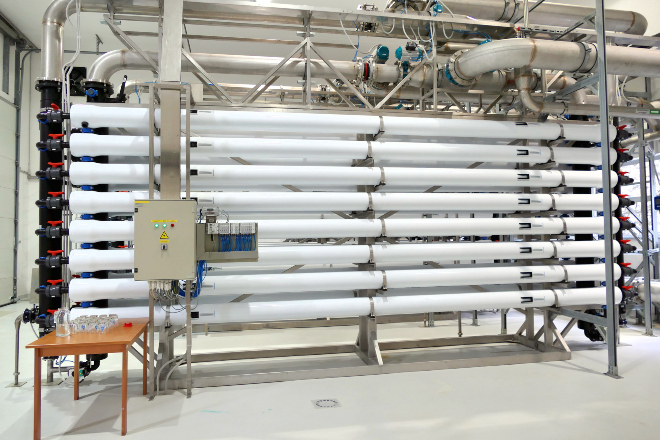
Membrane filtration can be used to treat wastewater. In some remote regions, ultrafiltration is already the sole solution for water treatment. On the large scale of a treatment plant, however, separation methods such as flotation and sedimentation remain in use, as they are far less energy-intensive and easier to operate. Membrane filtration can optionally be added at a treatment plant to further improve the quality or composition of the purified water.
Environmental Aspects
By capturing particles in a filter, environmental analyses can be carried out on a filtered suspension. The components in the retentate are recorded and analysed. This shows how heavily a sample is contaminated with environmentally relevant substances and organisms. Membrane filtration can therefore be an essential part of an environmental assessment.
Cross-flow filtration can produce concentrated contaminants. The concentrated waste streams it generates must be disposed of properly, or they would pollute the environment. This can also lead to environmental requirements and additional costs. Because cross-flow filtration is particularly energy-intensive, the method with the lowest resource consumption should be used where possible, or avoided altogether. Overall, though, membrane filtration is a rightly established process: reliable and versatile.
Image sources:
Feature image | © ydfotograf – stock.adobe.com
Overview of various pressure-driven membrane filtration processes | © Authorship was not provided in machine-readable form. Lotron is assumed to be the author (based on the copyright holder details)., CC BY-SA 3.0 <http://creativecommons.org/licenses/by-sa/3.0/>, via Wikimedia Commons
Water ultrafiltration plant | © ommbeu – stock.adobe.com