 Reichelt Chemietechnik Magazine
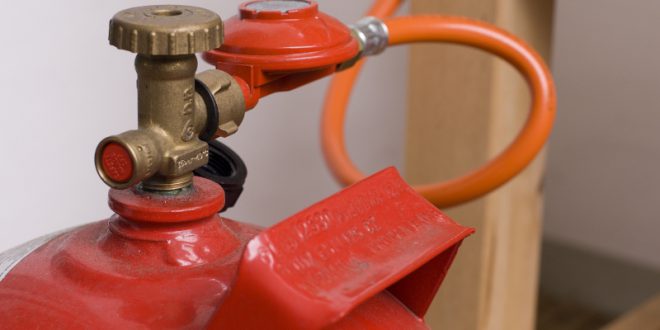
Technical gases reach end users via various routes. Natural gas for energy supply or process gases for the chemical industry are highly compressed and transported over long distances through pipelines and piping systems, or shipped in liquefied form in large tanks by sea. On the road, technical gases are delivered to consumers as hazardous goods in pressurized gas cylinders. They are typically supplied via distribution systems and fixed piping to the respective points of use in laboratories and pilot plants, where they are required as purge gases, carrier gases, or reaction media.
For on-site gas withdrawal from a permanently installed distribution system or from a compressed gas cylinder brought in from storage, flexible, gas-tight hoses made of elastomers are generally preferred over rigid piping. The technical requirements imposed on gas hoses and the materials particularly suitable for these applications are explained below.
The Gas Permeability of Plastic Hoses
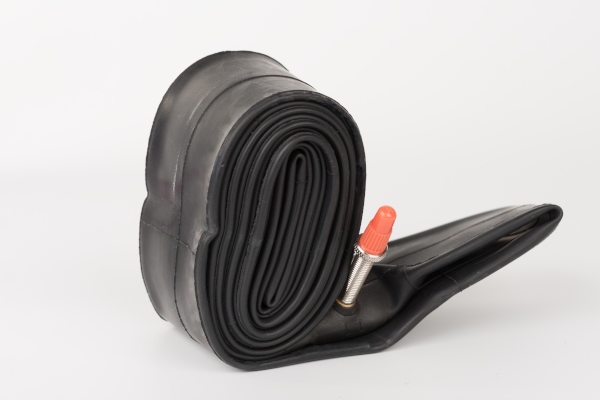
Most people have observed that gases diffuse through plastics. A bicycle tire made of butyl rubber or latex must be inflated from time to time, and the same applies to car tires—even when their valves are tight.
It is also well known that gases diffuse through plastics at different rates. A balloon filled with “gas” at a fairground often shrinks after only a few hours, while a balloon inflated at home with lung power remains taut much longer. The reason lies in the size difference between the gas molecules in the two balloon fillings—between hydrogen and the molecules contained in air.
Hydrogen molecules are significantly smaller than the nitrogen and oxygen molecules in ambient air. For illustration—without assigning particular importance to the absolute values—the “covalent radii” may be considered: approximately 30 picometers (3 x 10⁻⁹ cm) for hydrogen, compared with slightly over 70 picometers (7 x 10⁻⁹ cm) for nitrogen and oxygen.

The gas permeability of a plastic is determined by the “free volume” within the polymer macromolecule—that is, the space between the polymer chains. Consequently, larger molecules such as nitrogen or oxygen are hindered more in passing through a plastic than smaller molecules such as hydrogen or helium.
The “free volume” specific to each plastic—dependent on polymer composition and degree of crosslinking—ultimately results in different permeability values for a given gas in different plastics. Permeability is typically expressed as the quantity of substance passing through in micrograms per square centimeter per minute (µg x cm-2 x min-1).
Plastics become less gas-permeable as their degree of crosslinking increases. However, higher crosslinking also reduces the desired elasticity, ultimately resulting in rigid plastic pipes rather than flexible hoses. The immediate conclusion is that a hose that is completely impermeable to gases yet remains elastic cannot exist.
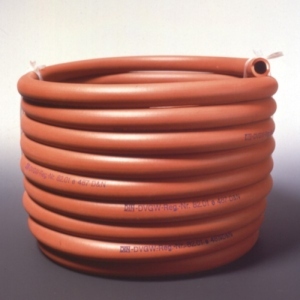
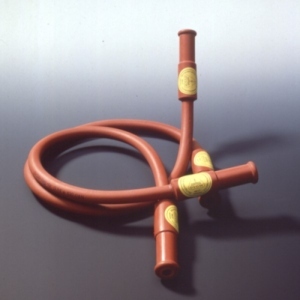
The filler content of a plastic also plays a crucial role in permeability. Fillers such as finely dispersed silicon dioxide can reduce the “free” volume and thus significantly decrease the permeability of a hose material without substantially compromising elasticity. The “art” of polymer compounding lies in developing hose materials with permeability so low that the term “gas-tight” is practically justified.
Additional Requirements for “Gas-Tight” Hoses
In addition to low gas permeability, materials used for “gas-tight” plastic hoses must meet various application-specific requirements. These often include high thermal and mechanical robustness as well as resistance to aggressive media such as hydrogen chloride, chlorine gas, or sulfur oxides.
In the semiconductor industry, tubing is required for transporting ultra-high-purity gases, for example silanes. In such cases, the hose must not release contaminants, such as through outgassing. Suitable tubing is also needed in the pharmaceutical and food industries, where it must comply with the requirements of the U.S. Food and Drug Administration (FDA) and European food safety standards such as those of the German BfR.
Selected Polymer Examples
A key reason for requiring “gas-tight” hoses is occupational safety. The permeation of gases through hose lines can lead to their accumulation in ambient air, potentially resulting in poisoning or the formation of explosive gas–air mixtures.
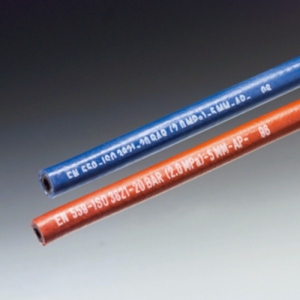
A prominent example is oxy-fuel welding and flame cutting, where oxygen and acetylene (ethyne) are supplied to a burner. Acetylene–air mixtures are explosive at concentrations as low as 2.5 vol.%, and acetylene also has asphyxiating properties. The base material for so-called “torch hoses” used for acetylene and oxygen is elastic styrene-butadiene rubber (SBR).
Because virgin SBR is sensitive to mineral oils, lubricating greases, and gasoline, acetylene hoses are additionally sheathed in a red-colored SBR/EPDM polymer blend, which also serves as identification. The corresponding oxygen hoses made from the same material are colored blue for differentiation.
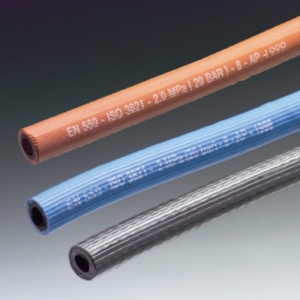
For natural gas, consisting primarily of methane, and for manufactured gas (historically used, containing mainly carbon monoxide), hoses made of chloroprene rubber (CR) are suitable.
High tightness is essential here as well, since natural gas forms explosive mixtures with air at concentrations as low as 4.4 vol.%. Carbon monoxide has a higher lower explosive limit at 12.5 vol.%, but its toxicity threshold is significantly lower than that of methane.
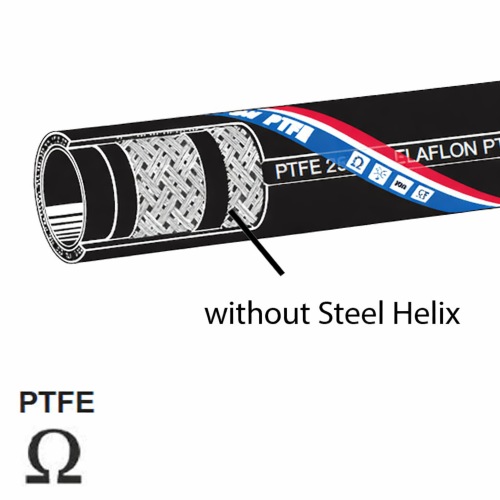
Tubing made of polytetrafluoroethylene (PTFE, THOMAFLON) offers high gas tightness against a wide range of gases. For hose technology, the exceptionally wide service temperature range from -200 °C to +260 °C is particularly significant. PTFE is also resistant to weathering, UV radiation, and nearly all inorganic and organic substances, except elemental fluorine and molten alkali metals. With a reinforcing stainless-steel braid, thick-walled PTFE high-pressure tubing can be used at pressures up to 300 bar.
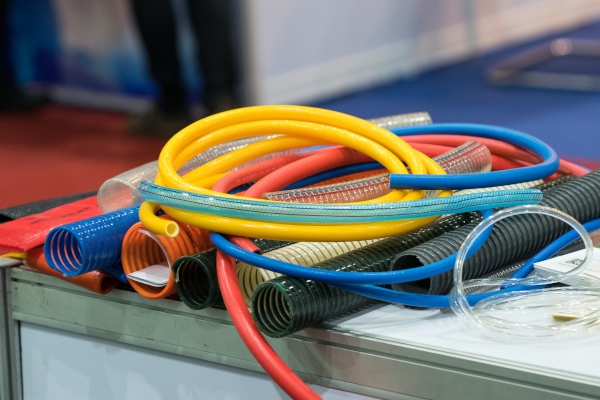
Perfluoroalkoxy polymers (PFA), like PTFE, are chemically highly stable and gas-tight plastics. The technical advantage of these copolymers of tetrafluoroethylene (TFE) and perfluoroalkoxy vinyl ethers (PFAVE) lies in their high flexibility, allowing extremely small bending radii. A chemical variant of PFA polymers is so-called “modified” perfluoroalkoxy polymers (MFA), whose tightness exceeds that of standard PFA polymers.
Appropriate tubing is also required in medical technology. Here, less emphasis is placed on impermeability and temperature resistance than on material purity and dimensional stability.
Hoses made from the copolymer fluorinated ethylene propylene (FEP) are used in corrugated form for ventilators. Their special corrugated design ensures high flexibility and excellent kink resistance.
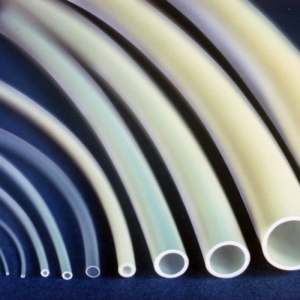
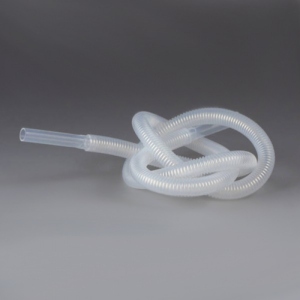
Hoses made of fluoroelastomer copolymers (FKM/FPM, Viton®, THOMAFLUOR) are highly elastic and resistant to oils and solvents. They therefore provide an excellent barrier against fuel vapors and comply with automotive regulations as well as the requirements of the California Air Resources Board (CARB). Due to their chemical resistance, FKM tubing is also used for conveying corrosive gases such as hydrogen chloride and ozone at temperatures up to 200 °C.
Rigid, gas-tight, chemical- and temperature-resistant tubing made of polyvinylidene fluoride (PVDF) is used in chemical plant engineering and, as it is plasticizer-free, also in the pharmaceutical and food industries. It is particularly suitable for fixed installations. Thanks to its hydrophobic surface and material purity, PVDF tubing is physiologically safe, food-grade, and sterilizable.
The widely used PVC hose is also suitable for gas applications. However, conventional PVC contains plasticizers that provide elasticity but gradually outgas. As a result, the range of applications for PVC as a material for gas tubing is limited. Crosslinked PVC, marketed under the trade name Tygon®, is plasticizer-free. Tygon® hoses are therefore approved for food and pharmaceutical applications as well as for medical technology use.
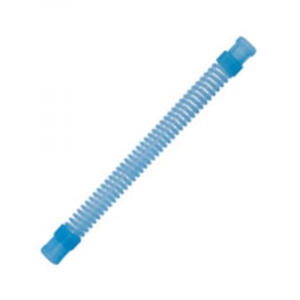
Although silicone hoses are excellent for many purposes, their bulky molecular structure—which provides their high elasticity—also results in a large amount of “free space.” As a consequence, they are entirely unsuitable for conveying gases. In fact, using them for this purpose may even pose risks, as silicone exhibits the highest permeability of all plastic tubing.
Outlook
For physicochemical reasons, an absolutely impermeable hose for all gases cannot exist. However, gas-tight tubing with negligible permeability is available. The wide variety of hose grades made from pure plastics as well as copolymers and polymer blends should be sufficient to identify the appropriate solution for virtually any application.
Careful material selection is essential, as choosing the wrong material may not only compromise functionality but, in extreme cases, lead to serious hazards.