 Reichelt Chemietechnik Magazine
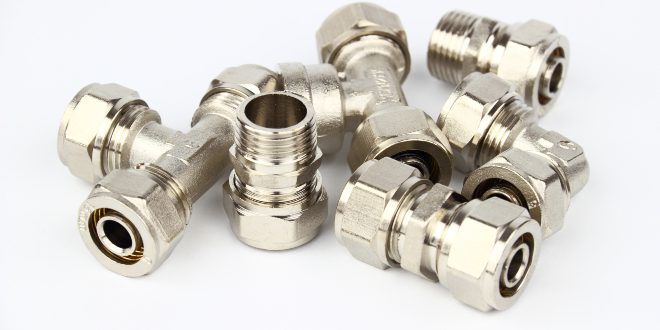
Compression fittings and cutting ring fittings are detachable connections and play an important role in the connection technology of hoses and pipes in order to create leak-free pipe connections. This article explains the differences in design, their distinguishing features, and what must be considered during installation.
How Does a Cutting Ring Fitting Work?
Colloquially, cutting ring fittings are also referred to as Ermeto fittings, named after the company Ermeto, which developed this type of pipe connection in the 1920s and received a patent for it in 1934.
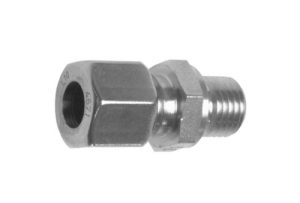
A cutting ring fitting consists of a fitting body such as a connector with male thread and 24° cone, a union nut, and a cutting ring, also referred to as a ferrule. The cutting ring is a 24° cone with one or two sharp cutting edges and is manufactured from a material harder than the pipe or hose material to be connected. Cutting ring fittings can be used, for example, to adapt glass tubes, stainless steel and other metal pipes, as well as hoses made of rigid plastics.
Before installation, pipes or hoses are cut to the required length. It is important that the cut is made at a right angle in order to prevent leakage. Pipes are then deburred to ensure a clean cut edge. To prevent crushing of hoses and thin-walled or soft metal pipes such as copper pipes, a support sleeve can additionally be inserted into the hose or pipe.
For installation, the cutting ring is inserted with the cone side into the sealing cone of the pipe fitting, the union nut is tightened by hand, and the pipe is pushed into the fitting up to the pipe stop. When tightening the union nut, the cutting ring is pressed into the cone of the connector, causing the sharp edge to cut into the surface of the pipe. In front of the cutting edge, an annular bead forms, ensuring excellent sealing and a secure hold for the union nut. The connection of a cutting ring fitting can be loosened and reassembled.
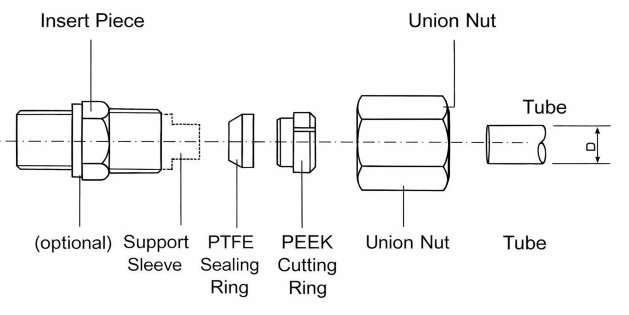
Depending on the operating pressure and pipe outside diameter, cutting ring fittings are classified into the series extra light (LL), light (L), and heavy (S). The LL series includes fittings used at pressures up to approx. 100 bar and pipes with an outside diameter of 4 to 8 mm. Cutting ring fittings for operating pressures up to approx. 350 bar and pipes with an outside diameter between 6 and 42 mm are assigned to the L series. The S series comprises pipe fittings for pressures up to approx. 630 bar and pipes with an outside diameter between 6 and 38 mm.
How Does a Compression Fitting Work?
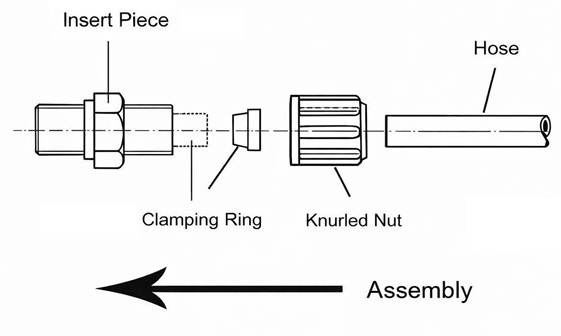
A compression fitting consists of a base body such as a fitting body with male thread and integrated support sleeve, a union nut, and a compression ring. As with cutting ring fittings, pipes or hoses are prepared accordingly, and the union nut and compression ring are slid onto them. The pipe or hose is inserted into the base body up to the stop, and the union nut is first tightened by hand.
Compression fittings with a single compression ring are typically used for low-pressure applications. A compression fitting can also contain two compression rings and is then referred to as a double compression fitting. The front ring is smaller and softer than the rear ring. When tightened, the rear ring firmly engages the front ring, pushes it forward in the axial direction, and is simultaneously pressed against the pipe. This “two-ring design” compensates for tolerances in pipe outside diameter, wall thickness, and material hardness and distributes pressure more evenly. It results in improved sealing and retention.
A special type of compression ring is the shaft clamping ring, which serves for axial fixation of components on shafts or as an axial stop. It is a ring that is clamped onto a shaft using a set screw. Alternatively, the shaft clamping ring can be single- or double-slit. With one or two screws, the compression ring is clamped over the entire contact surface on the shaft.
Compression fittings can also be used to adapt softer plastic hoses, for example rubber hoses made of PVC (polyvinyl chloride), silicone hoses, or other elastomer hoses.
What Materials Are the Fittings Made Of?
Both compression and cutting ring fittings are suitable as connectors for metal and plastic pipes as well as hoses and are available in various designs such as straight, elbow, T- or cross fittings, with cylindrical or tapered threads.
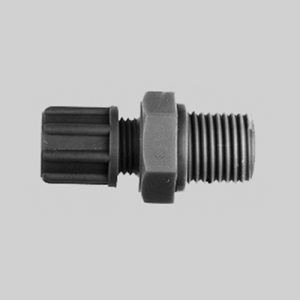
Fittings for soft hoses for low-pressure applications are primarily made of plastics such as polytetrafluoroethylene (PTFE), polyamide (PA), polypropylene (PP), perfluoroalkoxy (PFA), and polyvinylidene fluoride (PVDF). They are ideally suited for connecting rubber hoses and plastic hoses or adapting them to existing female or male threaded plastic connections. Compression fittings are also manufactured from metallic alloys, for example stainless steel, brass, or aluminum.
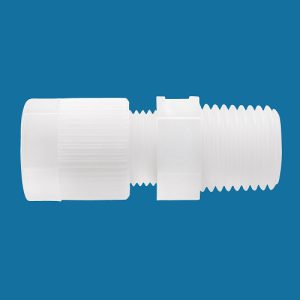
For cutting ring fittings used in high-pressure or high-temperature applications, metallic alloys are primarily used as the base material. Stainless steel fittings are used when corrosion and temperature resistance are required, as well as in the food and beverage industry. When using stainless steel cutting ring fittings, it must be noted that they require pre-assembly. When tightening the union nut, high forces act on the thread flanks, which can cause stainless steel surfaces to cold weld. Pre-assembly is carried out in a hardened pre-assembly fitting. Manufacturers of stainless steel cutting ring fittings recommend using seamless drawn pipes. In welded pipes, the material structure may change in the area of the weld seam, which can affect the cutting behavior of the ring.
Fittings for pipes and rigid hoses are also manufactured from high-performance polymers, for example with a body made of PVDF or PFA, a cutting ring made of PEEK, and a sealing ring made of PTFE. Such types are mainly used when extremely high chemical resistance is required.
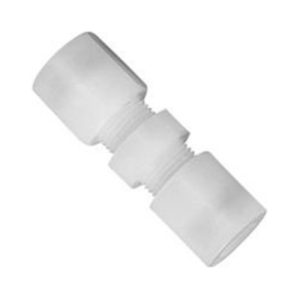
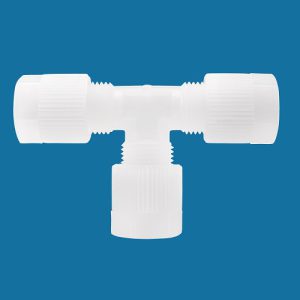
Brass fittings are recommended for copper pipes, which are frequently used in sanitary and heating installations.
Where Compression and Cutting Ring Fittings Are Used
Due to their different designs and modes of operation, the individual components of the two types of fittings are not compatible with one another.
Compression fittings are used in systems with pressures up to a maximum of 150 bar. They are used in water treatment and drinking water systems, heating technology, sanitary, gas and heating oil installations, pneumatic fittings, as well as in measurement, control and regulation systems. For drinking water and gas installations, compression fittings must bear the DVGW certification mark. DVGW stands for Deutscher Verein des Gas- und Wasserfaches e.V. (German Technical and Scientific Association for Gas and Water), which tests not only products but also companies and individuals for suitability.
Cutting ring fittings of the LL series, which can be used at pressures up to 100 bar, are suitable as hose connectors for plastic and pipe systems in pneumatic systems, laboratory applications, and apparatus engineering. Pipe fittings of the L series up to 350 bar are used in hydraulic components such as hydraulic pumps, cylinders and valves, in brake lines and fuel systems of vehicles, in measurement and control technology, in the paper and plastics industry, the pharmaceutical industry, aerospace, as well as in the paint and coatings industry. For pressures up to 630 bar, as encountered in heavy machinery construction, shipbuilding, mining, the chemical industry, as well as in port and lock systems, cutting ring fittings of the S series are used.
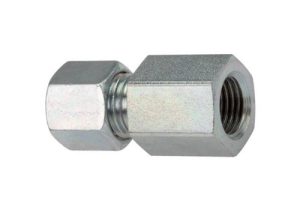
Whether a cutting ring fitting or a compression fitting is used depends on the respective application. Both types of pipe fittings are characterized by a compact design with minimal space requirements, simple and quick on-site installation, and cost-effectiveness due to durability and low maintenance requirements.
Image Sources: Featured image | © pawelg601 – stock.adobe.com