 Reichelt Chemietechnik Magazine
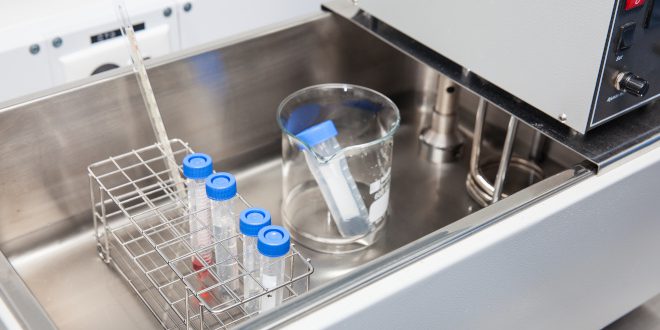
Laboratory water baths are indispensable for temperature control – in medical, biochemical and chemical work as much as in industry. Like other laboratory instruments, they must meet high standards of reliability, accuracy and reproducibility.
Types of Laboratory Water Baths
Compared with other liquids, water has one of the highest heat capacities – the ability to store absorbed energy as heat. This energy sets the molecules in motion. They can move in a straight line, rotate or vibrate. These independent forms of motion are known as degrees of freedom. The more different motions are excited, the higher the heat capacity. A laboratory water bath therefore allows very precise temperature control between ambient temperature and +100 °C (212 °F)[1].
In 1923, the German entrepreneur Theodor Hermann Friedrich Stiebel (1894–1960) developed a spiral-shaped immersion heater. He received a patent for it, and it replaced the bulb-type immersion heater common until then. Spiral immersion heaters are still available as laboratory supplies today.
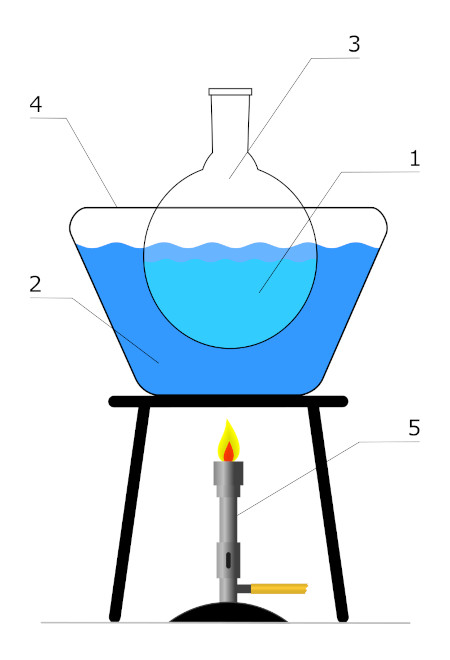
A unit that consists only of a container, a heater and a temperature-control fluid is called a “non-circulating water bath”. A drawback of this design is uneven temperature distribution throughout the volume.
Uniform temperature throughout the whole volume matters especially for temperature-sensitive, medical-diagnostic and biochemical work. A circulation pump or a magnetic stirrer keeps the liquid moving, which evens out the temperature. Such a model is sold as a “circulating bath”.
Some applications require the sample vessels to be moved – for example, cell cultures that need to mix with air. For these, models come with a shaking basket or shaking rack that moves in a linear, circular or orbital pattern. The amplitude and frequency can be set freely. Such units are sold in the laboratory trade as “shaking water baths”.
Components of a Water Bath
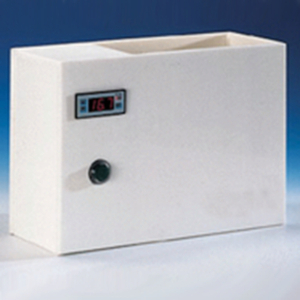
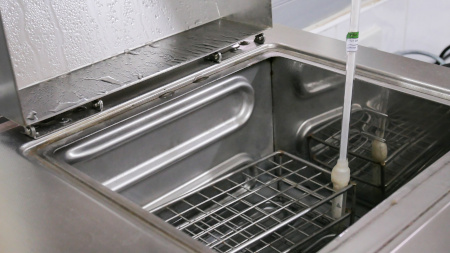
Laboratory water baths serve so many different fields that suppliers stock a wide selection of these instruments ans utensils. They come in many designs, with various openings and depths and a fill volume of 0.8 to 40 litres. Available materials include stainless steel, polypropylene, and transparent polycarbonate and acrylic glass.
The liquid can be heated by immersion heaters or by electric surface heaters built into the base or walls. Compared with immersion heaters, surface heaters warm the whole volume more evenly. Temperature control can run through analogue or digital interfaces.
A flat or roof-shaped cover reduces evaporation loss and helps keep the temperature constant. It also stops condensate from dripping back and contaminating samples.
Cleaning and Maintaining a Laboratory Water Bath
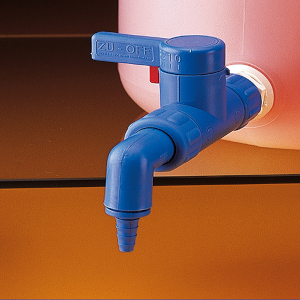
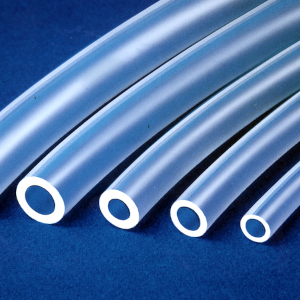
To prevent microbial growth and deposits, empty the bath when it is not in use and clean it regularly. Models with surface heaters are easier to clean here. Some have a drain cocks or drain plug for quick emptying. Manufacturers recommend deionised water to prevent limescale. To make filling and draining the temperature-control fluid easier, you can use hoses connected to the container with suitable hose connectors.
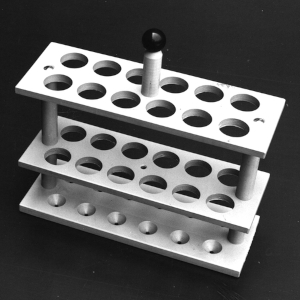
To stop the sample vessels from floating, laboratory suppliers offer various insert racks in stainless steel or plastic. These suit test tubes, bottles or Erlenmeyer flasks.
Some laboratory models include low-level protection, which guards against overheating if the bath runs dry. This is a float switch positioned above the heater. When the liquid level drops to the switch, the heater turns off.
A cooling coil can be connected to the mains water supply or a recirculating chiller. With one fitted, you can work below ambient temperature, down to +10 °C (50 °F). When you need a range below +10 °C (50 °F) or above +100 °C (212 °F), a different temperature-control fluid can be used, provided the device is suitable.
Digitally controlled laboratory water baths use a microprocessor to set temperature, time and shaking speed. Settings and operating values often appear on a display. Optional optical and acoustic signals can confirm inputs, mark the end of a programme or flag an operating fault.
Applications for Laboratory Water Baths
The biochemical laboratory uses them to control temperature and incubate cultures, and also for fermentation and homogenisation. In the pharmaceutical industry, they regulate the temperature of ointments and emulsions. Physiotherapists rely on them to warm fango and mud packs for muscle tension, back pain and rheumatic complaints. In histology, paraffin sections are placed on a bath at +42 °C (108 °F), where the warmth makes them spread out. They are then mounted onto a microscope slide.
In the chemical laboratory, they mainly heat flammable chemicals that cannot be exposed to open flames. They also serve for corrosion, leak and material testing. In the MACHU test – a short-term corrosion test for aluminium, steel and coatings – a cut is scribed into the test piece. The piece is then held in an acidic test solution at +37 °C (99 °F) for 48 hours. It passes if the undercutting at the scribed line is no greater than 0.5 millimetres. For leak testing, the object under test is immersed in a bath to reveal air escaping as bubbles. They also support quality assurance for the moisture resistance of photovoltaic modules. The panels are immersed to just below their junction boxes in water at +22 °C (72 °F) for two minutes. A current is then applied, and the insulation resistance is measured.
Water Baths in Industry and Food Production
Water baths have many uses in industry too. When casting resins, the compounds must be kept continuously at temperature. A constant temperature ensures constant viscosity, which makes it easier for air bubbles to rise and escape.
In the food industry, temperature control plays an important role in processing and in fermentation. In chocolate production, for example, cocoa mass, cocoa butter, sugar, milk, spices and flavourings are mixed and rolled. They are then stirred and kneaded at temperatures between +55 °C (131 °F) and +90 °C (194 °F) over several days. Laboratory water baths also helps determine the fat content of milk, cheese, butter and cream.
When apple juice is made, the apples are cleaned in a bath before they move to a shredder and then the press. In breweries, one unit combined with a photometer helps determine the shelf life of beer. The beer runs through a temperature cycle, repeated until it turns cloudy.
As with other equipment, the intended application decides which laboratory water bath to choose. A few questions help: Which volume and temperature range do you need? Is a circulating or shaking version required? What temperature accuracy is necessary? How much effort does cleaning involve? Price matters too, and it varies with the size and features of the device.
Sources:
[1] Organikum, Wiley-VCH Verlag GmbH, 23rd edition, 2009, p. 15

Image sources:
Featured image | © anamejia18 - stock.adobe.com
Water bath with round-bottom flask and sample solution | Von (of SVG version) Ss181292; (of original version) Polimerek - own work - SVG version of picture by Polimerek, CC BY-SA 3.0, https://commons.wikimedia.org/w/index.php?curid=781438
Stainless steel water bath | © toeytoey - stock.adobe.com