 Reichelt Chemietechnik Magazine
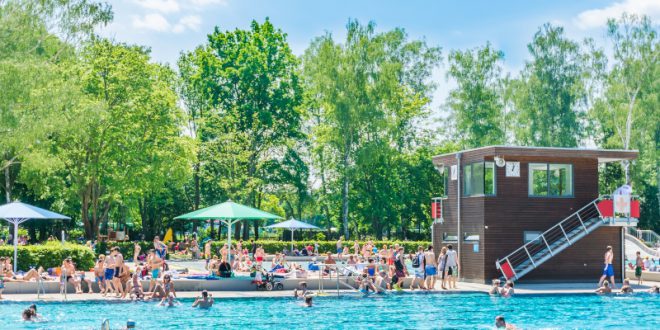
People of all ages enjoy regular visits to public pools, whether for leisure or serious swimming. A few criteria make every visitor feel at ease: clean and hygienic pool water, a pleasant smell, and no harmful germs in the water. Meeting these varied demands on water quality calls for continuous water treatment. We show you which technical methods keep water quality consistently high.
How Water Treatment Shapes Water Quality
Water treatment also means meeting recognised standards of water quality and hygiene. Microorganisms pose a serious risk, especially to bathers with relevant pre-existing conditions. Here, water treatment competes with the constant input of contaminants from pool use. Visitors alone carry dirt and germs into the pool water simply by swimming. Environmental substances can pollute the water too.
Outdoor pools deserve particular attention, as plant debris, dust and animal droppings often find their way in. To maintain hygienic, consistently good water quality, operators use various technical methods to clean and disinfect.
Continuous Water Exchange
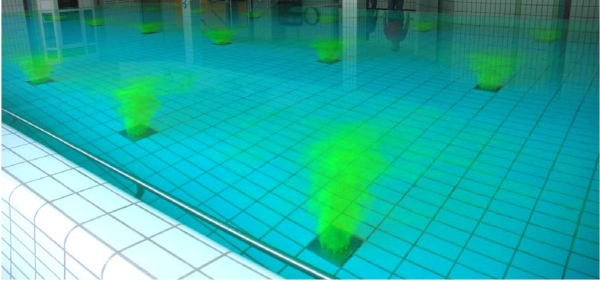
To keep the water clean, an even flow of water must first pass through the pool. Operators use either horizontal or vertical circulation for this. The overflowing pool water then reaches the treatment system through a channel running around the basin. This flow also creates a surface-cleaning effect. As a result, contaminants in the upper water layer leave the pool by the shortest route.
The volume of water requiring treatment depends on the basin size, the surface area and the level of contamination. As a guideline, each bather requires around 2 cubic metres of cleaned pool water. Water treatment therefore runs 24 hours a day. This keeps the disinfectant, usually chlorine, working and stops algae and germs from settling.
Common Water Treatment Methods
Rapid filters and precoat filters carry a constant flow of pool water. Inside them, filter sand and activated carbon remove water-insoluble substances. To capture even the finest particles, colloidal turbidity and bacteria, operators add flocculants ahead of the pool filter. Typical agents include aluminium sulfate (Al2(SO4)3) and iron(III) chloride (FeCl3). In water, these hydrolyse into hydroxide gels with a large surface area, which bind contaminants by adsorption. A pleasant visit also depends on preventing the familiar indoor-pool smell.
Chloramines cause this nuisance in particular. They form when the disinfectant reacts with contaminants such as urea. They also often leave bathers with red eyes. UV irradiation breaks chloramines down again.
Even so, no treatment method removes every foreign substance from the pool water completely. Operators therefore top up the water regularly with fresh water of drinking-water quality, known as primary make-up water. They also add some treated secondary service water. This make-up water offsets losses from evaporation and keeps the salt concentration stable.
Disinfecting the Pool Water
Disinfection should reduce the health risk in a pool to a minimum, so it must be highly effective. It should kill 99.9% of germs and pathogens within 30 seconds. Afterwards, the pool water must contain no infectious germs such as Escherichia coli or Pseudomonas aeruginosa.
Legionella contamination also demands particular attention.
The bacterium Legionella pneumophila can trigger severe Legionnaires’ disease, an especially aggressive form of pneumonia, once aerosols carry it into the airways.
Even today, operators rely almost exclusively on chlorine for disinfection. They use either elemental chlorine (Cl2) or chlorine dioxide (ClO2), which is also a gas. Alternatively, electrolysis can generate the chlorine gas directly in lightly salted pool water.
Chlorine owes its disinfecting power to the hypochlorous acid (HClO) that forms in water. This acid needs a concentration of at least 0.3 mg/l to take effect. Adequate disinfection also requires a pool water pH value between 6.5 and 7.5. Above pH 7.5, the effect drops sharply and the skin’s natural acid barrier suffers.
Lower pH values promote corrosion in the pool and prevent flocculation before filtration. They also intensify odour from chloramine formation. To maintain the required chlorine level, operators therefore add around 0.2 to 0.5 g of chlorine per cubic metre.
Ozonation offers another disinfection option. Because ozone (O3) is highly toxic, it runs inside a closed treatment system. Before the disinfected water returns to the pool, the system must remove all unused ozone completely.
How to Check Water Quality in the Pool
All measures used to treat the pool water link closely together. For them to work properly, operators must monitor key chemical and microbial parameters in the water.
The microbial load of pool water shows in the germ or colony count (CFU). In bathing water, this value must not exceed 100 CFU/ml. To measure it, technicians spread samples onto a culture medium and incubate them in a heating cabinet. They can then count the bacterial colonies that have grown. Because this count is slow and costly, operators prefer to measure the redox potential for continuous disinfection monitoring.
Here, the redox potential measures how well disinfection works. As an index of disinfection performance, it must not fall below +700 mV. For continuous monitoring of redox potential and pH value, water treatment today uses combination electrodes.
Chemical Parameters in Pool Water Treatment
Colorimetric and photometric methods can also determine the pH value. Both rely on the colour reaction of pH indicators such as phenol red. For quick checks, test strips let staff verify the pool’s pH value simply and reliably.
The chlorine level also needs checking several times a day. For this, pool regulations prescribe the DPD method. Its diethyl-p-phenylenediamine reagent (DPD reagent) reacts with chlorine to produce a colour. Staff then measure that colour by visual comparison or photometry.
Operators also measure the water’s acid capacity (KS4.3) regularly, so that flocculation and disinfection keep working smoothly.
This buffer capacity, also known as total alkalinity, must stay high enough. Otherwise, adding flocculants and disinfectants would shift the pH value. Quick tests can check the acid capacity, and the related water hardness, by titration or photometry.
Urea serves as the indicator substance for water-soluble contaminants. Titration determines its level. Staff add a calibrated potassium permanganate solution to a water sample step by step, until the colour shifts from clear to pink-violet. The amount used up to that point reflects the urea concentration in the pool water.
Necessary Steps to Adjust Water Quality
If the water quality ever falls short of key requirements, operators must correct the monitored parameters. Shock chlorination, for example, reduces high germ counts quickly. When buffer capacity against acids and bases runs too low, a soda solution raises the acid capacity, which depends mainly on the water’s bicarbonate content. If the pH value has also left its optimal range, caustic soda (NaOH) or soda ash (Na2CO3) can raise it.
Sodium hydrogen sulfate (NaHSO4) or sulfuric acid (H2SO4) can lower the pH value again.