 Reichelt Chemietechnik Magazine

In the chemical laboratory, many standards must be observed, including those for standard ground joints on laboratory apparatus or glass containers. Standard ground joints ensure that glassware and vessels, such as flasks and Liebig condensers, can be connected and sealed reliably. They are used in distillation and extraction setups, rotary evaporators, glass stoppers, and desiccators.
Taper Joints – The Most Common Joint Connection
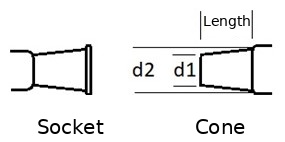
With these standard ground joints, the mating surface between cone and socket is tapered, as shown in the figure below.
A taper-joint connection is suitable for vacuum use and rigid, which is why care must be taken to ensure a stress-free setup. The connection can additionally be secured with a joint clip.
The size designation uses the letters NS, the abbreviation for Normschliff (standard ground joint), followed by two dimensions: the first number indicates the larger diameter d2 and the second number indicates the length of the cone. Dimensions and tolerances for taper joints are defined in ISO 383, the international standard for interchangeable conical ground joints, which is published in Germany as DIN 12242 by the German standards body Deutsches Institut für Normung (DIN).
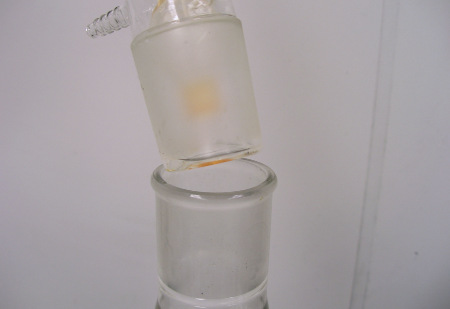
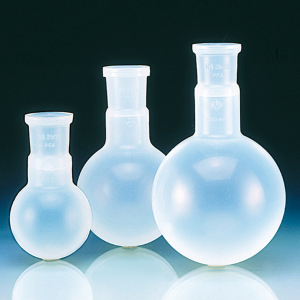
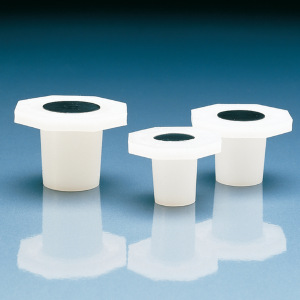
The smallest size is NS 5/13, the largest is NS 85/55. Sizes NS 14/23 and NS 29/32 are used most frequently. In laboratory jargon, the length is usually omitted and people simply refer to a “14” or “29” joint. To securely seal round-bottom flasks and other laboratory containers with a standard socket, suitable laboratory stoppers can be used.
In addition to the medium-length joints, long joints are also manufactured. A long version with a diameter of 14 mm has a length of 35 mm; with a diameter of 29 mm, the length is 42 mm. Because they provide a larger sealing surface, long joints are preferred for vacuum work.
Sealing Taper-Joint Connections
To seal the glass connection and prevent it from “sticking”, the joint is greased, for example with silicone-based greases. Instead of greases, sleeves and sealing rings made of PTFE (polytetrafluoroethylene) are increasingly used today. Such seals made of plastics are low-maintenance, chemically resistant, reusable, and make it easier to separate the connection.
Connecting Different NS Sizes
Glassware with joints of different sizes can be connected using adapters, which are specified in DIN 12257, the German standard for ground-joint adapters. A reducing adapter connects a large cone to a smaller socket, for example a 19 cone to a 14 socket. The counterpart—small cone to large socket—is referred to as an expansion adapter.
Taper joints are frequently used in the chemical laboratory. Examples of such glassware include laboratory containers such as round-bottom flasks, volumetric flasks, reflux condensers, distillation bridges, dropping funnels, and glass stoppers.
Where Cylindrical Joints Are Used
With cylindrical joints, the mating surface corresponds to the shape of a cylinder. The connection is not fixed; cone and socket can be moved axially relative to each other or rotated. Cylindrical joints are found in gas syringes used for dosing gases and referred to as piston samplers.
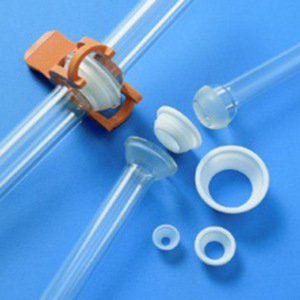
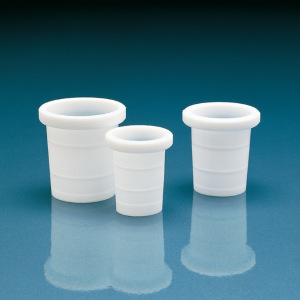
Cylindrical joints are also used as guides for rotating shafts such as KPG stirrers—an abbreviation for “kerngezogenes Präzisions-Glasgerät” (core-drawn precision glassware). KPG stirrers consist of a stirring sleeve and a stirring shaft with a precision cylindrical fit, so the shaft can rotate with an exact fit inside the sleeve. These glass laboratory devices are used for stirring liquids when magnetic stirrers are not sufficient.
This is the case when stirring viscous liquids, when a solid forms during a reaction taking place in the stirring vessel, when a high stirring speed is required, or when working with a large reaction batch.
Spherical Joints – The Flexible Joints
Instead of cone and socket, spherical joints consist of a ball and a socket (cup), with spherical mating surfaces that can move freely against each other around the centre of the ball. This makes these connections more flexible than others; however, they must be secured with clamps.
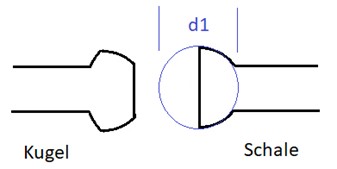
Spherical joints are designated with the letter S, from the English “spherical”, and the rounded cone diameter. They are offered in sizes from S 13 to S 64. In addition to adapters for different sizes, there are also adapters from ball to taper and vice versa.
Spherical joints are more expensive than other joints, but they have the advantage that they cannot “seize”, i.e., they do not jam in such a way that they become difficult to separate. They can be found on flasks connected to rotary evaporators, on vacuum traps, and on condensate separators of diaphragm pumps.
Flat (Planar) Joints
Flat joints are characterised by completely level ground surfaces. They cannot be inserted into each other and are freely movable radially. The dimensions of and requirements for tube ends and lids with flat joints are specified in DIN 12214, the German standard for flat ground joints. In the laboratory supplies range, round, standardised flat joints with diameters of 35, 60, 100, 120, 150, and 200 mm are available. They are used in desiccators, flat-joint lids for glass reactors, and vacuum bells.
Types of Joint Clamps
A clamp prevents the cone and socket from sliding apart under tensile or compressive load. In laboratory supplies, clamps made of metal or plastic are available. Plastic clamps are usually made of polyoxymethylene (POM), which is characterised by good chemical resistance and autoclavability and can be used at temperatures up to +150 °C.
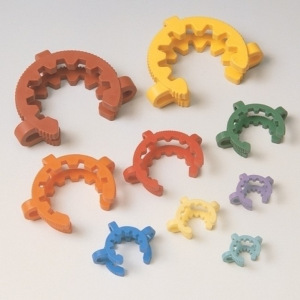
These safety clamps are colour-coded by size, do not bend, and are suitable for both taper and spherical types. They are also known as Keck clips, named after the German chemist Hermann Keck (1919–2010), who received a patent for them in 1984.
Clamps made of PTFE with an encapsulated steel spring are also offered, as well as versions made of metallic alloys such as V2A spring steel, which are attached according to the functional principle of clothes pegs and can additionally be secured with a knurled set screw.
Various Ground-Joint Stoppers
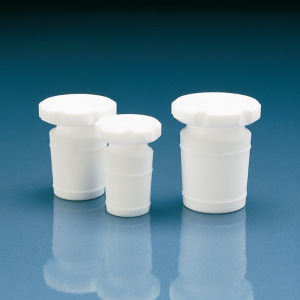
To seal glassware, ground-joint stoppers, mainly with taper joints, are used. They are made of plastics such as polypropylene (PP), low-density polyethylene (PE-LD), and PTFE, or glass, and are usually equipped with a hexagonal or octagonal cap.
Glass ground-joint stoppers can be solid or hollow, with hollow stoppers being lighter but also more expensive due to the more complex manufacturing. Hollow ground-joint stoppers are available with a flat or pointed base. Glass ground-joint stoppers are offered in clear and amber glass.
Manufacturing Standard Ground Joints
To meet the standards’ requirements for dimensions and tolerances, both a complex production process and careful quality control are necessary. First, glass tubing is heated to a viscous state and a joint blank is produced using a glass-forming machine. In several steps, socket and cone are ground to the required roughness. Conicity, roundness, wall thickness, and roughness are checked.
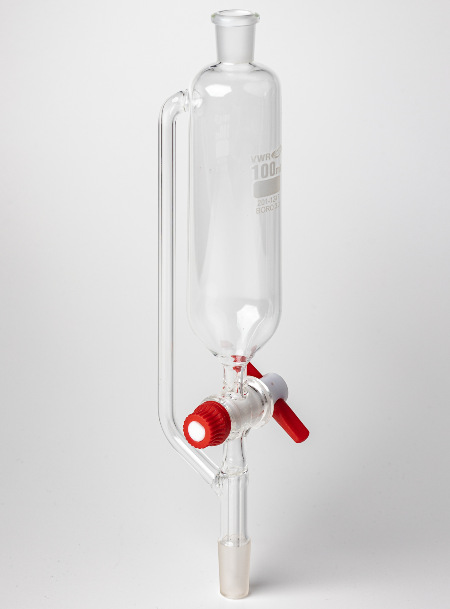
Standard ground joints play an important role, above all, in preparative organic chemistry. They make it possible to assemble complex glass apparatus for the synthesis, purification, and concentration of chemical compounds.
Image Sources:
Cover image | © Souvik – stock.adobe.com
Opened taper-joint connection | © Phasmatisnox on English Wikipedia, CC BY-SA 3.0 <https://creativecommons.org/licenses/by-sa/3.0>, via Wikimedia Commons
Glass dropping funnel | © Ichwarsnur, CC BY-SA 4.0 <https://creativecommons.org/licenses/by-sa/4.0>, via Wikimedia Commons