 Reichelt Chemietechnik Magazine

Proteins are high-molecular-weight macromolecules and fundamental building blocks of all living organisms. They are a particular focus of medical and biochemical research disciplines. One recurring task in this field is protein purification from cell lysates and other origins for subsequent in vitro investigations. Dialysis has become an indispensable method for this purpose, as it enables low-molecular-weight substances such as salts or fragments of proteins and nucleic acids to be gently separated from high-molecular-weight proteins. Dialysis tubing, dialysis membranes and dialysis cells are required for this process.
How Dialysis Works for Protein Purification
This separation technique is based on the diffusion of dissolved substances below defined molecular sizes through semipermeable membranes that larger molecules cannot pass through. A semipermeable membrane can therefore be compared with a sieve.
Protein purification by dialysis aims to gently separate low-molecular-weight substances from protein-containing solutions, such as salts, small peptides, amino acids and other unwanted low-molecular-weight compounds from preceding process steps. Dialysis is also commonly used for buffer exchange in connection with protein purification.
Two Modes of Operation: Equilibrium and Flow Dialysis
The dialysis process proceeds spontaneously from higher to lower solute concentration. A distinction is made between equilibrium dialysis and flow dialysis.
Equilibrium dialysis is technically very simple to implement. The process ends when equal concentrations of the diffusible low-molecular-weight substances have been reached in the solutions on both sides of the semipermeable membrane, in the retentate (Lat. retinere = to retain) and permeate (Lat. permeare = to pass through). To continue the process, the concentration of the already separated low-molecular-weight substances in the solution, i.e. in the permeate, must be reduced. In practice, the permeate is repeatedly replaced with pure water at set intervals.
Flow dialysis enables a continuous diffusion process in which constant rinsing of the permeate side with pure water prevents concentration equilibrium from being established between retentate and permeate.
MWCO and the Dalton Unit
A fundamental measure of the filtration performance of dialysis membranes is their pore size or, equivalently, their pore width. However, because the pores are by no means all the same size, specifying an exact pore size for dialysis membranes is neither meaningful nor practically possible. It is therefore unsuitable as a measure of filtration effectiveness. For this reason, the MWCO (molecular weight cut-off) is used instead. It indicates the molecular weight at which a defined semipermeable membrane retains at least 90% of an approximately spherical solute and is expressed in daltons (Da).
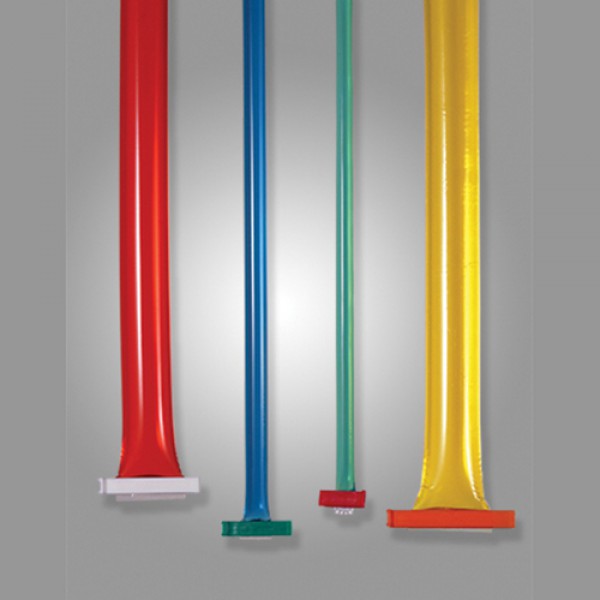
By definition, one Dalton corresponds to one twelfth of the mass of the stable carbon isotope C12. Because this SI-compatible unit is very small, MWCO values are usually given in kilodaltons (kDa).
Protein Purification Using Dialysis Tubing
For the dialysis of larger sample quantities, dialysis tubing made from hydrophilic polymers has proven effective, for example regenerated cellulose, cellulose hydrate (Cellophane®) or cellulose esters.
Functionally, the tubing acts as a flexible membrane and is usually available in various catalogues with diameters specified as so-called “flat width” and with different MWCO values up to 20 kDa.
Dialysis tubing is offered almost exclusively in pre-swollen form. To reliably prevent damage to the material during storage caused by mould and other microorganisms, manufacturers stabilise it with a 0.05% aqueous sodium azide solution (NaN3). It must therefore always be sufficiently soaked before use in order to wash out the readily soluble preservative. At the same time, drying out of the tubing must be strictly avoided, as it becomes brittle when dry and loses its functionality.

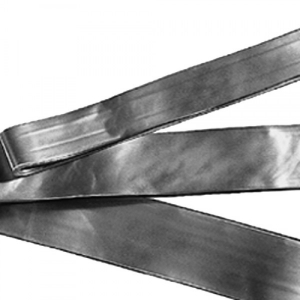
Dialysis tubing with the appropriate MWCO value and sufficient dimensions is first sealed on one side by knotting or with special clamps, filled with the solution to be dialysed and then also sealed at the filling end, most simply by knotting. Dialysis begins after the tubing prepared in this way has been placed in a water reservoir. Depending on the technical setup, protein purification can proceed as equilibrium dialysis or flow dialysis.
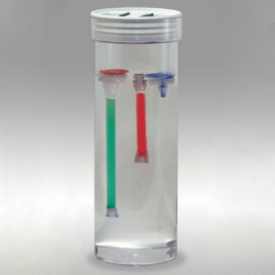 Purpose-made dialysis cylinders are suitable as water reservoirs. These tall glass vessels with lids are available in various sizes and allow several pieces of dialysis tubing to be dialysed simultaneously.
Thanks to their flat base, they can also be placed on magnetic stirrers without difficulty in order to accelerate the diffusion-controlled dialysis process.
Dialysis Tubing Funnels
Such funnels considerably simplify the handling of dialysis tubing because the filling end no longer needs to be sealed. The tubing is pulled over the stepped funnel outlet, which is therefore suitable for all common tubing diameters (flat widths), and fixed in place with a rubber ring.
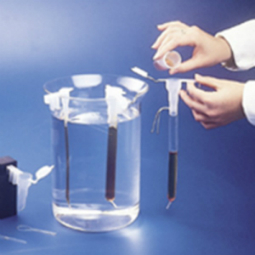 After the sample has been added, the funnel remains attached to the dialysis tubing and is closed with a lid. An integrated hook is used to suspend the prepared tubing in a dialysis cylinder or another vessel filled with water.
The lid of the funnel can easily be labelled, helping to prevent mix-ups even when several different samples are dialysed at the same time.
Dialysis Tubing Closures Made from Hostalen®
Reusable closure clamps made from coloured, biocompatible Hostalen® (polypropylene, PP) are available for secure sealing. They are easy to handle and suitable for dialysis tubing of different dimensions.
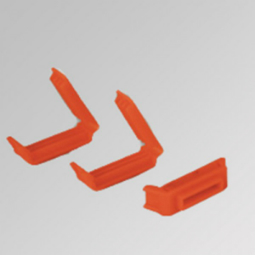 Their benefit, which should not be underestimated especially when preparing larger quantities, is that hardly any tubing material is lost compared with conventional knotting, as the closure clamps can be positioned very close to the end of the tubing. In addition, the clamps seal the tubing very reliably and largely eliminate leaks caused by mechanical ruptures during knotting, which usually go unnoticed, or by knots that have been tied too loosely.
Protein Purification Using Dialysis Cells
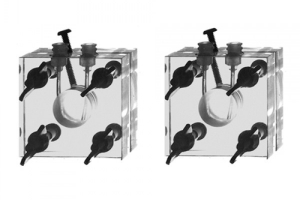
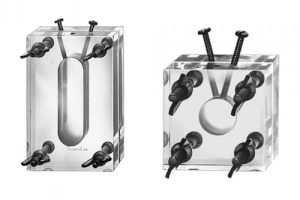
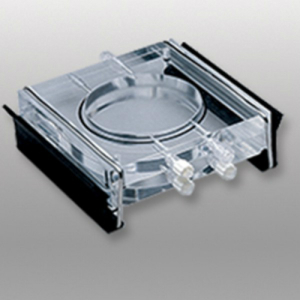
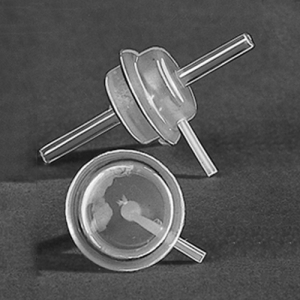
The use of dialysis cells with dialysis membranes for protein purification is particularly appropriate for small sample quantities. They consist of two half-cells, usually made from transparent acrylic, separated from each other by an application-specific dialysis membrane.
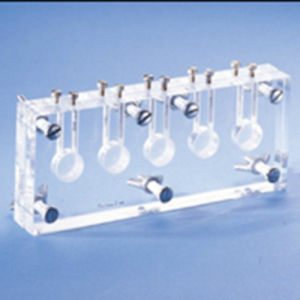
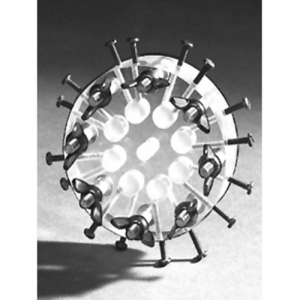
With fundamentally the same design, dialysis cells are suitable for both equilibrium dialysis and flow dialysis. One disadvantage is the sensitivity of dialysis membranes to higher pressure loads and mechanical stress.
Dialysis for Protein Purification – Two Options: Dialysis Tubing or Dialysis Cells
Protein purification by dialysis is intended to remove unwanted low-molecular-weight substances from protein-containing solutions of different origins. Semipermeable membranes with different separation limits are used for this purpose and are impermeable to the larger protein molecules. A distinction is made between equilibrium dialysis and flow dialysis.
- One almost universally applicable, technically very simple and therefore widely used method is based on the use of dialysis tubing for protein purification. It is predominantly used as equilibrium dialysis.
- Alternatively, dialysis cells can also be used. In this case, a semipermeable membrane is clamped between two half-cells made from acrylic glass, one for the retentate and one for the permeate. Dialysis cells are predominantly used for flow dialysis.