 Reichelt Chemietechnik Magazine
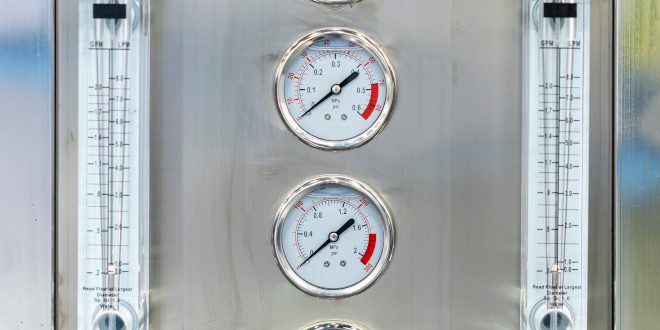
Flow sensors are ubiquitous in process chemistry operations. But what operating principles are these volumetric flow measurement devices based on, what designs are available, and where are they used? This article explains these aspects, outlines the key factors for selecting the right flowmeters, and provides an outlook on further trends in flow measurement.
Fundamentals of Flow Measurement
Flow measurement technology is available in various designs, each tailored to specific applications depending on the fluid to be measured, the required accuracy, and the ambient conditions.
Just as diverse as the commercially available range of flow meters are the materials used: depending on the application area and the required chemical resistance, flow meters are usually made of engineering plastics, brass, or stainless steel.
Operating Principle and Use of Flowmeters
Flow sensors are based on various physical principles, including fluid dynamics, thermal, acoustic, or electromagnetic properties. Flow rates are either measured directly or derived indirectly from other measured variables.
Flow sensors – often also referred to as flowmeters – essentially consist of the actual measuring transducer or sensor and the evaluation and supply unit, also known as the transmitter. Depending on the design, the sensor measures a specific physical variable such as temperature or pressure. The transmitter converts the data supplied by the sensor into values that can be further processed and presents them via analog or digital displays, or transmits them in the form of electrical signals.
To not only measure but also regulate the flow, flow switches, also referred to as flow monitors, are frequently used. They allow operating processes to be monitored at higher temperatures and under greater pressure requirements.
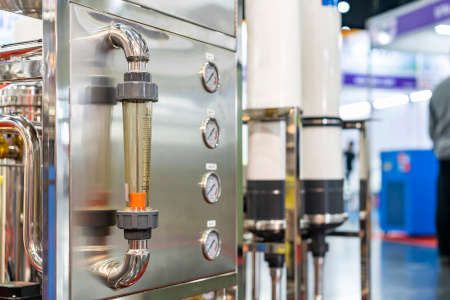
Like any other measuring instrument, flow sensors must be calibrated to ensure that they deliver accurate results. The choice of the correct method and the required intervals depend on the type of flowmeter and the accuracy requirements.
Types of Flow Sensors
Depending on the application requirements, a distinction is made between volumetric flow measurement and mass flow measurement technology.
In volumetric flow measurement, the quantity of liquid or gas flowing through a defined cross-section per unit of time is measured. This is a simple and cost-efficient method. In mass flow measurement, by contrast, the mass of the liquid or gas flowing through a defined cross-section per unit of time is measured. Mass flow measurement is more accurate than volumetric flow measurement, but also more expensive.
Depending on the intended use, various measuring methods are available, based on different physical principles.
Mechanical Flowmeters
Mechanical flow sensors operate on the principle of direct volumetric flow measurement. The fluid is guided into a measuring tube, and the movement of the fluid is converted into mechanical movement. This is then either displayed directly or converted into electrical or digital signals, for example in electronical flowmeters.
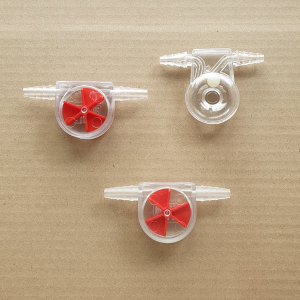
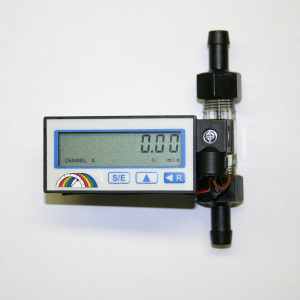
Turbine flow sensors are among the best-known designs and are based on a relatively simple operating principle. They consist of a rotor with blades, mounted on a bearing and supported by a central shaft inside the meter. As soon as flow occurs in the pipe, the kinetic energy of the fluid causes the rotor to rotate. This movement is detected by a motion sensor that generates electronic pulses corresponding to the volume passed. The volumetric flow rate is therefore proportional to the pulse frequency. Turbine flow sensors can be used for flow measurement of liquids and gases and provide a suitable option for non-conductive liquids such as oils.
Variable-Area Flow Sensors
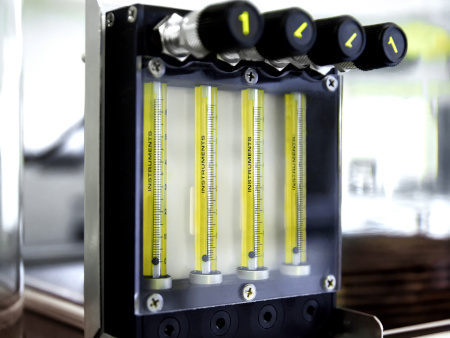
Flow measurement with variable-area flowmeters is performed using a float located in a vertically mounted sight tube with a scale.
Variable-area measuring devices are offered in different designs and materials, for example in metallic alloys or engineering polymers. The measuring tube is usually made of borosilicate glass, acrylic (PMMA), or transparent engineering plastics.
The float itself is also manufactured from different materials and should be selected according to the medium, volumetric flow rate, and operating conditions. Common materials include glass, stainless steel, titanium, or fluorinated plastics such as polytetrafluoroethylene (PTFE) or polyvinylidene fluoride (PVDF).
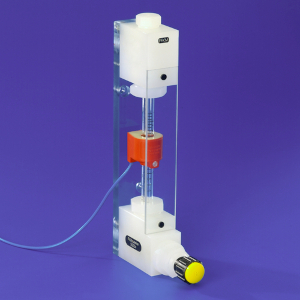
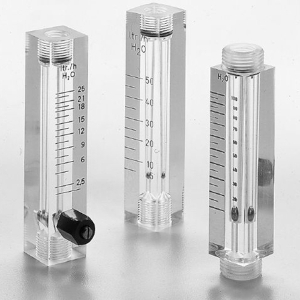
To allow the flow not only to be measured but also regulated, many of these flow measurement devices are equipped with a needle valve installed on the inlet side.
Differential Pressure Measuring Devices
Differential pressure flowmeters are based on the Bernoulli equation, according to which the sum of potential, kinetic, and pressure energy remains constant in a flowing fluid. They are used for volumetric flow measurement of liquids, gases, and steam.
For this purpose, the fluid is guided through a constriction in the pipe. This constriction causes a pressure drop that is proportional to the volumetric flow rate. By measuring the pressure upstream and downstream of the inserted element, the volumetric flow rate is determined. There are various forms and types of throttling primary elements. The most common type is the orifice plate, which can likewise be available in a wide variety of forms and designs. Differential pressure flowmeters are one of the most widely used and versatile flow measurement technologies.
Thermal Mass Flow Sensors
Thermal mass flow sensors operate according to the principle of heat transfer. When a gas or liquid flows past a heated surface, it removes heat from this surface and absorbs it into the medium.
They usually consist of a tube with two temperature sensors projecting into it: a reference sensor, which measures the fluid temperature independently of the flow velocity. The second sensor is constantly heated by electrical current in such a way that a predefined temperature difference, for example 10 °C, is established between the two sensors.
As soon as flow occurs in the tube, heat is removed from the heated sensor and carried away by the fluid. The resulting cooling is measured, and the electronics must supply more current to the heated sensor to maintain the temperature difference at a constant level. The required current consumption is then a measure of the mass flow rate. This type of flow sensor is frequently used as a compressed-air meter and also for various gases, as it is a reliable yet cost-efficient technology.
Selection and Application of the Right Flow Measurement Device
The correct selection and application of flow sensors in industrial or analytical contexts are crucial for accurate and reliable measurement. However, the number of designs and technologies as well as the diversity of possible applications can make the selection of a flow sensor complex, as the choice is influenced by a wide range of factors:
- The expected flow rate is one of the most important factors when selecting a flow sensor.
- The flow sensor must be suitable for the medium to be measured. Some flowmeters are better suited to certain media than others. For example, differential pressure flow sensors are not suitable for abrasive or highly viscous media.
- The flow sensor must withstand the operating conditions under which it is to be used. These include temperature, pressure, and vibration, but also the density and viscosity of the fluid and any pressure loss caused by the measurement.
- Measurement accuracy or tolerance is an important factor for many applications.
- In many cases, the measuring unit must be calibratable and certified by a recognized certification body.
In principle, selecting the right flow sensor is important in order to obtain accurate results and ensure proper operation of the system.
How Are Flow Sensors Connected?
When selecting the right flow sensor, the connection to existing hoses and tubes or pipe systems should also be considered. Flow measurement devices are usually manufactured with female or male threaded connections. Suitable tube and hose connectors and pipe connectors can be adapted to these connections.
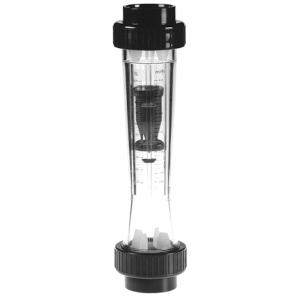
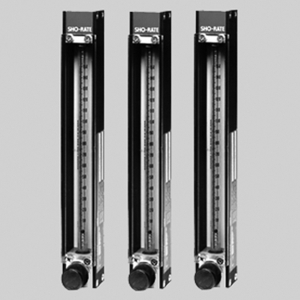
Alternatively, flowmeters can be used that already include compression fittings for hoses and tubes made of rigid plastics or solvent-weld and welded sockets for pipe systems as connections.
Challenges and Further Developments
Flow sensors are indispensable tools for ensuring the smooth operation of measurements and processes. As with any technology, flow measurement also involves challenges and considerations in order to maximize efficiency and accuracy.
Factors such as fluid properties, flow conditions, and device type influence accuracy, as do environmental conditions. Calibration, regular maintenance, and proper installation are also crucial for ensuring long-term accuracy and minimizing measurement errors.
Flow sensor technology is a field that is continuously evolving. In recent years, a number of new developments have emerged that improve the accuracy, reliability, and efficiency of these versatile all-rounders. These developments will help to further improve flow measurement technology and enable new applications:
- Smart sensors and processors can analyze and evaluate flowmeter data in real time. This enables processes to be monitored and controlled more effectively.
- Miniaturized flow sensors are suitable for use in small pipes and lines, as well as in mobile applications.
- Flow sensors are increasingly being used for measuring new media, such as liquid crystals or nanoparticles.
- AI algorithms can be used to analyze and evaluate data from flow sensors. This can help reduce errors and improve measurement accuracy.
- The development of flow sensors based on optical technologies is suitable for measuring non-conductive media.
Flow sensors are used in numerous applications and play a decisive role in the efficient monitoring and control of liquid or gas flows in industrial processes. The different types of flowmeters, such as magnetic-inductive flow sensors, ultrasonic flow sensors, variable-area flowmeters, vortex meters, and many others, provide solutions for different requirements and media.
The use of flow sensors will continue to increase in the coming years, as industry increasingly relies on precise measurements and data to optimize processes and comply with environmental standards. Advances in technology will lead to improved flowmeters that are more accurate, more reliable, and more efficient. In addition, the integration of IoT (Internet of Things) and data analytics will make it possible to collect and analyze real-time data in order to adjust and optimize processes in real time. This will contribute to better resource utilization and more sustainable production methods.
Image Sources:
Featured image | © Surasak – stock.adobe.com
Variable-area flowmeter made of plastic with socket connection | © Surasak – stock.adobe.com
Variable-area flowmeter with glass measuring tube and stainless-steel control valve | © Tricky Shark – stock.adobe.com