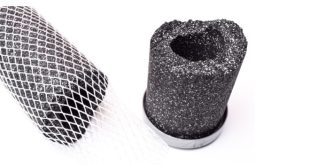
The two terms adsorption and absorption describe processes that take place at the interface between two phases. In adsorption, gases or liquids—known as adsorbates—adhere to the surface of a solid …
Read more »All articles
The Hardness of Materials
Knowledge of a material’s hardness is indispensable for its proper application. In response to this need, hardness testing methods were developed, particularly over the course of the last century. However, …
Read more »Silicon: Properties and Applications
Without silicon, our modern daily life would look entirely different. It is found in every microchip but also in baking moulds, lubricants, cosmetics, and plastics: the element silicon. Silicon – …
Read more »Polyolefins – Properties, Differences and Applications
The term polyolefins refers to polymers produced from alkenes such as ethene, propene, butene, 2-methylpropene, and 4-methyl-1-pentene. Polyolefins are saturated hydrocarbons characterized by low density, good chemical resistance, low water …
Read more »Deionised and Ultrapure Water: Production and Use
Fully demineralised water, also known as deionised, demi-water, demineralised, distilled, or ultrapure water — all look just like regular tap or spring water but contain very few or no foreign …
Read more »Aqua Regia: Applications and Properties
Industrial Applications and Compatible Hose Technology Many people have heard the term aqua regia, but what exactly is this special ‘water’ and what is it made of? The name “aqua …
Read more »Polyurethane: Properties and Applications
What do ski boots, household sponges, mattresses, and insulation panels have in common? All of these products contain the plastic polyurethane. Who Developed PUR? Polyurethane was developed in 1937 by …
Read more »Epoxy Resin: Production, Applications and Fields of Use of the Synthetic Resin
Epoxy Resin is a sought-after material used in industry, everyday life, and even in art. It is a synthetic resin which, when mixed with a hardener, forms a thermosetting plastic. …
Read more »Shut-off Valves: Types, Functions, and Applications
Shut-off valves are used to regulate or completely block a volume flow. For this purpose, a closing element, also called a closure element or shut-off body, is moved within a …
Read more »The POP List: Persistent Organic Pollutants
Persistent Organic Pollutants (POPs) are organic compounds that are harmful to humans and animals and degrade only very slowly in the environment. They contaminate air, soil and water and can …
Read more »
Reichelt Chemietechnik Magazine