 Reichelt Chemietechnik Magazine
How Hydroxide and Hydronium Ions Ensure Cleanliness in the Bathroom
Hygiene plays a more important role than ever in the current situation. Regular hand washing, social distancing, respiratory hygiene and avoiding contact with the eyes, nose, mouth are the most important, WHO-recommended measures to prevent the spread of the novel coronavirus, which now officially bears the name SARS-CoV-2. Just as important in everyday life is ensuring cleanliness and hygiene within your own four walls. But who can keep track of the many household cleaning products out there? They are usually liquid, smell fresh, and seem harmless, yet on many labels/instructions it says: “Do not mix with other cleaners“. But what exactly does that mean? And why must they not be mixed? Which cleaner is suitable for what? And why? The following article provides an overview of acids and bases in everyday life and also practical recommendations for the safe handling of these products.

Different Types of Contamination – Hair vs. Limescale
If you take a conscious look around your bathroom and try to identify which types of contamination are present, what is it that catches your eye first? In most cases, this will be limescale deposits on tiles, on the shower wall or on chrome-plated taps, but sometimes it is also the drains contaminated with hair and black sludge from an undefined biofilm – or even blocked drains. But how do you get rid of stubborn limescale residues without tedious scrubbing? How do you clear the drain again without having to dismantle the entire sink?
Acidic Cleaner Against Limescale
The first thing that matters is recognising the difference between various types of contamination so that you can decide which product should be used. The limescale deposits found in everyday household settings mainly consist of calcium carbonate (CaCO3).
In formal chemical terms, they are identical to naturally occurring lime minerals such as marble or calcite and form grey, unsightly films or crusts on tiles and fittings. All carbonates have one thing in common: their reaction with acids. In aqueous solution, acids release one or more protons (H+), which react in aqueous solution directly with the water molecule to form the hydronium ion (H3O+), which is responsible for the acidic property:
H+ (aq) + H2O (l) → H3O+ (aq)
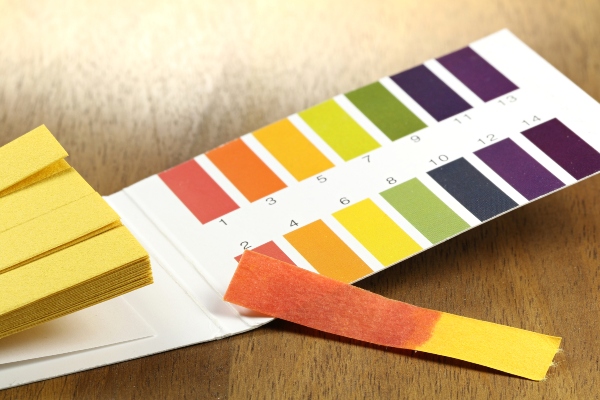
The indices written after the formulas indicate the states of the substances involved: l for liquid, aq for aqueous (i.e., surrounded by water molecules), g for gaseous and s for solid. For the sake of simplicity, reaction equations are often written in a shortened form, showing only the “free proton”, i.e., H+. Its concentration is, by the way, the key indicator for the pH value. A pH value below 7 indicates an acidic solution, a pH value above 7 an alkaline/basic solution, and a pH value of exactly 7 a neutral solution.
When an acidic cleaner is used against limescale deposits, the calcium carbonate dissolves under the release of carbon dioxide (CO2), which can be perceived as slight foaming, and what remains is limescale dissolved in water in the form of calcium ions (Ca2+), which can then be rinsed away. In the shortened reaction equation, this means:
2 H+ (aq) + CaCO3 (s) → H2O (l) + CO2 (g) + Ca2+ (aq)
For successful removal of limescale deposits in the bathroom, using acidic products is therefore recommended – but because of the carbon dioxide produced (CO2) and possible acidic fumes, it is important to ensure good ventilation. The acids most frequently used in cleaners, besides amidosulfonic acid, a strong inorganic acid related to sulfuric acid, are mainly citric acid and acetic acid.
These as well as other organic acids, such as tartaric, lactic or malic acid, can even be used directly to remove limescale deposits. Their advantage is that they are biodegradable. But as effective as acidic cleaning agents are at removing limescale, their corrosive properties should not be underestimated and require careful handling.
Alkaline Cleaner Against Hair and Other Organic Contamination
But what if it is not limescale on the tiled wall that needs to be removed, but rather a drain pipe clogged with hair, soap residues and other contamination that needs to be cleared again? One note in advance: an acidic solution will not work for this. Because unlike limescale, hair and similar substances are organic contamination. Acidic solutions are hardly effective against them. So what helps then? A basic solution!
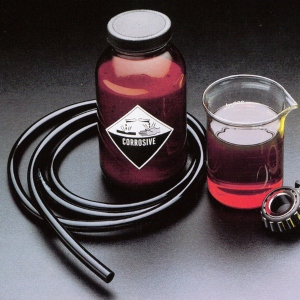
Bases have a pH value greater than 7. The terms base, lye, or alkaline solution are often used interchangeably. The latter stems from the fact that alkali metals, such as sodium and potassium, react with water to form their corresponding alkaline lyes or alkali hydroxides while producing hydroxide ions (OH–) and gaseous hydrogen (H2). By the way, this is a property shared by all bases:
NaOH (s) → Na+ (aq) + OH– (aq)
But how does this negatively charged OH ion, the anion OH–, help to clear a drain pipe? Various effects are responsible for this. Due to its negative charge, the hydroxide ion can adhere to dirt particles and thus make transport by water significantly easier. The other effect is far more complex. Organic contamination, such as hair, oils and fats, is broken down by the addition of the mostly chemically very aggressive alkaline solution through saponification and other reactions into water-soluble components.
This can be illustrated impressively with a small experiment at home: Add a little drain cleaner, which in most cases contains sodium hydroxide (NaOH), and some water to a beaker, which will initially warm up. Then add a small tuft of hair (simply collect some from a hairbrush) to the basic solution and wait a few days. The hair dissolves into a sticky, soapy substance that can be rinsed away with water. However: This experiment must only be carried out with safety goggles and protective gloves in a safe environment to prevent the corrosive solution from getting into the eyes or onto the skin!
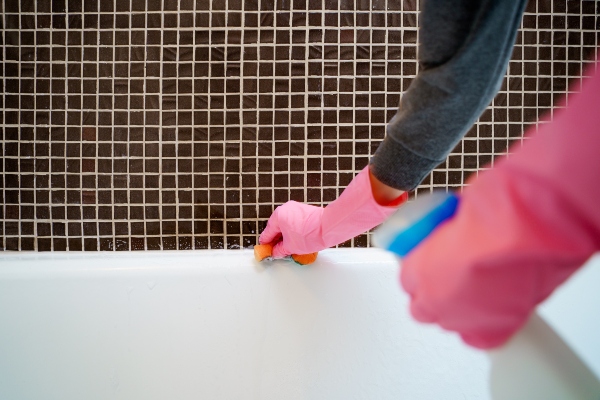
Do Not Mix Acidic Cleaners with Alkaline Cleaners! – But Why?
Just like acidic cleaners, alkaline cleaners are also mixtures of very different chemical substances that are intended not only to clean, but also to achieve a hygienic effect. But why is the simultaneous use of acidic and basic solutions not sensible, and why is mixing them so dangerous? The answer is simple: When acidic and basic solutions are mixed, a neutralisation reaction occurs, in which the hydronium ions of the acidic cleaner react with the hydroxide ions of the alkaline cleaner to form water, releasing neutralisation heat:
H3O+ (aq) + OH– (aq) → 2 H2O (l) + neutralisation heat
This neutralisation heat can reach temperatures up to +100 °C and thus bring aqueous solutions to the boil in a very short time. The danger essentially lies in the expansion of the water volume – one litre of water produces around 1,600 (!) litres of steam when strongly heated. So mixing acidic and alkaline cleaners can lead to dangerous scalding and, due to the chemicals involved, to no less serious chemical burns.
In addition, released gases can also become a hazard. Because sodium hypochlorite (NaOCl), often added to alkaline cleaners for disinfection purposes, the sodium salt of hypochlorous acid (the older term is “underchlorous acid”), reacts in acidic solutions to form chlorine gas (Cl2), which, if inhaled, can cause life-threatening damage to the respiratory tract and lungs.
Who Knows the Number?
There is a seemingly unmanageable number of cleaning products for household and bathroom use available on the market today. Keeping an overview is difficult, but still necessary in order to always use the right cleaner in the right place. Because any improper use, any mix-up, can become dangerous – after all, all these products contain aggressive chemicals in substantial concentrations, even if they smell pleasant, are attractively coloured and filled into clever little, unbreakable plastic bottles.
Safe storage of cleaning agents, especially protected from access by children, should therefore be a top priority.
Paying attention to the safety and usage instructions on the containers and, not least, having at least a basic level of chemical knowledge – including reading and understanding the ingredient list of cleaning products – also helps to prevent chemical accidents in the home.
Nevertheless
The end does not justify the means. For the sake of the environment, chemical cleaners should always be considered only as a last resort for household cleaning. Because the small household steam cleaner is often enough to restore the tiled wall in the bathroom and the chrome-plated tap to their former shine without effort – or to get a drain flowing again. You just have to try it.