 Reichelt Chemietechnik Magazine

Anyone who has worked in a lab knows that pipettes are indispensable for handling liquids. Depending on the design, they either transfer liquids simply or dispense them with precision. Laboratory pipettes are straightforward dispensing tools. With them, the user draws a volume of liquid from one vessel and transfers it into a second. Today, laboratory suppliers stock pipettes, pipetting aids and equipment in a wide range of designs.
A Brief History of the Pipette
The French scientist Louis Pasteur invented one of the very first pipettes in the 19th century, which is why it still bears the name “Pasteur pipette” today. Pasteur co-founded medical microbiology. In 1864, he developed the preservation process named after him, which briefly heats food to between 60 °C and 100 °C.

Hard as it is to imagine today, laboratories rarely used pipetting aids until the mid-20th century. Instead, technicians commonly pipetted by mouth. This practice carries serious risks, above all with infectious, radioactive and toxic substances. For that reason, the German Social Accident Insurance (DGUV) now strictly prohibits it. In 1957, Heinrich Schnitger invented a simple piston-stroke pipette. His device solved the problem of mouth pipetting and made transferring many small volumes far easier.
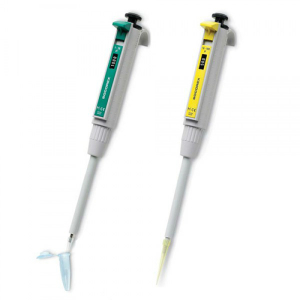 Manufacturers called it the Marburg pipette. A spring and a piston allowed it to dispense millilitre volumes. Once the prototype had been refined with the Eppendorf company, mass production began under the name “Eppendorf pipette”. Warren Gilson and Henry Lardy developed the first laboratory pipettes with an adjustable volume a little later, in the 1970s. The literature credits the first microlitre pipette partly to Schnitger and partly to Gilson.
Today, a wide variety of pipettes and controllers dispenses volumes as small as the picolitre range. In modern laboratories, robot-controlled systems also dispense liquids with great precision.
Pasteur Pipettes – Disposable Types in Glass and Plastic
The Pasteur pipette, sometimes called a transfer pipette, is a simple glass tube drawn to a point at one end. At around 2 ml, its volume is fairly small, and it carries no graduations.
Small rubber suction bulbs typically serve as the controller here. Suppliers also apply the name Pasteur pipette to disposable plastic versions, which usually come in volumes from 1 to 10 ml. These are moulded in one piece from flexible low-density polyethylene (LDPE), complete with an integrated bulb at the top.
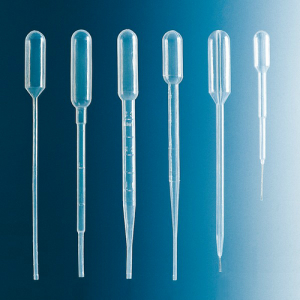
Unlike the glass version, they often do carry graduations. For medical laboratories, sterile disposable plastic variants are available as well. Because these disposables are not calibrated, they suit only the transfer of approximate volumes or drop-by-drop dispensing.
Volumetric and Graduated Pipettes
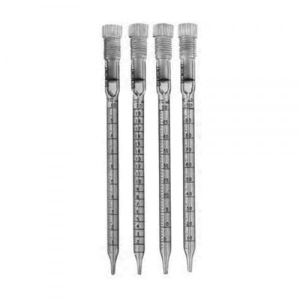
For exact volumes, volumetric or graduated pipettes are the right choice. Volumetric pipettes are calibrated to a specific volume, such as 25 ml. In essence, they consist of a long tube with a bulb (a wider section) in the middle and a ring mark, or calibration line, above it. Graduated pipettes, by contrast, keep a constant diameter and carry a scale. This lets the user measure out various volumes, though with lower accuracy than a volumetric one offers.
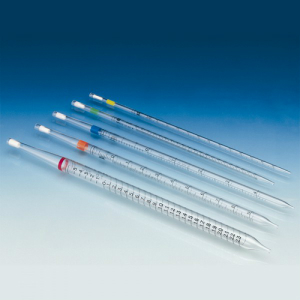
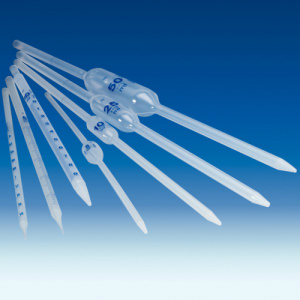
Disposable graduated types in polystyrene (PS) are also common and sell under the name “serological pipettes”. Their measurement error exceeds that of the glass type. In return, they come individually wrapped and sterile, which is why medical laboratories often use them for cell-culture work, for example. As a rule, laboratory pipettes are calibrated to deliver, marked “Ex”. Alongside this marking, it usually shows all the key figures: the nominal volume and the ± tolerance. Manufacturers also grade quality into classes A, B and AS. The table below compares these classes.
Comparison of tolerances, delivery times and waiting times for a 25 ml volumetric pipette across the different classes.
| Class | Tolerance / % | Delivery time / s | Waiting time / s |
| A | ± 0.13 | 25–50 | – |
| AS | ± 0.13 | 10–15 | 15 |
| B | ± 0.32 | 10–50 | – |
Class A has a narrowed delivery tip. This lengthens the delivery time but also raises accuracy, because residual liquid on the pipette wall can drain during that time. Class B offers shorter delivery times, yet accepts wider error limits. Class AS models have become very common. They combine a faster delivery time with a low margin of error. One point matters here: they require a 15-second waiting time, which the imprint also states. Pipetting correctly is not intuitive, since a whole series of errors can creep in.
How to Pipetting Correctly with a Volumetric Pipette
As a general rule, always hold the pipette vertically. A short guide to pipetting with volumetric pipettes runs as follows:
- Hold the pipette in the solution without touching the bottom
- Using a controller, draw the liquid to about 5 mm above the calibration mark
- Wipe its lower section
- Slowly release the liquid down the glass wall of the tilted vessel to the required level. When checking the level, make sure the lowest point of the meniscus touches the calibration line, and keep it at eye level as you read.
- Hold it in the target vessel and let the liquid run down the glass wall, again keeping the vessel tilted
- Observe the waiting time if required, then wipe off against the glass wall
If a drop remains, do not try to force it out. The calibration already accounts for that residual drop.
Pipette Controllers: Filling Aids from Bulb to Battery
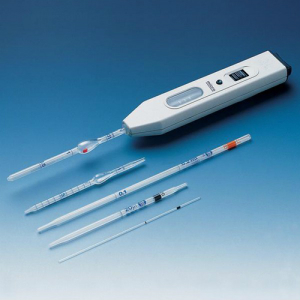
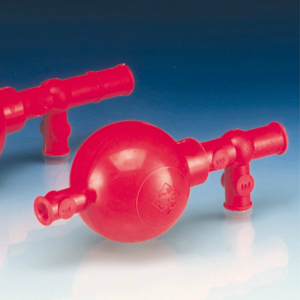
With volumetric, graduated and serological pipettes, a controller draws the liquid up. Today, most laboratories keep a whole range of such aids on hand. One of the most common is the Peleus ball, invented by Friedrich Pels Leusden. Users favour it above all for its simple operation. Simpler suction bulbs such as the Aspirette and the Howorka ball are also common, though both take more practice.
Modern controllers come in manual and battery-operated versions, and the aspiration speed is adjustable. This makes drop-by-drop dispensing possible too.
Microlitre, Multichannel and Repeating Pipettes: Dosing at Scale
Microlitre pipettes and repeating dispensers are dosing instruments that usually let the user set the required volume. For small volumes in the microlitre range (roughly 0.1 µl to 5 ml), these instruments achieve high accuracy. To stop the solution from being drawn straight into the instrument, they use disposable attachments known as pipette or dispenser tips. The user should not touch these tips by hand at any point during pipetting. Special boxes hold the tips in order and make fitting them easy.
An ejector button removes the tip, which also allows use under sterile conditions.
Unlike microlitre or standard laboratory pipettes, repeating dispensers can take up a larger volume and release it in several portions. This spares the user from drawing up liquid each time. Multichannel pipettes work on the same principle as microlitre models. The difference is that they draw up and dispense liquid through 8 to 12 tips arranged in a row, rather than a single tip. In biology and medical technology especially, this aid saves time when working with microtitre plates.

Pipetting Correctly: Common Pitfalls to Avoid
Disposable Items
With disposable plastic items such as Pasteur pipettes or pipette tips, always check how well the plastic resists the solvents in use. Since contact times are usually short, the risk of the plastic being attacked stays fairly low. For that reason, laboratories often reuse disposable items. Should the plastic degrade, however, significant dosing errors can follow.
Correct Handling
Before you start, consider which type of pipette best suits the task. That assessment should weigh the volume, the solvent and the accuracy required. Correct handling of the chosen tool matters just as much for an exact volume. With micropipettes, a typical error is liquid entering the barrel, for instance when a filled one is laid down. Glass pipettes, by contrast, often lead to errors when reading the meniscus.
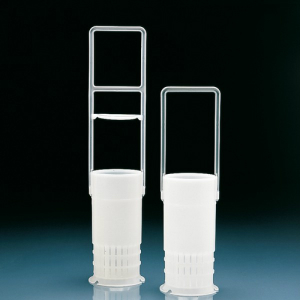
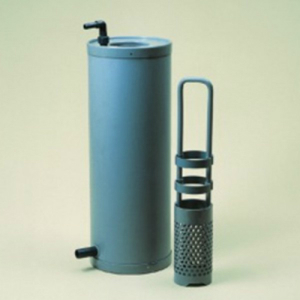
Correct cleaning is another absolute must for glass pipettes. Only when it is grease-free and clean does the liquid drain properly, avoiding contamination. That is essential for sensitive applications such as trace analysis.
Image sources:
Featured image | © hakat – stock.adobe.com
Pasteur pipette in the laboratory | © pressmaster – stock.adobe.com
Everyday laboratory scene | © Gorodenkoff – stock.adobe.com