 Reichelt Chemietechnik Magazine
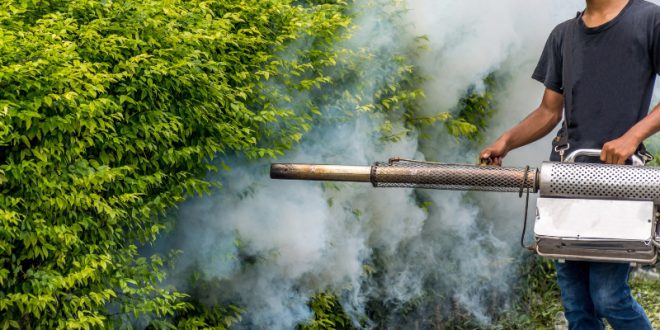
Persistent Organic Pollutants (POPs) are organic compounds that are harmful to humans and animals and degrade only very slowly in the environment. They contaminate air, soil and water and can enter the food chain. When consuming foods contaminated with these compounds, POPs can enter the body, accumulate in adipose tissue and trigger health problems. With the “Stockholm Convention on Persistent Organic Pollutants” (the Stockholm Convention), international restrictions on the manufacture, use and release of organic pollutants were established for the first time in 2004. Since then, follow-up conferences have been held every two years at which the contracting parties decide on the inclusion of additional chemicals in the POP list.
A Global Problem for Humans and Nature
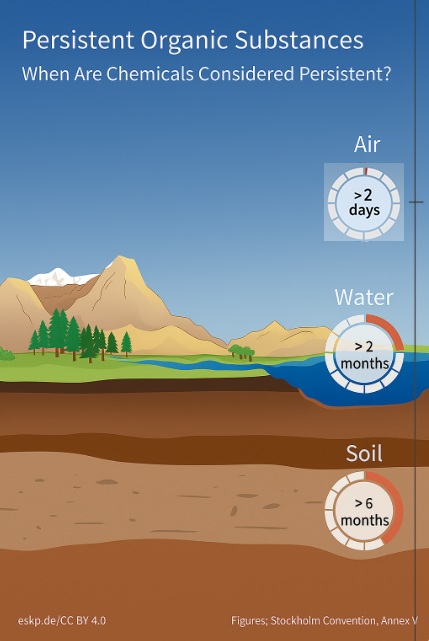
Persistent organic pollutants are problematic substances that are broken down only very slowly by natural processes and can remain in the environment for decades. They spread through the atmosphere and accumulate in soils, eventually reaching our water reservoirs. In addition, they can be adsorbed by suspended matter and accumulate in sediments. In this way, they can enter our bodies through the air we breathe and the food we consume. This is known as bioaccumulation. As the concentration of these substances in the body increases, harmful effects become more likely.
Many products we use every day often contain POPs. Substances used to improve product performance are not always recognised as pollutants at first. Human exposure to these mostly genotoxic compounds can increase cancer risk and lead to neurologically induced behavioural disorders, reproductive disorders, a rise in birth defects and miscarriages, as well as pathological changes to the immune system. Recently, Korean scientists reported that children with pronounced obesity respond more strongly to chemical influences than non-obese children from comparable groups. In particular, the likelihood of an earlier onset of puberty is increased in these cases.
International POP Convention
Persistent pollutants cross borders and travel far from their sources, reaching regions where they have neither been used nor ever produced. They therefore affect ecosystems worldwide, the environment, nature and human health.
The original list of substances under the Stockholm Convention comprised twelve persistent chemicals and was divided into three categories:
- Pesticides: Aldrin, Chlordane, Dieldrin, DDT, Endrin, Heptachlor, Hexachlorobenzene, Mirex, Toxaphene
- Industrial chemicals: Polychlorinated biphenyls (PCBs)
- Industrial by-products: Polychlorinated dibenzo-p-dioxins and dibenzofurans
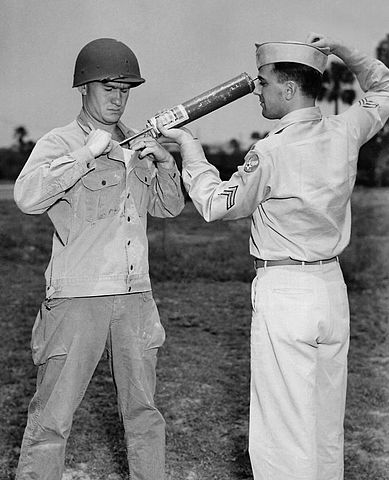
Subsequently, the manufacture and use of further substances, such as DDT, were significantly restricted, and the manufacture and use of several other chemicals, such as the insecticide Aldrin and polychlorinated biphenyls, of which 209 congeners exist, were already completely banned.
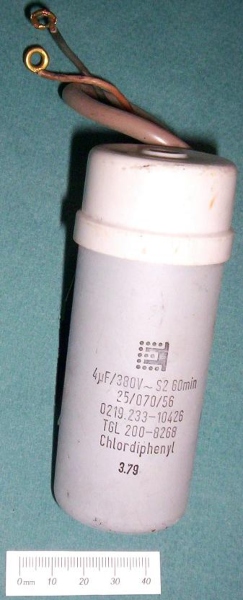
Polychlorinated biphenyls (PCBs) are highly stable chemicals, that were used in a wide range of industrial and consumer goods until the 1980s as plasticisers for plastics and paints, but also as hydraulic fluids, insulating oils in high-voltage transformers and as puncture-resistant dielectrics in electrolytic capacitors. The latter were installed in every radio and television set of the time. PCBs, however, are carcinogenic, affect the immune system and accumulate in human adipose tissue and breast milk. Studies have shown that neurological developmental disorders in children are likely to occur even at low levels of PCB exposure.
Relevant EU Regulations
In April 2004, EU Regulation (EC) No. 850/2004 (the EU POP Regulation) set out detailed requirements for the manufacture, use and limitation of persistent organic pollutants. The European Chemicals Agency (ECHA), based in Helsinki and responsible for the enforcement of the EU Regulation, specified special implementing provisions in four annexes:
- Annex I concerns the prohibition of manufacture, placing on the market and use of persistent organic pollutants, with specific exemptions;
- Annex II concerns restrictions on the manufacture, placing on the market and use of persistent organic pollutants;
- Annex III concerns the regulation of the release of small quantities of persistent organic pollutants;
- Annex IV sets out provisions for handling persistent organic pollutants within the framework of waste management.
The Stockholm Convention lists POPs in three annexes that are constantly updated and supplemented:
- Annex A comprises chemicals whose manufacture and use are prohibited
- Annex B comprises chemicals whose manufacture and use are permitted only under restrictions
- Annex C comprises chemicals that arise as unintentional by-products of chemical production processes or in incineration plants and must be minimised or entirely avoided through process modifications
In Germany, the competent authorities for monitoring compliance with the POP Regulation are the Federal Chemicals Agency (BfC) and the Federal Institute for Occupational Safety and Health (BAuA). The German Environment Agency (UBA) also performs certain tasks at national and international level within the scope of these regulations.
As part of the POP Convention, further chemicals were added to the POP list in 2009, primarily pesticides and insecticides: pentachlorobenzene, gamma-hexachlorocyclohexane (γ-HCH), α- and β-hexachlorocyclohexane, and chlordecone. In addition, perfluorooctane sulfonic acid (PFOS) and its salts, which were used as surfactants, as well as tetra-, penta-, hexa- and hepta-bromobiphenyls, which, like PCBs, were used as plasticisers and flame retardants, were included.
In 2011, endosulfan, a neurotoxic insecticide, was added, and in 2013 hexabromocyclododecane (HBCD). The latter was used mainly as an additive flame retardant for rigid polystyrene foams in the construction sector and in the furniture industry and thus found widespread use in people’s immediate living environments. HBCD degrades only slowly under environmental conditions and, as a bioaccumulative substance, can also enter our food via many pathways. As animal studies demonstrated damage to embryonic and infant development, the precautionary inclusion of HBCD in the POP list and therefore the general prohibition of its manufacture and use was a necessary decision.
In 2015, three further chemicals were added to the POP list: pentachlorophenol (PCP), its salts and esters; polychlorinated naphthalenes (PCNs), which act as fungicides and were used in wood preservatives; and hexachlorobutadiene (HCBD), a biocide used predominantly in industrial water reservoirs and cooling-water systems to prevent algal growth. In 2017, the list was expanded to include decabromodiphenyl ether, a flame retardant, and in 2019 finally perfluorooctanoic acid (PFOA), a perfluorinated, bioaccumulative surfactant attributed with hepatotoxic and carcinogenic properties.
Further chemicals are currently under discussion and are being reviewed for inclusion in the POP list. These include
- Dechlorane Plus (DDC-CO), a flame retardant
- Perfluorohexane sulfonic acid (PFHxS) and its salts, still used as technical surfactants
- Methoxychlor (DMT), a plant protection product chemically related to DDT
In July 2019, EU Regulation (EC) No. 850/2004 was replaced by EU Regulation 2019/1021.
… and What Comes Next?
To date, 183 of the 193 UN member states have acceded to the “Stockholm Convention on Persistent Organic Pollutants” of 2004. Almost all states have thus committed themselves not only to strictly monitoring the manufacture, use and effects of chemicals, but also to helping prevent the release of persistent toxic and hazardous substances into the environment.
The majority of chemicals synthesised and known to date are organic compounds. Their number has long exceeded the 100-million mark and new ones are added every day. However, the effects of only a few of these substances on humans and the environment are sufficiently well known. Even substances such as polychlorinated biphenyls, which, due to many favourable properties, were produced on an industrial scale from 1929 and saw worldwide application, were recognised as chronically toxic chemicals only decades later, in the 1980s. The long-standing, careless handling of this supposedly harmless chemical has led to global PCB contamination, the consequences of which for subsequent generations are still not reliably foreseeable. May the signatories of the Stockholm Convention do everything to ensure that future hazards to humankind from insufficiently tested synthetic chemical products are safely ruled out.
Image sources:
Cover image | © pongmoji – stock.adobe.com
Graphic: When are chemicals considered persistent? | © Geografik – de.wikipedia.org
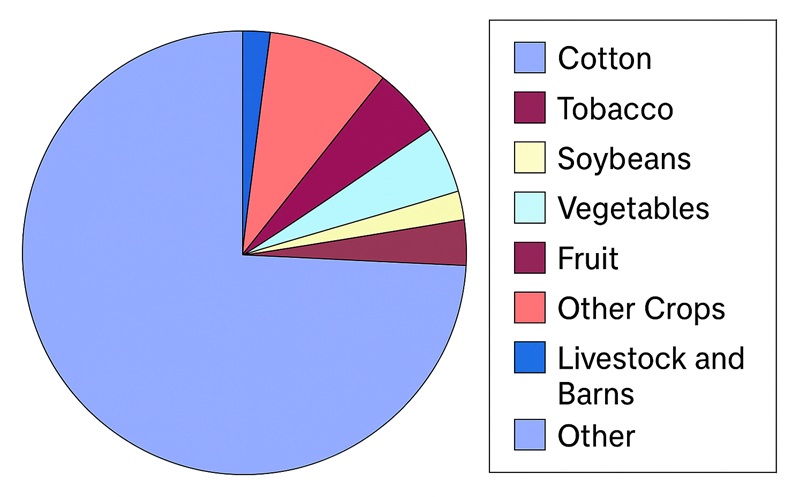
Diagram: Distribution of a total of 14,500 tonnes of DDT used in U.S. agriculture in 1963 | © Blech – de.wikipedia.org