 Reichelt Chemietechnik Magazine
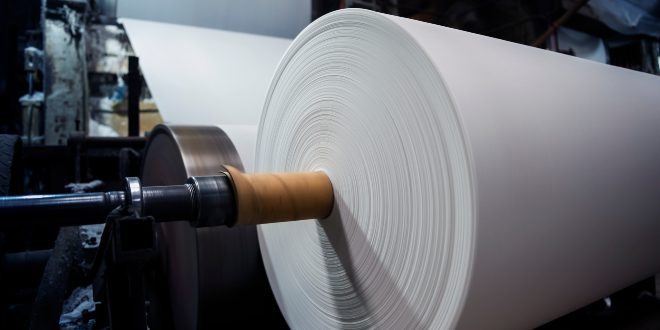
In terms of cost efficiency, calendering technology remains indispensable not only in the production of fabrics, textiles, and paper and in achieving specific surface finishes. It also demonstrates clear advantages in shaping sheets and films made of PVC and other polymers in large production batches. This article briefly and concisely outlines how it all began, when major developmental breakthroughs occurred, and what this processing technology is capable of today.
The term originates via the French calandre from the Greek κύλινδρος/kylindros, originally meaning “roller”. The geometric form known as the cylinder derives its name from the same root. The term has virtually nothing to do with a calendar.
Fabrics and Textiles – The Beginnings of the Calender
Processes that could be described as precursors to calendering date back to textile and paper production in ancient times. In ancient China, for example, large stones were rounded and polished smooth in order to press woven fabrics. This made it possible to smooth the textiles, seal them against wind and water, and give them a particularly glossy surface. One of the best-known fabrics refined using this technique is satin, which takes its name from the former place of manufacture or trade, Tsen-Tung, now Quanzhou.
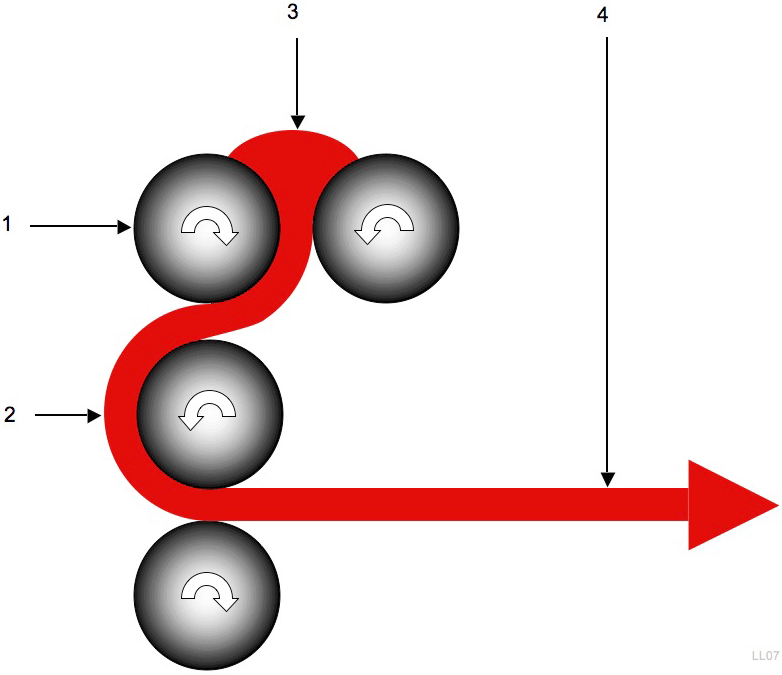
The first known calenders, machines in which pressure is applied to the workpiece by several rotating rollers, were used in the 16th and 17th centuries in the production of the then world-famous Flemish fabrics.
Calenders generally consist of two to four rollers, although depending on the design there may be significantly more. The rotating rollers are typically made of steel or chilled cast iron with high hardness and toughness. Depending on their application, they are arranged in different configurations. Common designs include I-, F-, L-, and Z-calenders. The designation of these designs results from the positioning of the individual rollers in the side view of the machine and the material feed.
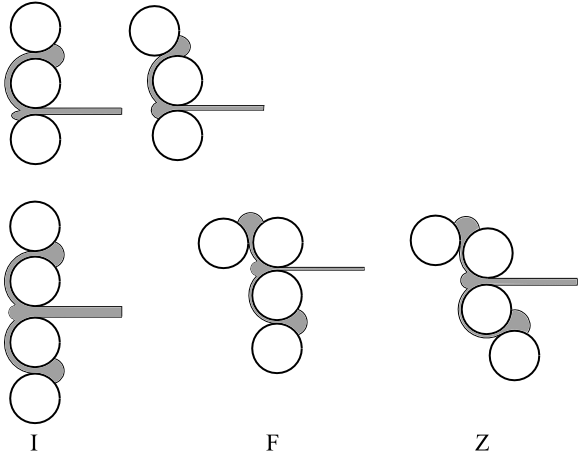
The spacing and material of the heated and polished rollers are determined by the material to be processed (fabric, paper, polymer melt, rubber, or metals) and the desired thickness or structure. Despite the name, the rollers are not completely cylindrical. Instead, they are slightly thicker in the center to compensate for deflection under their own weight, resulting in a subtle barrel shape. This thickening is alternatively referred to as camber. To stabilize the running of the rollers, an anti-vibration compound is often applied to the inside of the roller.
Paper Production
Like satin-finished fabrics, paper was first produced in China, according to historical sources around 2,000 years ago. A pulp made from various plant fibers, adhesive, and water was created, the solid components were skimmed off, and the material was pressed or hammered between plates.
When paper reached Europe via the Arab world in the late Middle Ages, it was considered inferior to parchment and was not permitted for handwritten official documents. However, around 1450, when Johannes Gutenberg invented the printing press in Europe – although it had already existed in East Asia on a smaller scale for centuries – the demand for paper increased dramatically. Here too, calendering enabled the mass production of paper and thus the dissemination of information.
The calender smooths the paper and ensures uniform thickness, as required for book printing, for example. Historically, it was also important in the production of paper capacitors for electrical engineering applications.
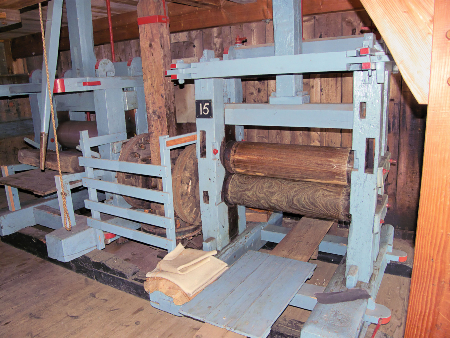
Depending on requirements, the paper may undergo further calendering. To produce machine-coated paper, a coating layer of binders is applied to the machine-smoothed paper to improve its printability. A form of machine-coated paper is high-gloss paper, in which an additional layer of pigments and binders is applied to achieve gloss. A machine consisting of several calenders used in subsequent finishing processes is referred to as a supercalender. One technique to further improve surface quality is satin finishing, in which several heated steel smoothing rollers further refine the paper surface.
Coated Fabrics and Textile Lamination
One of the earliest practical applications of calendering plastics was the production of laminated fabrics, combining the stability of the base fabric with the sealing and chemical properties of the polymer.
In offices, schools, or at home, a similar process is used with laminating devices, where a thermoplastic film is applied to paper or similar materials.
One of the first calenders – featuring four rollers – was developed in 1836 by the American inventors Edwin M. Chaffee and Charles Goodyear to produce waterproof, rubberized mailbags. However, as rubber technology was not yet fully developed, the applied rubber was often still sticky, rendering the bags unusable. It took several more decades before rubber production became sufficiently reproducible for economic textile lamination.
When the first calender for fabric coating was successfully used in 1874, it marked the beginning of mass production of coated fabrics. These included tarpaulins as well as conveyor belts, which further accelerated the industrial revolution. Today, coating calenders are usually designed in a Z-configuration.
Film Production
While coating calenders are used to coat fabrics, melt calenders are employed in film production. With the development of chemically synthesized polymers and their rapidly increasing production in the first half of the 20th century, processing methods were required to convert them into large quantities of finished products such as films for seat covers, tablecloths, tarpaulins, or automotive interiors. Calendering thus became a preferred process for the mass production of films, backing materials for adhesive tapes, and thin sheets made of thermoplastics.
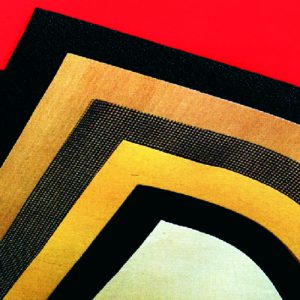
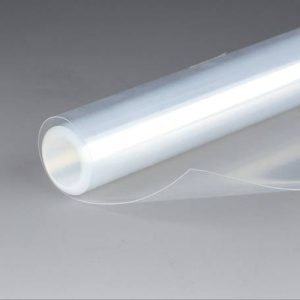
In the 1930s, various German and American manufacturers developed calendering processes capable of processing polyvinyl chloride (PVC), which becomes readily formable at temperatures between +120 and +150 °C. Even today, PVC remains the most frequently processed thermoplastic in this method. This film production technique is more cost-effective than extrusion, which is used to manufacture hoses, plastic pipes, and rods, but it places specific requirements on the material.
Polymers with overly low-viscosity melts, such as certain types of polyethylene (PE), cannot be processed in this way. Other suitable materials include acrylonitrile-butadiene-styrene copolymer (ABS) and polystyrene (PS). Some metal foils can also be produced using a melt calender, such as tin foil, which was historically manufactured by calendering molten tin. Today, however, this method plays only a minor role compared to rolling mill production.
The gap between the rollers of a PVC calender determines the thickness of the product, typically ranging from 75 µm to 800 µm for PVC. PVC sheets for flooring applications with thicknesses of up to 5 mm can also be produced in this way.
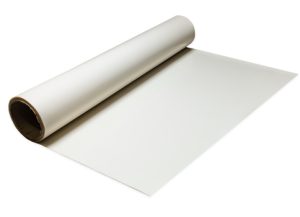
Calendered polystyrene sheets based on styrene-butadiene are characterized by exceptional hardness and rigidity. Very thin plastic films, by contrast, are generally produced using blown film extrusion, in which molten polymer, usually polyethylene, is blown through a die, then rolled and wound. Depending on plasticizer content, F- or L-calenders are used for PVC processing. Additional product properties can be modified by adjusting temperature, calendering speed, and roller surface structure.
Conclusion
Although the term calendering may not be widely known, calendered products are encountered everywhere – unfortunately often also in the form of plastic waste. While calendering gives raw materials in the paper and textile industries new surface properties, it provides plastics with an entirely new shape.
In this way, calendered products have not only achieved widespread distribution but through conveyor belts and continuous paper they have also played a decisive role in the growth of industrial production and in the dissemination and transmission of information.
Image Sources:
Feature image | © hxdyl – stock.adobe.com
Calender process for film production | © Author not specified in machine-readable form. LaurensvanLieshout assumed as author (based on rights holder information). Public domain, via Wikimedia Commons
Examples of roller arrangements in calenders | © kifo, Public domain, via Wikimedia Commons
Paper mill "De Schoolmeester" | © Rasbak, CC BY-SA 3.0 <http://creativecommons.org/licenses/by-sa/3.0/>, via Wikimedia Commons