 Reichelt Chemietechnik Magazine
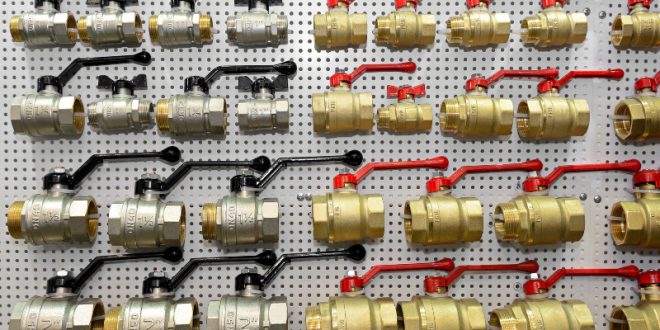
Shut-off valves are used to regulate or completely block a volume flow. For this purpose, a closing element, also called a closure element or shut-off body, is moved within a pipeline. Depending on the design and function of the valve, a distinction is made between cocks, valves, gate valves and butterfly valves. Cocks and butterfly valves serve only as shut-off valves, while gate valves and, above all, valves can also be used to regulate and control a volume flow.
What Are Gate Valves?
With gate valves, the gas or liquid flow is partially or completely separated by a movable closing element. The closing element is raised or lowered perpendicular to the direction of flow by means of a spindle and moves along the sealing surfaces of the valve housing. The closing element may take the form of a cone, a piston or a plate. When fully open, these shut-off valves have a very low flow resistance compared to other taps, cocks and valves.
How Does a Butterfly Valve Work?
A butterfly valve or throttle valve is a valve in which the gas or liquid flow in a pipeline is regulated by a rotatable disc or vane located in the flow cross-section. The disc or vane is moved about its central axis lengthwise or crosswise in the fluid stream. A 90° rotation of the closing element fully opens or closes the pipeline.
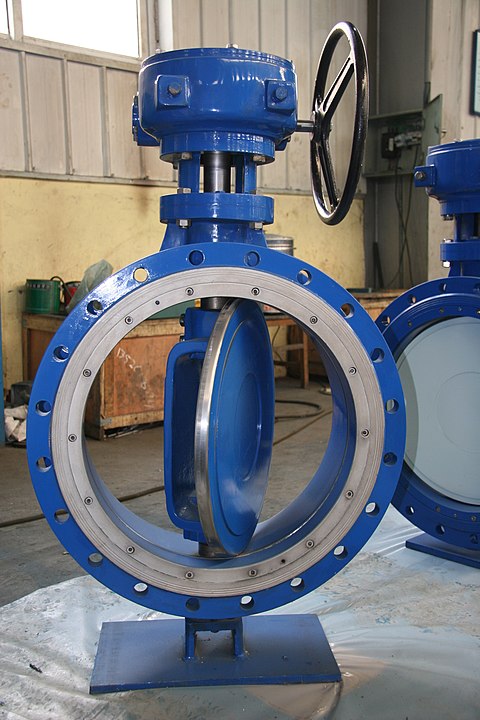
When fully open, the disc is positioned parallel to the direction of flow. As a result, butterfly valves have a certain flow resistance in the open position. They are characterized by a short installation length and the associated low space requirement. Butterfly valves can regulate the gas or liquid flow only to a limited extent. The group of butterfly valves also includes check valves, which allow the flow of a liquid or gas in only one direction.
Shut-off Valves / Shut-off Cocks
A shut-off cock is a valve that either completely opens or blocks the flow of a liquid or gas. Opening or closing the cock is achieved by a 90° rotation of the closing element.
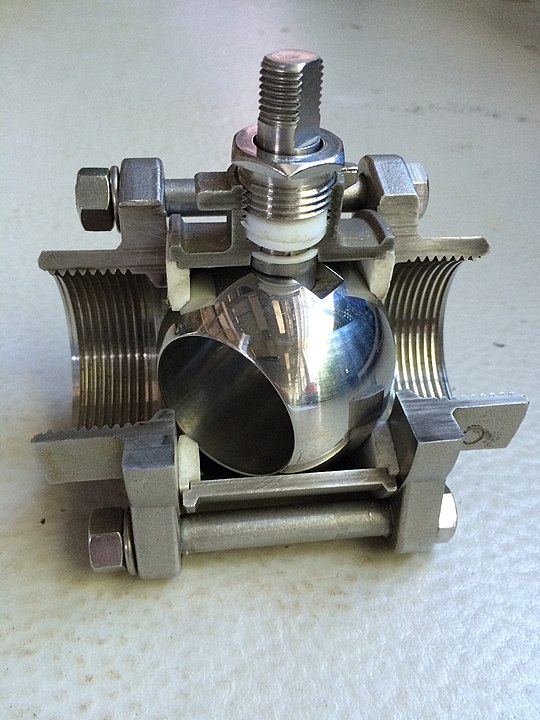
If it is shaped as a ball, it is called a ball valve; if shaped as a cylinder, a cylinder or piston cock; and if shaped as a cone, a plug cock. When fully open, these shut-off valves have a low flow resistance. Cocks are used as stop-cocks and straight-way cocks, filling cocks, drain cocks or shut-off valves.
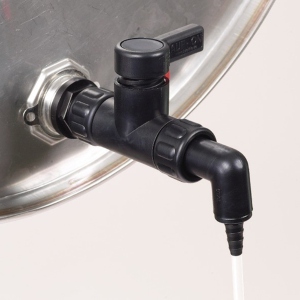
These types of cocks are also referred to as drain cocks, filling cocks or barrel cocks. On one side these cocks have a thread or a fitting for connection to a container, barrel or pipeline; on the opposite side there is a straight or curved outlet, a thread or a barb connector. These cocks may also be used as filling cocks.
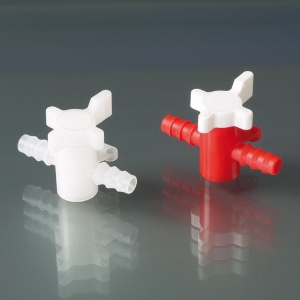
The group of cocks also includes multiple-way cocks. These have more than two ports and, depending on the number of openings, are referred to as three-way or four-way cocks. These valves can be used to distribute or mix gases or liquids.
Two- and three-way cocks with Luer-Lock connections are frequently used in medical and hospital technology.
Types of Valves
Valves are fittings used to shut off, regulate or control the flow or direction of liquids or gases. For this reason they are also referred to as regulating valves.
They consist of a closure element with a sealing surface. When closing, the closure element is pressed against a correspondingly shaped opening, the valve seat or sealing seat in the housing, by means of a spindle. Several turns are required to fully open or close the valve. In the area of the closure element and valve seat, the flow direction is redirected. Valves therefore have a higher flow resistance than cocks, butterfly valves and gate valves.
The closure element may take the form of a disc, a cone, a ball, a needle or a diaphragm. Accordingly, these shut-off valves are referred to as disc valves, cone valves, ball valves, needle valves or diaphragm valves.
Different Valve Shapes
According to their shape, a distinction is made between straight-way valves, angle valves and multi-way valves. In straight-way valves, both pipe connections lie on one axis, and the flow direction is the same at the inlet and outlet. The inlet and outlet openings may have different cross-sections. Straight-seat and angle-seat valves belong to the straight-way valves. In straight-seat valves, the closure element is perpendicular to the flow direction, while in angle-seat valves it is positioned at an angle of about 45°. In angle valves, the inlet and outlet openings are arranged at right angles to each other.
Multi-way valves are valves that can open or close several flow paths. Their designation is based on the number of openings. Thus, a three-way valve has three openings, a four-way valve four. Multi-way valves are used for mixing or dividing fluid streams.
What Functions Do Valves Have?
According to their function, a distinction is made between flow valves, check valves, pressure valves and multi-way valves. Flow valves regulate or control a volume flow. If they operate pressure-dependently, they are called throttle valves; if pressure-independent, flow control valves.
Check valves ensure that a volume flow can move in only one direction and does not flow back. Check valves are found in drinking water systems, in wastewater engineering and in pump lines.
Pressure valves or pressure retaining valves are used to regulate, control or limit pressure. Pressure reducers, which reduce high inlet pressure in water lines or gas cylinders, belong to this group of pressure valves.
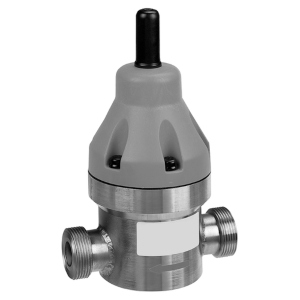
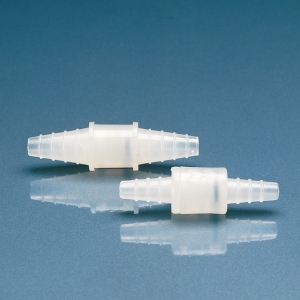
Multi-way valves have more than two ports and switching positions. Switching positions determine which inlet ports are connected to which outlet ports. Multi-way valves are named according to the number of their ports and switching positions: a 3/2-way device has three ports and two switching positions.
Tube Pinch Valves: A Special Form of Valve
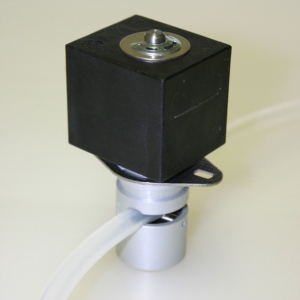
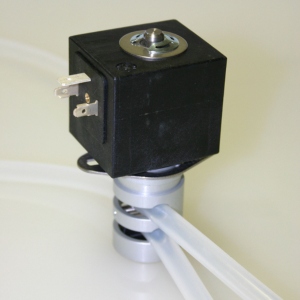
Pinch valves or tube pinch valves carry the designation “valve,” but the regulation of the volume flow does not take place by means of a closure element inside the pipeline. Instead, the cross-section of the media-carrying hose line is manipulated.
Soft elastomer tubing, usually made of silicone, is inserted into the housing of the pinch valves. By mechanically compressing or pinching the tube, e.g., by means of an electrically or pneumatically actuated wedge inside the valve, the cross-section of the tube is reduced until completely closed. As a result, the media flow is interrupted. When the force is released, the elastic tube returns to its original shape: the cross-section opens, and liquids and gases can once again flow through unrestricted.
This prevents contamination of the medium and protects valve components from corrosive or particle-loaded chemicals.
However, hose pinch valves have only two states, open and closed, and they are designed only for nearly pressureless applications. If the line pressure exceeds the limit specified by the manufacturer, the pinching force of the valve is no longer sufficient to prevent the hose from opening and leakage occurs.
Types of Actuation for Shut-Off Valves
Valves can be actuated manually, electromagnetically, pneumatically or by media. Manual valves are operated by lever, handwheel or crank. In solenoid devices, opening and closing is achieved magnetically. An electric current generates a magnetic field inside the coil, which moves the closure element. Pneumatic actuation requires compressed air. Valves that are pneumatically controlled are called pneumatic units.
Only a 90° rotation of the closure element is required to open or close butterfly valves and cocks, whereas several turns are necessary for gate valves and shut-off units. Therefore, butterfly valves and cocks can be opened or closed more quickly than gate valves and shut-off components.
Plastic Valves or Metal Valves?
Shut-off valves are indispensable in water treatment, environmental technology, the chemical, pharmaceutical and semiconductor industries as well as in metallurgy. Whether plastic or metal valves are used depends on operating conditions such as temperature, pressure or medium. At temperatures above +120 °C and pressures greater than 16 bar, metal valves are recommended. At lower temperatures and pressures, plastic valves are often the preferred solution. They are more cost-effective and lighter than metal valves. This facilitates transport, storage and installation. In addition, they are more resistant to abrasion.
Metal shut-off valves, mainly used for gases, liquids and vapors, are made of stainless steel and brass. Plastic components are produced from materials such as HD polyethylene (HDPE), LD polyethylene (LDPE), polypropylene (PP), polytetrafluoroethylene (PTFE), PFA (perfluoroalkoxy) or polyamide (PA).
The selection of a suitable valve depends on the requirements regarding temperature, pressure, medium and function. Due to the wide range of shut-off valves available, a suitable valve can be found for every application.
However, caution is advised, as shut-off valves are often incorrectly named in everyday language. For example, the “water tap” actually belongs to the group of valves and not cocks, and the bicycle valve is actually a check valve.
Image sources:
Cover image | © FedotovAnatoly – stock.adobe.com
Butterfly valve | © Heather Smith - The Alloy Valve Stockist's photo gallery., CC BY 3.0, https://commons.wikimedia.org/w/index.php?curid=9488547
Ball valve | © Bitjungle, CC BY-SA 4.0, https://commons.wikimedia.org/w/index.php?curid=41064308