 Reichelt Chemietechnik Magazine

The Birth Certificates of Chemical Substances
In chemical research – and especially in the development of new chemical products – detailed knowledge of the properties of the raw and auxiliary materials used is an essential prerequisite. When conducting literature searches, reviewing patents, or browsing databases, one almost always encounters the so-called CAS numbers alongside the usual substance data. The following article explains how they are created and what they mean.
According to the latest figures from the American Chemical Society (ACS), more than 140 million chemically defined substances are currently known – and the number continues to grow daily. These substances are mainly published in scientific journals and patent documents and are increasingly indexed in databases that serve as information tools. However, many of these databases are field-specific and therefore not comprehensive.
One example is the extensive GESTIS database, which is maintained by the German Social Accident Insurance. It mainly focuses on substances relevant to occupational safety and accident prevention. This can be compared to national occupational safety databases or toxicological information systems available in other European countries.
GESTIS, for instance, lists pure water (H2O) but not its isotopic analogues: so-called heavy water, deuterium oxide (D2O), and radioactive tritium oxide (T2O).
The Chemical Abstracts Service (CAS)
The most comprehensive database for chemical research is provided by the Chemical Abstracts Service (CAS), based in Columbus, Ohio, USA. Established in 1965, CAS serves as a classic reference database for literature searches.
This service is operated by the American Chemical Society (ACS), the world’s largest professional organisation for chemistry, which evaluates global scientific literature and records every newly identified substance.
In addition to English abstracts of collected scientific articles, the CAS database offers direct links to the original publications. It contains nearly all scientific literature on chemistry, biochemistry, polymer technology, and materials science dating back to 1907.

The CAS Number
A CAS number (Chemical Abstracts Service Registry Number) is the unique registration number assigned to each individual substance entry in the CAS database. It provides a clear numerical identifier for every chemical substance. The numbers are issued sequentially and bear no intrinsic relation to the properties or structure of the compound itself. In this sense, the CAS number functions as a “birth certificate” for each known chemical substance.
The CAS number consists of up to ten digits divided into three blocks (e.g. 9 8 7 6 5 4 3 – 2 1 – 0). The first two blocks represent the registration entry; the last digit is a check digit that verifies the validity of the entry. It is calculated as the last digit of the weighted sum of all preceding digits in the CAS Registry Number, using the following formula:
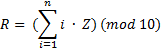
For example, for the polymer polypropylene (PP) with CAS Registry Number 9003-07-0, the check digit 0 results from the following calculation (from right to left):
R = (1 x 7) + (2 x 0) + (3 x 3) + (4 x 0) + (5 x 0) + (6 x 9) = 70
Since the sum R = 70, the check digit is 0. Thus, the complete CAS number for polypropylene (PP) is 9003-07-0.
The CAS Database in Practice
The CAS database provides information on virtually every chemical substance known to date — including minerals, polymers, alloys, proteins, and DNA sequences. It also contains entries for all chemical elements, each uniquely documented by its CAS number, for example: oxygen (CAS number 7782-44-7), chlorine (CAS number 7782-50-5), lead (CAS number 7439-92-1), and radioactive plutonium (CAS number 7440-07-5).
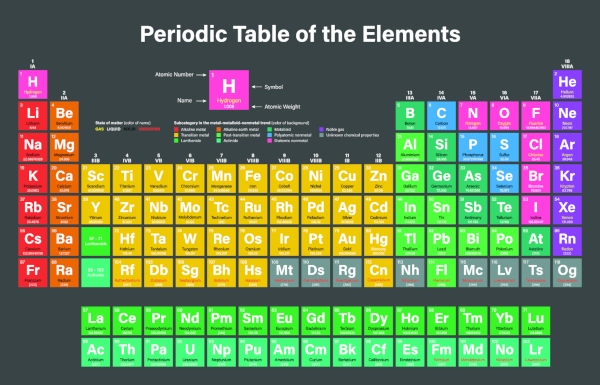
Even recently synthesized, artificial elements have been added to the CAS Registry. The element Tennessine (Ts), first produced in 2010 and assigned atomic number 117, has the CAS number 87658-56-8.
Likewise, the superheavy element Oganesson (Og), with atomic number 118, is registered under 54144-19-3. Its existence, first reported in 2006, was debated for years until it was officially confirmed by the International Union of Pure and Applied Chemistry (IUPAC) in 2015.
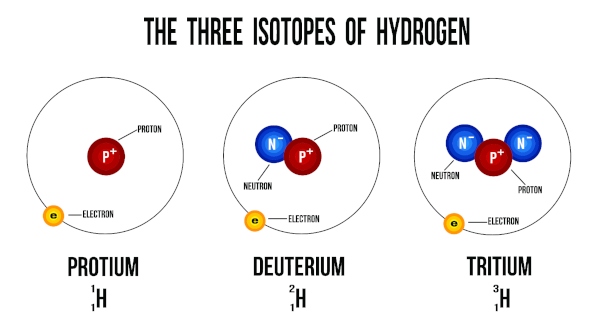
Unlike many other databases, the CAS Registry also includes isotopic analogues of compounds. This can be illustrated using water:
Pure water (H₂O) has the CAS number 7732-18-5, while so-called “heavy water” (D₂O), in which hydrogen is replaced by its heavier isotope deuterium (D), is registered under CAS number 7789-20-0. Water formed from the heaviest of the three hydrogen isotopes, radioactive tritium (T₂O), has the CAS number 1494-65-9.
The CAS Registry is updated daily, making it the most comprehensive information source worldwide for chemists, product developers, engineers, and decision-makers in industry. Access is available through the SciFinder® software via the Chemical Abstracts Service website. Using a CAS number, users can directly retrieve substance-specific information and related literature references.


Outlook
The number of new substances continues to rise. In the late 1960s, only about one million substances were known and registered; ten years later, the number had grown to five million, and by the early 2000s it exceeded twenty million. Today, over 140 million substances are recorded in the CAS Registry — and there is no end in sight.

One major reason is that since the mid-1990s, biologically relevant compounds such as DNA sequences and proteins have been included in the registry, accounting for a large share of new entries. Still, continuous research in classical areas of chemistry — including pharmaceuticals, medical chemistry, polymer science, agriculture, and food chemistry — will keep contributing new substances in the future.
Whether these substances find practical application or not is irrelevant: the CAS Registry records everything new, even if some entries may seem abstract or theoretical — as in the case of the synthetic elements. In this way, knowledge once gained is never lost.